

Oral Workplace Communication (OWC)
About OWC
What distinguishes you from all others and AI will be your soft skills and this includes your words and how you use them. Your words are the spark that ignites ideas that will take off and make the difference in your field. Your ability to marshal your ideas, give critical feedback in meetings and to people, to give pertinent and insightful analysis that shows a razor-sharp brain without an acidic sharp tongue, galvanize a team, lead your company to success, comfort the disappointed and re-ignite their mojo, all this and more comes from your ability to communicate.
So, if you have taken a course in business communication, or you got an A for project work, it does not mean you are fully equipped for oral communication at university or the workplace. The oral communication committee offers targeted and focused workshops in advanced skills.
These workshops are designed to give you personalized hands-on practice and feedback that watching online tutorials cannot give you.
Our workshops are designed to give just enough theory, so you know there is evidence for why the principles and practices work, and maximum practice and coaching time.
From packing a punch with your words yet giving nonjudgmental but constructive feedback, you will take communication from transactional to relational.
Communication is key to showing your sphere your value-add. What you can say and how you say it is what makes you a bright spark!
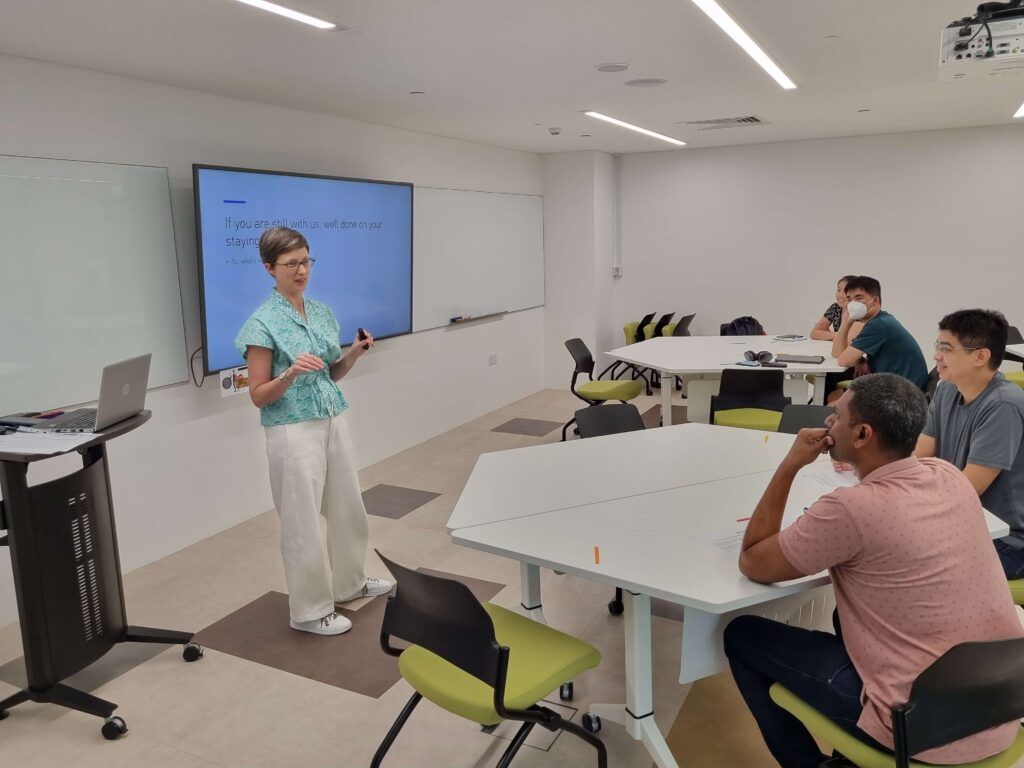
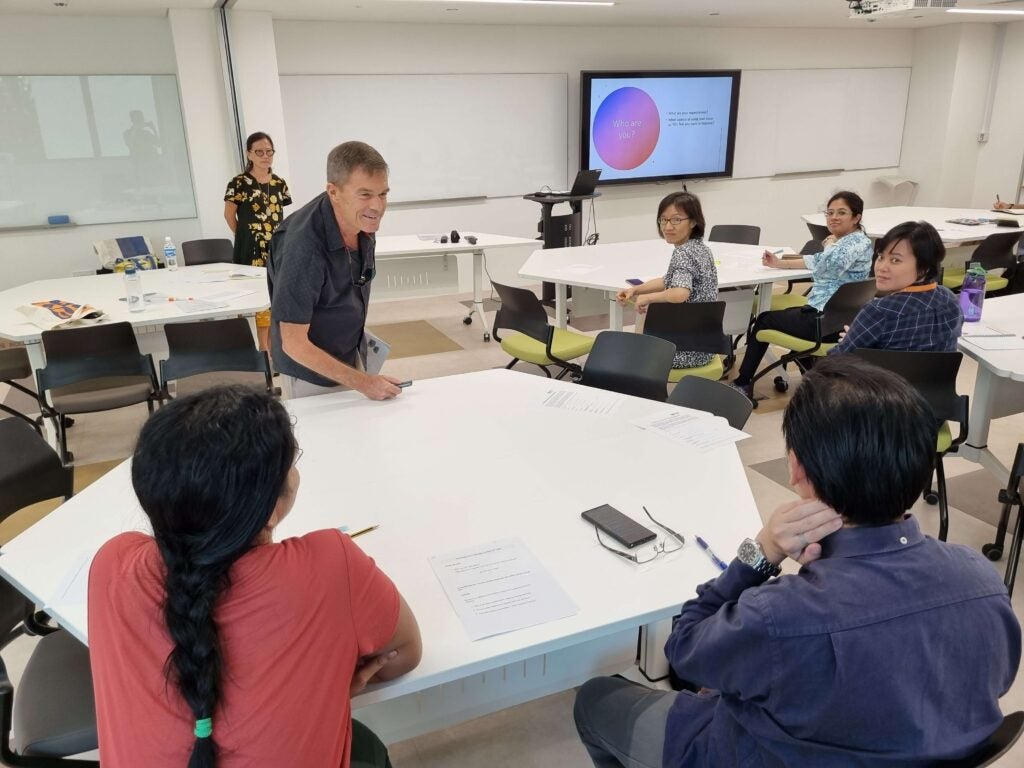
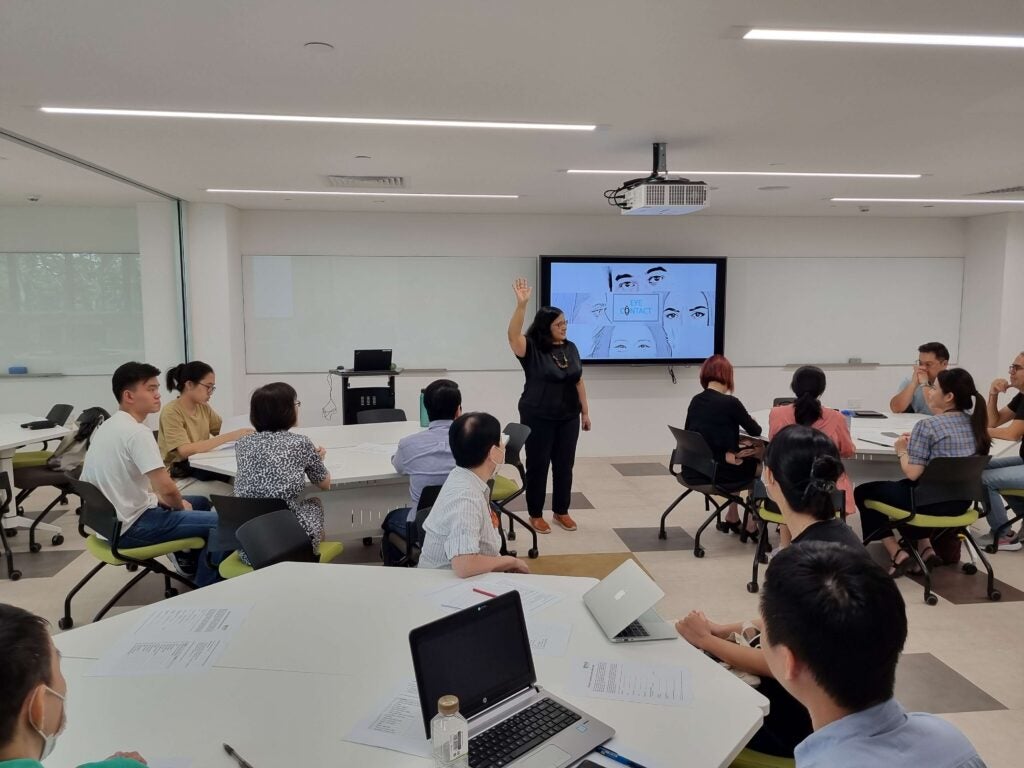
Workshops
Series Theme (For AY2026/2027)
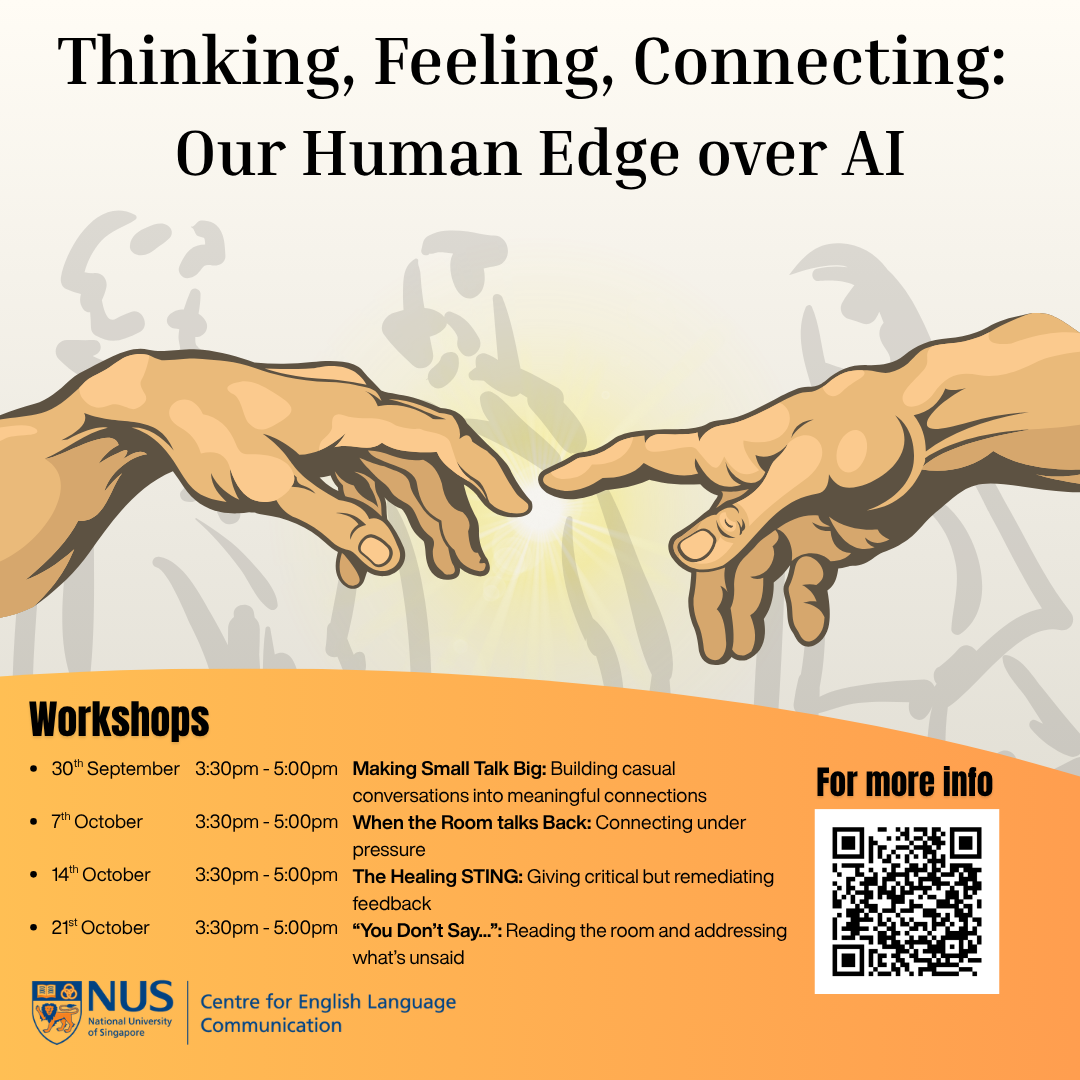
Generative AI has more bits of knowledge and information than the smartest individual human. A large language model may have more bits than thousands of smart humans put together. In a working world where low level clerical jobs and even entry level graduate jobs are being replaced humans must keep their edge over AI. They must leverage on their human advantage. What do all humans have but no AI can ever have?
Humans have physical bodies! AIs are disembodied machines incapable of making real connections. They only mimic our emotions and have a memory bank of possible experiences. Humans, however, can think, feel, experience, connect and maintain multi-way relationships. We connect with other humans when we use all our senses with our words to connect authentically, empathetically and critically. This is our superpower and our enduring edge over even the smartest AI.
This workshop series encourages participants to integrate thinking, feeling, reflecting and then communicating by involving all their senses. Participants learn to link together what’s on their minds with how to say that with heart, resulting in communication that is authentic, empathetic, yet critical.
Our workshops draw on Embodied Critical Thinking (ECT) practices, engaging participants in guided experiential and hands-on activities that extend critical thinking beyond purely cognitive processes to include instinct, emotion, and lived experience, supporting deeper and more human-centred ways of relating and understanding.
Each in-person workshop focusses on a particular aspect of oral workplace communication and adopts an ECT-informed teaching approach. Participants will engage in authentic workplace scenarios, explore genuine emotional responses, and take part in realistic role-play activities that bridge theory and practice. Participants are welcome to send in anonymised real-life scenarios they have encountered.
30th September 2026, 3:30pm - 5:00pm
Making Small Talk Big: Building casual conversations into meaningful connections
Have you ever struggled to hold a conversation at a work event such as a staff retreat? What could you say to a colleague from another department or worse yet one of the big bosses? How do you respond when you notice their eyes glaze over? Learn how to introduce yourself with confidence, use active listening strategies to keep conversations flowing so that you can spark meaningful conversations in professional conversation settings.
In this workshop, participants will learn how to:
- Introduce yourself confidently so that you can navigate networking situations with confidence and poise.
- Use your voice effectively to engage your audience.
- Apply non-verbal communication and active listening skills to build rapport and meaningful connections.
What to bring:
Please bring a physical object that represents you or your work, and dress comfortably. We will be taking you through a series of physical and vocal exercises.
Registration is closed
Workshop Facilitators
Jinat Rehana Begum
Instructor, Centre for English Language Communication
Jinat Rehana Begum currently teaches academic communication to postgraduates for the Centre for English Language Communication (CELC). She has taught communication, language, literature, and pedagogy to learners from diverse age groups and backgrounds. She is particularly interested in non-verbal communication and active listening, and their essential contribution to effective communication in both academic and workplace contexts.

Julie Gouin
Instructor, Centre for English Language Communication
Lee Gek Ling
Senior Lecturer, Centre for English Language Communication
GL Lee is a Senior Lecturer at the Centre for English Language Communication. She has taught and researched on and published books on professional communication for over 30 years. She is particularly interested in timeless practical tips and strategies to communicate politely and tactfully in complex situations.
7th October 2026, 3:30pm - 5:00pm
When the Room Talks Back: Connecting Under Pressure
AI might be able to help you prepare for a presentation, but it’s not much use when things don’t quite go according to plan. We’re often told to expect the unexpected, but how can you best overcome the anxiety and adrenaline that comes with being asked a question you haven’t prepared for? In this interactive workshop, you will learn how to be more responsive and adaptive to unpredictable questions, whether they be interruptions or part of a Q&A. You will practise the art of buying time while you think, building trust with your answers, and connecting with an audience that actively responds.
For FASS undergraduate students: Registration link here
For NUS Students: Registration link here
For NUS Staff: Registration link here
Workshop Facilitators

Owen Harry
Lecturer, Centre for English Language Communication
Owen has taught academic communication at various levels since 2017. As a PhD graduate of NUS, he has substantial experience in delivering presentations at major international conferences in his field. His guiding philosophy of academic communication is that complex information can (and should) be conveyed with clarity and always with an eye towards audience engagement.

Teddy Siraki is a Lecturer at the Centre for English Language Communication. He holds a Ph.D. in English Literature and has taught a variety of Humanities and Communication courses including Public Speaking, Literary Studies, and Media Literacy. Originally from Toronto, Ontario, he lived and taught in the Arabian Gulf for ten years before arriving at NUS in 2024.
14th October 2026, 3:30pm - 5:00pm
The Healing STING: Giving Critical but remediating feedback
In the Honeyed Tongue, participants learned how to identify daily instances of FTA (face threatening acts) in which we impose on others or challenge their need for approval in workplace communication, from seemingly simple requests such as borrowing a pen to giving critical feedback. Participants also learned five levels of politeness strategies that could reduce face loss i.e. take out the sting, from these communication contexts.
Are there higher levels of FTA in the workplace? Of course there are, e.g. when critical feedback verges on criticism, when probation is extended, when reprimands are needed. Here the sting must be clear, yet messengers must be mindful of the likely major collegial fallout. Knowing how to signal our good intentions despite the real threat in the message, helps hearers to receive difficult messages without outright rejection. Using ideas from Embodied Critical Thinking (ECT) practices (Schoeller et al., 2024), we introduce our new STING strategies where words are connected to voice and other nonverbal communication clues to effect “healing” conversations.
(Yes, we are using STING therapy from biology and medicine as a metaphor).
In this 90-minute workshop, participants will:
- Revise or learn the hamburger strategy for giving basic critical feedback.
- Use “STING” strategies to signal bad news with good intentions and fair play.
- Consider how they might receive painful critical feedback if given to them.
Participants need NOT have attended The Honeyed Tongue to attend The Healing Sting.
For FASS undergraduate students: Registration link here
Workshop Facilitators
Lee Gek Ling
Senior Lecturer, Centre for English Language Communication
GL Lee is a Senior Lecturer at the Centre for English Language Communication. She has taught and researched on and published books on professional communication for over 30 years. She is particularly interested in timeless practical tips and strategies to communicate politely and tactfully in complex situations.

Susan Lee
Lecturer, Centre for English Language Communication
Susan Lee is a Lecturer in CELC. She has taught English communication for 20 years at IHLs and with corporate clients. She is ACTA (WSQ Advanced Certificate in Training and Assessment) certified and passionate in designing learning to enhance individuals’ skills in presentations, interpersonal communication, negotiation and business writing.
21st October 2026, 3:30pm - 5:00pm
“You don't say...": Reading the room and addressing what’s unsaid
People sometimes don’t mean what they say, and don’t say what they mean. This is where human communicative judgment offers an advantage over AI. While AI can easily deal with explicit communication, it struggles to interpret implicit contextual meanings and nuances in conversations (Eragamreddy, 2025). This 90-minute interactive workshop helps participants to strengthen their human advantage in recognizing power asymmetry and navigating the underlying tensions within conversations to maintain respectful dialogue. The workshop will discuss what subtext people may be conveying when they communicate indirectly such as omitting information, overloading with details, changing topic, using euphemisms, hedging, hinting, or even keeping silent. Participants will also learn how to create safe and inclusive conversation spaces for mutual collaboration.
Registration opening soon
Workshop Facilitators

Yurni Sirhan-Said
Lecturer, Centre for English Language Communication
Yurni Sirhan-Said has taught academic and professional communication at various levels for 10 years. She has also conducted several oral communication workshops for both students and professionals within and beyond NUS. In her teaching, she enjoys creating dialogic learning spaces that allow students and workshop participants to share their diverse perspectives. Drawing on her Interactional Sociolinguistics background, she helps them develop pragmatic awareness and communicate more strategically across contexts.

Anita Toh
Lecturer, Centre for English Language Communication
Anita Toh is a professional communication skills lecturer at the Centre for English Language Communication. She specializes in designing engaging, real-world learning experiences that integrate technology and workplace communication skills. Her lessons equip participants with practical strategies to present with clarity, confidence, and persuasive impact to diverse audiences.
The workshops are open to all NUS students/staff unless specified. Booking availability on a first-come-first-served basis.
For enquiries related to this event, please contact elcbox70@nus.edu.sg.
Ask OWC about:
- The workshop you are interested in.
- Customizing one of the workshops for your residential college or hall - free
- Customizing one of the workshops for your department or organization – chargeable at preferential rates for NUS staff.
- A workshop you would like us to offer in the near future.
- Preferred timings for workshops – we will look for trends in timing.
Getting to the CELC Seminar Room (02-30)
We are located across from the Central Library and AS8, next to Techno-Edge and NUS IT
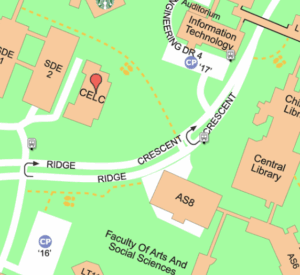
To reach the CELC Seminar Room (02-30) from the main entrance, enter through the glass doors and continue straight ahead. This will lead you directly to the CELC Seminar Room (02-30).
For those arriving via the car park, proceed to Level 2 using either the lift or the stairs. Upon reaching Level 2, follow the corridor signs to the main lobby of the Centre for English Language Communication (CELC). The CELC Seminar Room (02-30) will be located on your left.