
CELC Masterclasses
We invite you to experience a preview of our Master of Arts programme firsthand through our complimentary masterclasses from June to November 2026, where graduate students and working professionals can gain insights into the curriculum and engage with CELC faculty.
Please see below for the full list of our Masterclasses.
Upcoming Masterclasses
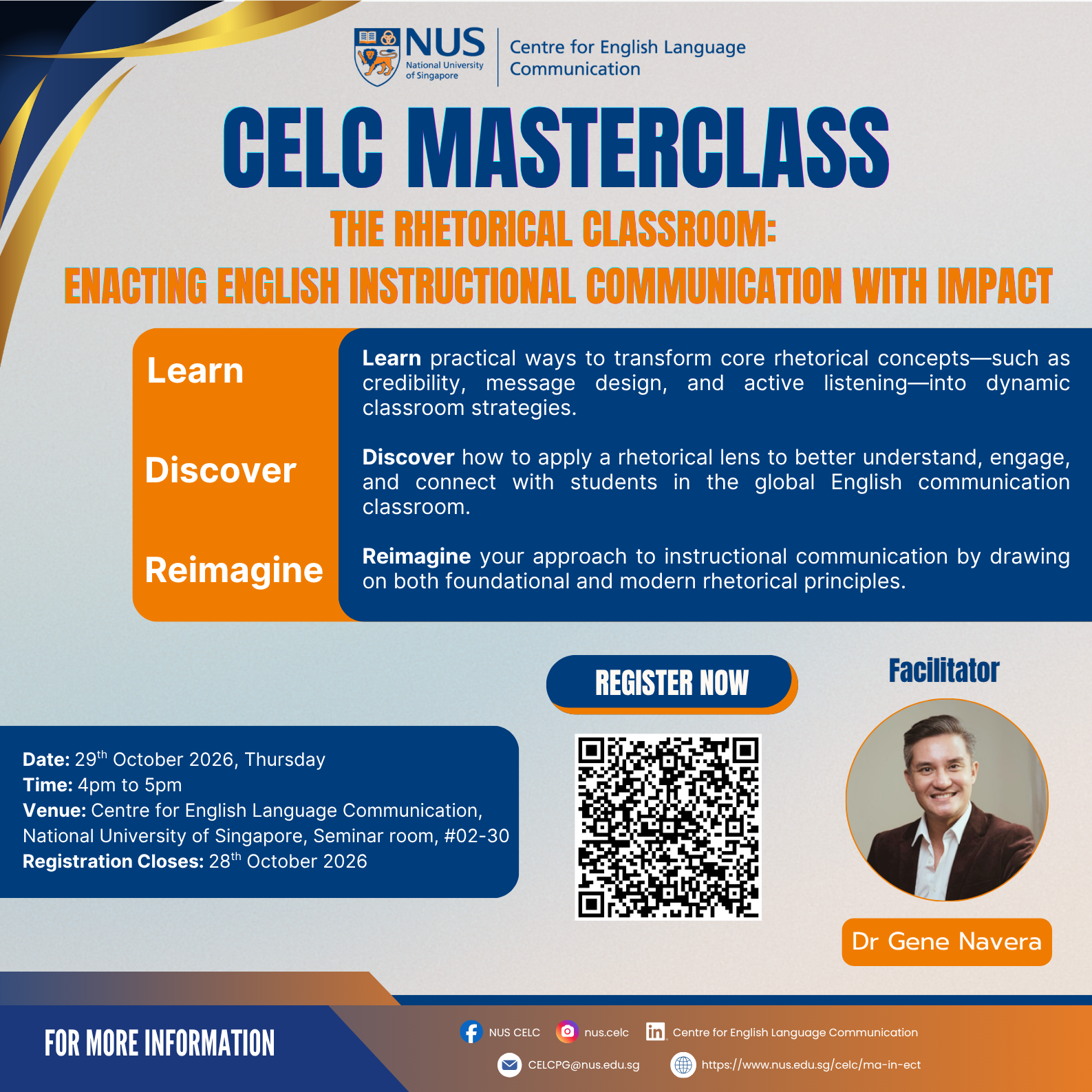
29th October 2026 (Thu), 4:00pm - 5:00pm
The rhetorical classroom: Enacting English instructional communication with impact
What happens when we view English communication teaching through a rhetorical lens? Rhetoric, broadly defined as the art and study of using language and symbols effectively, persuasively, and ethically in speech and in writing, has been a subject of much thinking and scholarship from antiquity to the present. But what does a rhetorical lens for English communication teaching entail? How does it contribute to our development as communication educators?
In this Masterclass, we will examine how English communication instruction can be made more impactful by mobilizing insights from the field of rhetoric. To deepen the participants’ understanding of the contributions of rhetoric to the field of instructional communication, we will survey and articulate perspectives that enable us to focus on some of the most significant rhetorical elements of the global classroom. These perspectives draw upon rhetorical concepts and principles such as source credibility, message design, dialogic communication, situational judgment, and rhetorical listening, among others.
Participants in this Masterclass will be able to
- Discuss practical ways to turn rhetorical principles into dynamic teaching strategies.
- Reimagine their pedagogy through a rhetorical lens while understanding how they can connect deeply with their learners in the English communication classroom.

As AI continues to reshape English communication teaching and learning, language educators have opportunities to rethink how assessment and feedback can better support learning. Rather than viewing AI as a grading tool, this masterclass explores how AI can be thoughtfully integrated into assessment and feedback to foster authentic communication, meaningful learning, and learner reflection in higher education.
Drawing on current research and practical examples, the masterclass examines two AI-enhanced approaches to assessment and feedback: AI simulation chatbots that support a dialogic approach to formative feedback and promote learners’ academic writing, and AI-enabled multimodal presentation assessment systems that analyse academic presentation performance and provide feedback. These approaches strengthen assessment for learning through enhanced feedback practices and the development of learners’ feedback literacy. They help learners interpret, engage with, and act on AI-generated feedback to improve academic communication skills. The masterclass also considers the pedagogical and ethical issues involved in designing and implementing AI-enhanced assessment and feedback in English communication teaching.
In the masterclass, participants will:
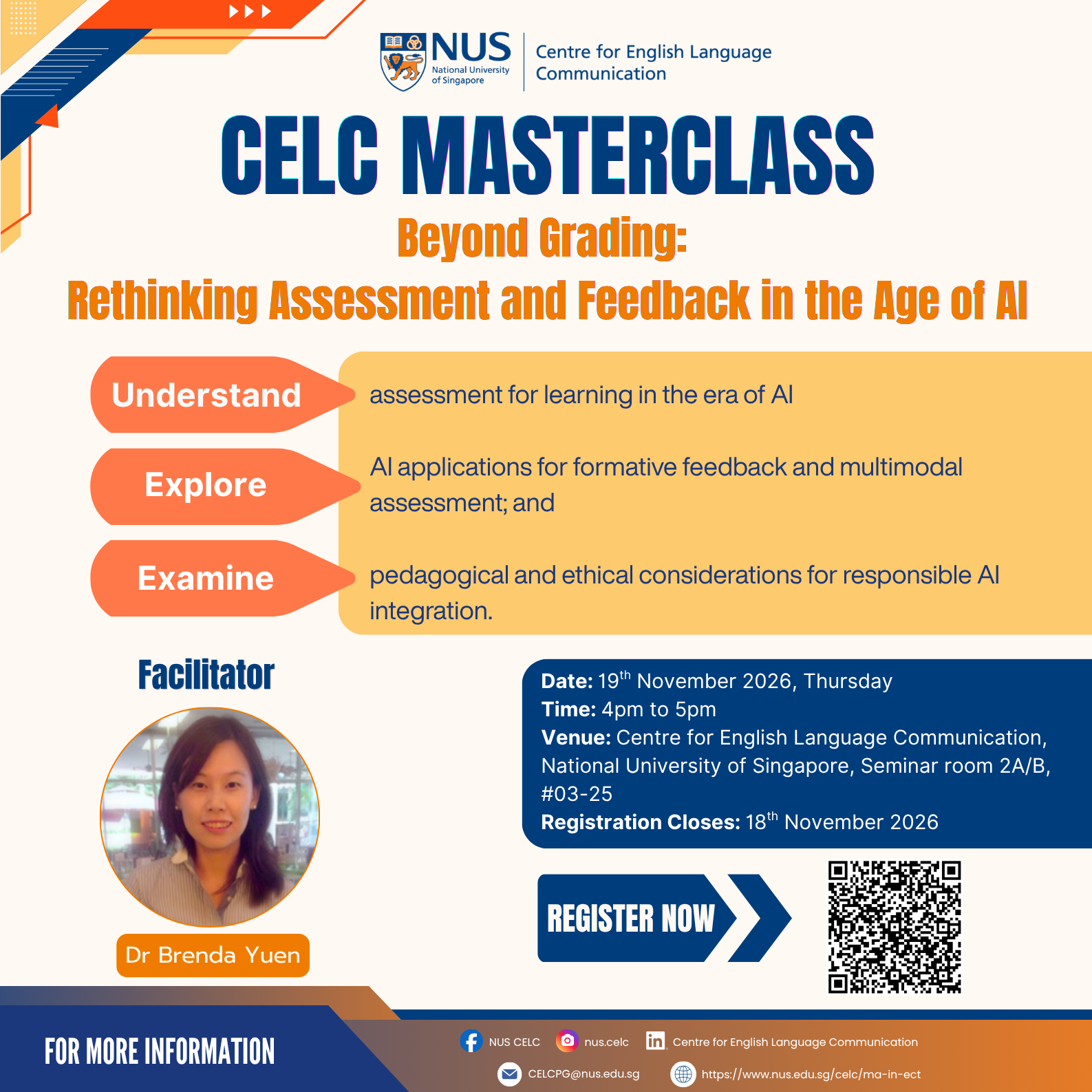
- understand assessment for learning in the era of AI;
- explore AI applications for formative feedback and multimodal assessment; and
- examine pedagogical and ethical considerations for responsible AI integration.
Past Masterclasses
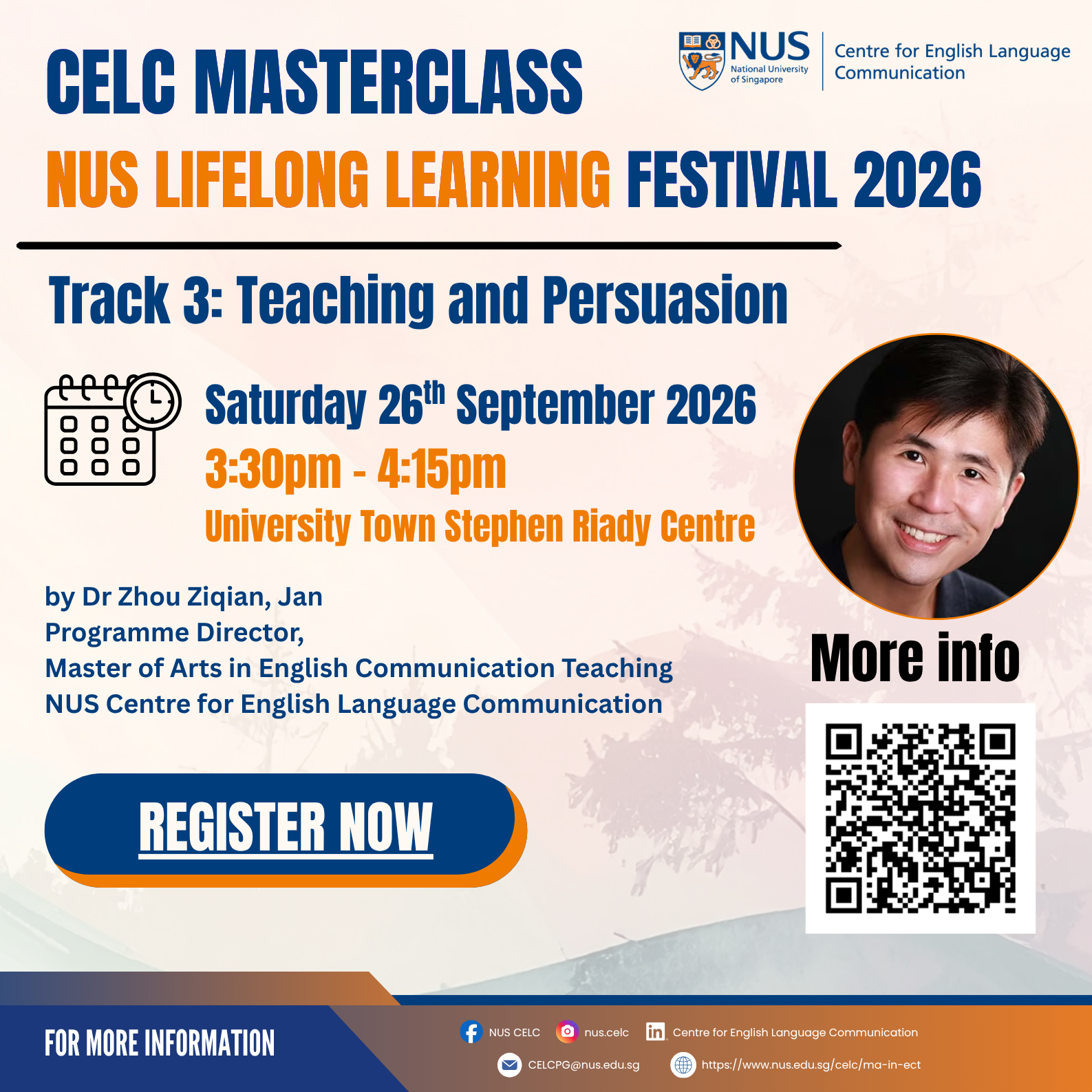
26th September 2026 (Sat), 3:30pm - 4:15pm
Teaching and Persuasion
(In collaboration with NUS Lifelong Learning Festival 2026)
Aristotle’s ideas of ethos, logos and pathos remain highly relevant in today’s fields of public persuasion, including education. This masterclass explores how these classical principles can be adapted to classroom practice, while cautioning against simplistic applications that may no longer engage learners effectively.
Instead, it proposes that English communication teachers inspire hope as a powerful emotion in the AI era. By bringing human-centred themes such as justice and equality into lessons, educators can foster resilience, inspire action and nurture critical, forward-looking minds. The masterclass invites participants to rethink persuasion as a meaningful tool for teaching, learning and transformation.
For more info click here to view the festival at large:
Agenda - Day 1 | NUS Lifelong Learning Festival 2026
opens in new tab)
30th June 2026 (Tue), 4:00pm - 5:00pm
Discover your Signature Pedagogy and Turn It into Confident, Effective Course Design
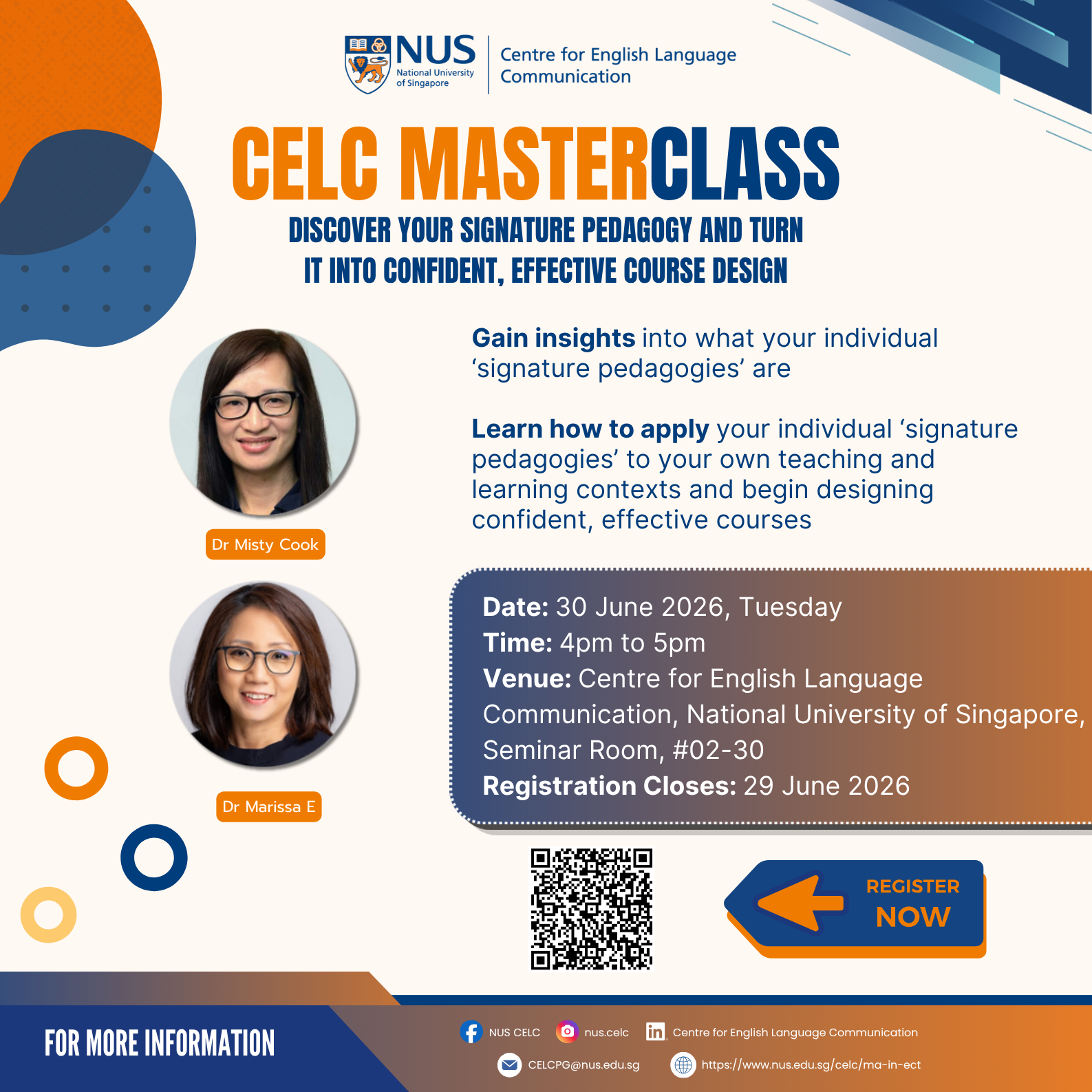
The concept of ‘signature pedagogies’ can be understood as key teaching and learning experiences constructed to facilitate the development of thinking and practices characteristic of a particular field or discipline. For example, critical reading as a necessary literacy skill can be modelled in both talk and action by a language teacher who deconstructs a text using Socratic questioning techniques in class.
As educators who are practitioners of specific disciplines, we are often seen by our students as reference points for what participating in a discipline means. Signature pedagogies are thus not just key teaching and learning experiences but expressions of an educator’s professional teaching identity that we use to form connections with our students that facilitate our teaching and their learning.
This masterclass thus offers the opportunity to discover the signature pedagogies that most align with your qualities, beliefs and values when it comes to teaching and learning. From there, you will learn how you can apply signature pedagogies to design confident, effective courses based on the concept of a community of inquiry.
What participants will gain:
- Insights into what their individual ‘signature pedagogies’ are
- Opportunities to apply their individual ‘signature pedagogies’ as relevant to their own teaching and learning contexts to begin designing confident, effective courses.
17th July 2026 (Fri), 4:00pm - 5:00pm
Exploring Best Practices in EMI with AI: Who, What, When, Where, Why, and How?
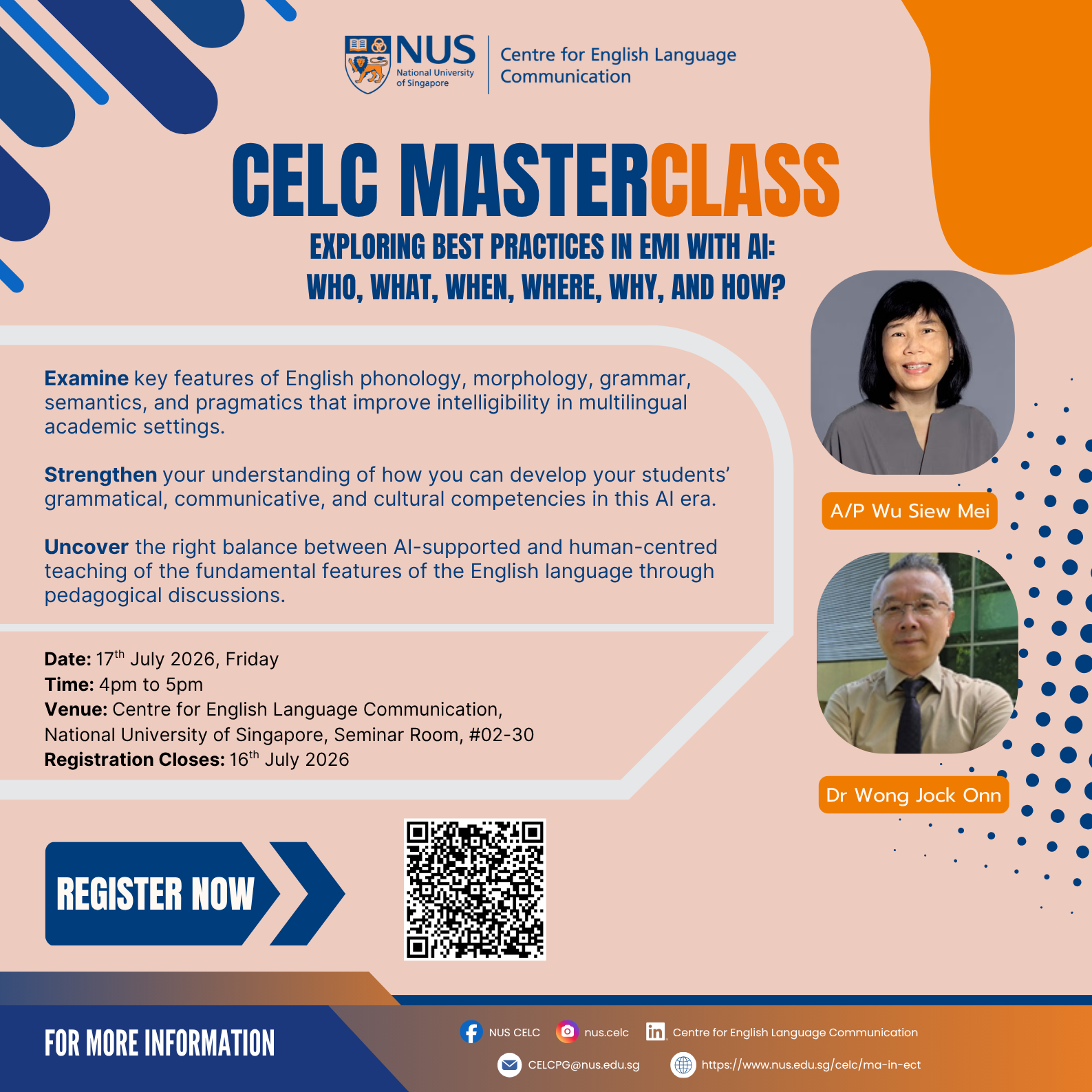
The current education context legitimises the use of AI for textual design at all levels of learning.It appears, therefore, that the role of the communication educator is being reconfigured as that of a pedagogical expert who works with learners to leverage the affordances and limitations of generative AI as a probabilistic text-prediction system, guiding them to evaluate, refine and use AI-generated text for purposeful and intelligible human communication. Learners, on the other hand, sharpen their metalinguistic awareness and learn processes to enable the next level of optimal human communication. Against this backdrop, there are key features of the English language affecting intelligibility that still need to be learnt to ensure highly effective communication in an EMI context.
The objectives of this masterclass are to:
- Encourage participants to examine key features of English phonology, morphology, grammar, semantics, and pragmatics that improve intelligibility in multilingual academic settings.
- Strengthen participants’ understanding of how they can develop their students’ grammatical, communicative, and cultural competencies in this AI era.
- Discuss pedagogical approaches that strike the right balance between AI-supported and human-centred teaching of the fundamental features of the English language.
The masterclass will adopt an interactive, seminar-style format for participants to exchange ideas.
28th August 2026 (Fri), 4:00pm - 5:00pm
Moving Beyond the Human as Sole Author: Teaching Multimodal Composition in the AI Age
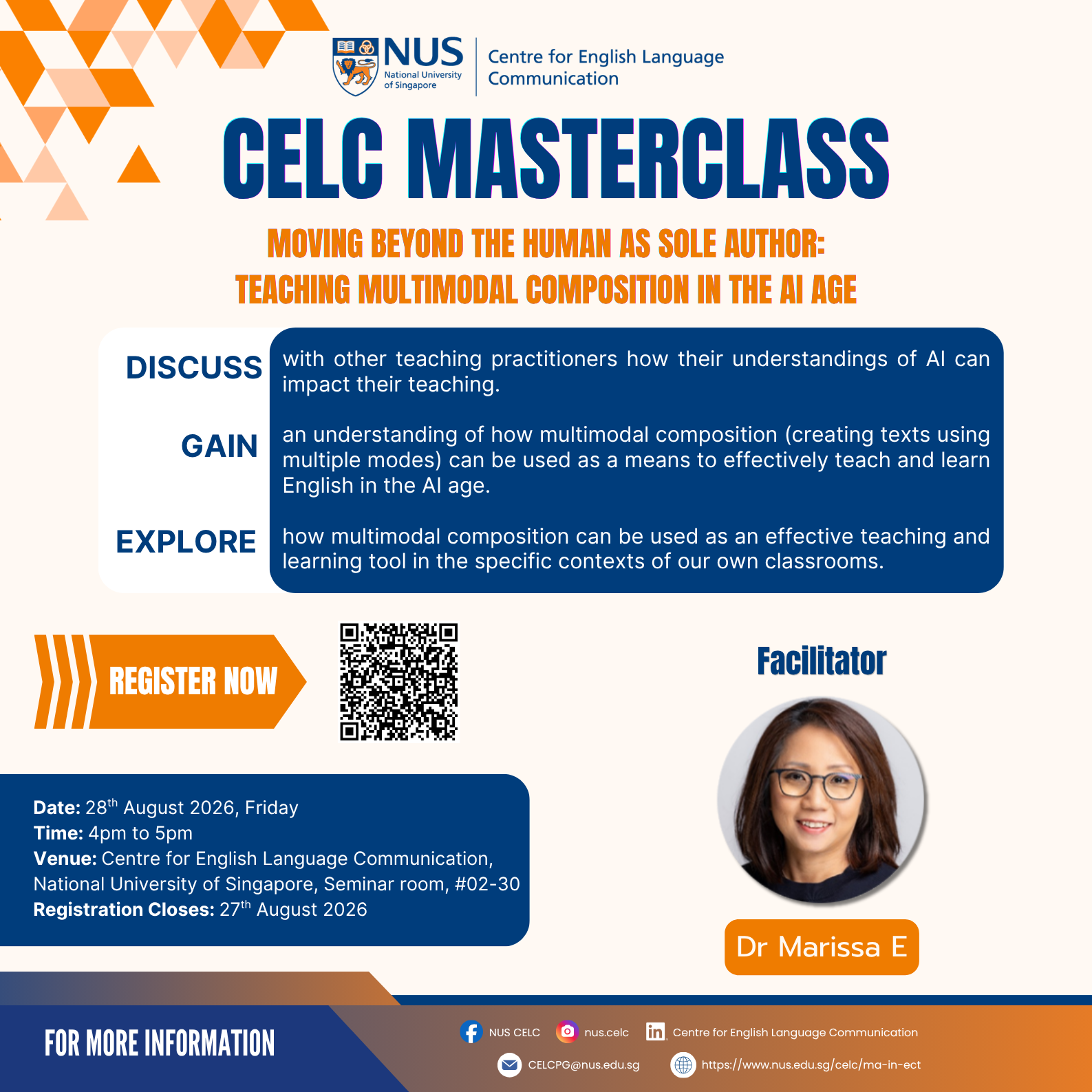
The dawn of the AI age has given rise to new considerations motivated by new forms of multimodality (making meaning using multiple modes like words, image and sound) enabled by AI.
More specifically, we face a future driven not just by human agency, but by co-creation with a technological entity enabled with seemingly ‘human’ traits and capabilities that can generate human-like responses of its own to different situations of varying complexity and interact with users in new ways.
There is thus a strong case for English Communication Teaching to seriously consider the importance of educating our students with the appropriate multimodal skills that will facilitate their effective operation in a highly digitalized world where technology is no longer just tool, but potentially agent and co-author as well.
In this masterclass, participants will have the opportunity to:
- Discuss with other teaching practitioners how their understandings of AI can impact their teaching.
- Gain an understanding of how multimodal composition (creating texts using multiple modes) can be used as a means to effectively teach and learn English in the AI age.
- Explore how multimodal composition can be used as an effective teaching and learning tool in the specific contexts of our own classrooms.
Getting to the CELC Seminar Room (02-30)
We are located across from the Central Library and AS8, next to Techno-Edge and NUS IT
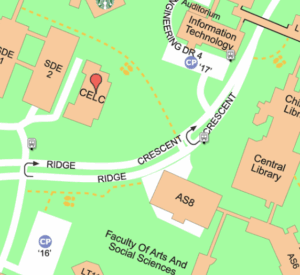
To reach the CELC Seminar Room (02-30) from the main entrance, enter through the glass doors and continue straight ahead. This will lead you directly to the CELC Seminar Room (02-30).
For those arriving via the car park, proceed to Level 2 using either the lift or the stairs. Upon reaching Level 2, follow the corridor signs to the main lobby of the Centre for English Language Communication (CELC). The CELC Seminar Room (02-30) will be located on your left.