

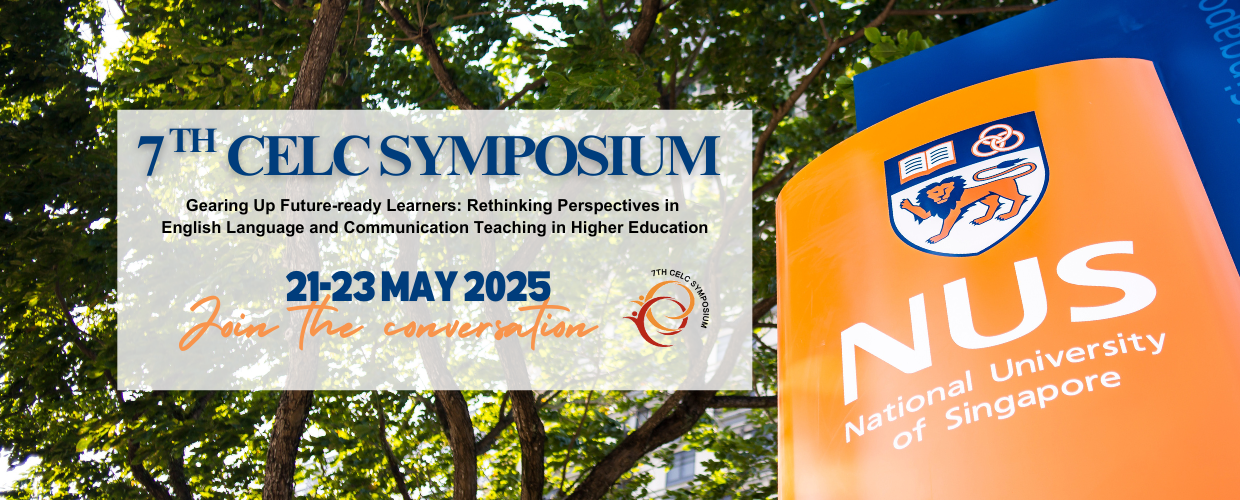
Venue: University Town, Stephen Riady Centre, Level 1, Auditorium 2
Call for papers for publication
Thank you to all presenters and participants of the 7th CELC Symposium. Your participation and insights made the event a great success!
We are excited to announce that a selection of the best papers will be included in a volume that we hope to publish under Springer. Here are the details on how to submit your extended abstracts for consideration:
- Download the submission template here.
- Include a bio-data of 50 to 100 words.
- Extended abstracts should include the following:
- For conceptual papers
- 10-20 word title
- 400-500 word description of the context and need to adopt certain teaching approach(es)/framework/policies, aim(s) of the chapter, methodology (if applicable), conclusion, and recommendations.
- key in-text citations and reference list (excluded from the word count).
- For research papers
- 10-20 word title
- 400-500 word description of the context and need to adopt certain teaching approach(es)/framework/policies, research question(s), aim(s) of the study and chapter, methodology, results, conclusion, and recommendations.
- key in-text citations and reference list (excluded from the word count).
- For conceptual papers
- Submissions should be sent as Microsoft Word files to celcsymposium@nus.edu.sg
- The deadline for submission is 11.59 pm on Friday, 26 September 2025
We look forward to receiving your submissions.
About the Symposium
The Centre for English Language Communication (CELC) finds itself in the forefront of preparing students to become able communicators of the future. The able communicators of the future are adaptive to the changing times—adept in using technology in their writing and communication practices and agile in responding to the constraints posed by their various audiences and communication situations. At the same time, they are committed to sustaining effectiveness as well as ethical practice in writing and communication in various contexts—whether in academic or workplace settings.
CELC’s commitment to developing able communicators of the future is a responsibility it shares with the rest of the English language and communication teaching community. English language and communication teachers and researchers inhabit a space where they can influence and shape learners to become the able communicators in the evolving present as well as in the future.
The conference invites papers that feature theorisations, conceptualisations and evidenced-based research from EL and communication teachers, practitioners and researchers specifically focusing on preparing learners to be future-ready. Papers may focus on any of the following thematic strands:
- Technology-enhanced teaching and learning
- Assessments and feedback
- Interdisciplinary/collaborative teaching and learning
- Other topics related to the Symposium theme
For more information, please refer to the detailed Symposium description.
Speakers
Keynote Speakers
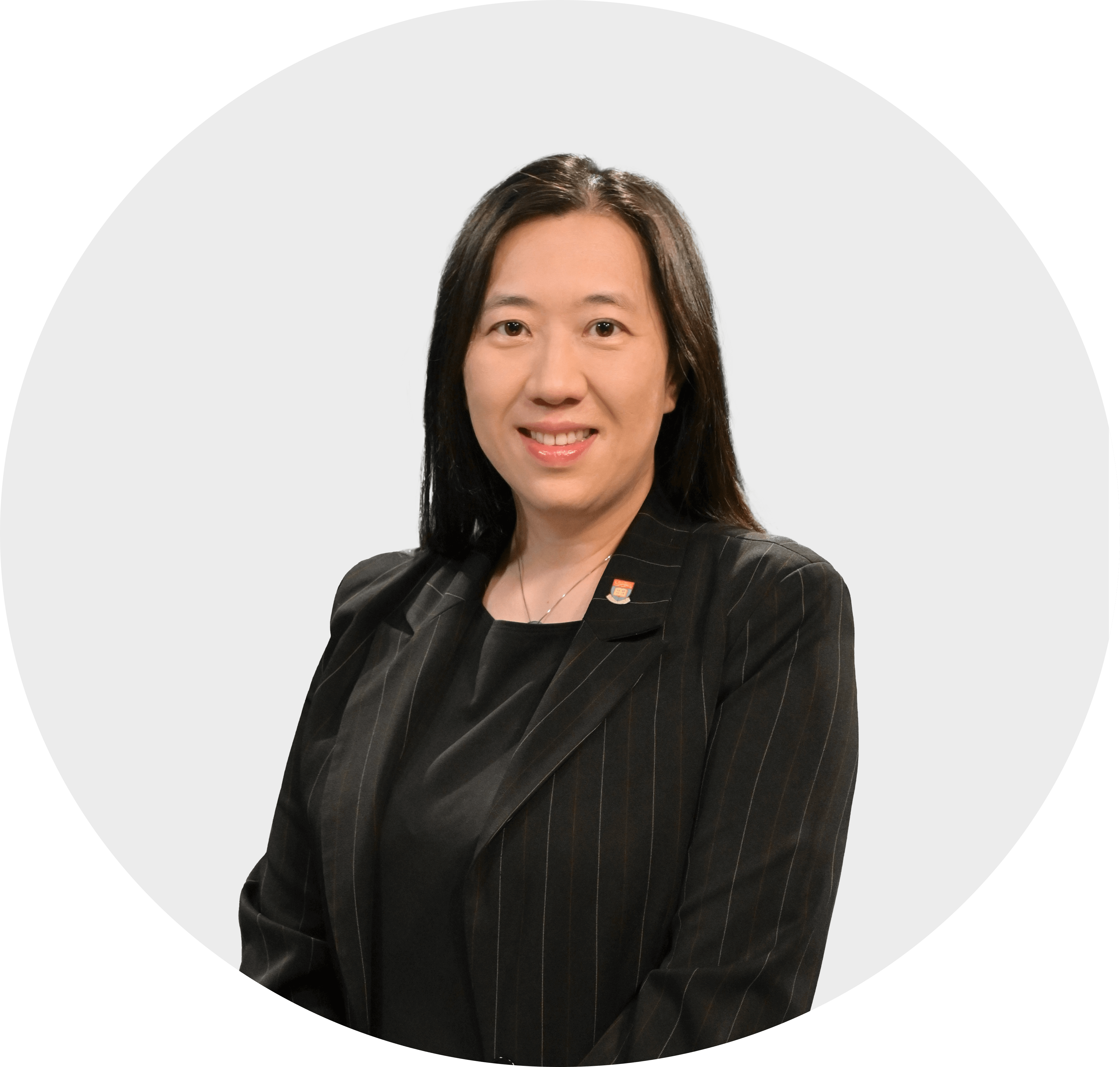
Professor Cecilia Chan
The University of Hong Kong

Professor Heath Rose
University of Oxford
Featured Speakers

Professor Icy Lee
Nanyang Technological University

Professor Jessie Moore
Elon University
Programme
The Symposium Schedule and Programme Booklet with abstracts can be downloaded via the respective links above.
Please stay tuned for updates to the programme. Here are some of the exciting offerings at the 7th CELC Symposium
Workshops
Please sign up for the workshops through the registration form here. Spaces are limited and will be allocated on a first-come-first-served basis.
Keynote Forum
What does it take for our learners to be future ready? Listen to our keynote and featured speakers address this question and share their insights in a panel discussion to be facilitated by the CELC Director, Associate Professor Lee Kooi Cheng.
This exciting conversation will be a synthesis of the Symposium, exploring various aspects of practice, research, and advocacy, while offering diverse perspectives and approaches. Join us to share valuable insights and fresh viewpoints.
Presentations
The symposium will feature not just paper presentations, but also lightning talks, poster presentations, teaching demonstrations and panel presentations. Engage with thought leaders in the field of English Language and Communication coming from different countries and institutions from around the world.
Product Demonstrations
Leading stakeholders of the education industry will be showcasing their innovative and impactful products in seated presentations at the Symposium. Learn about how their solutions can be incorporated into and influence the future of English Language and Communication teaching.
Symposium Dinner
Wednesday, 21 May 2025 (Day 1), 6-8pm
Dining Hall of College of Alice and Peter Tan
8 College Avenue East, #B1-50, Singapore 138615
Join us for a delightful evening on the first day of the Symposium. Held at the charming dining hall at the College of Alice and Peter Tan, this event offers a wonderful opportunity to unwind and connect with fellow attendees. Enjoy a diverse international-style buffet with vegan, vegetarian and halal options, along with refreshing non-alcoholic drinks. The dinner is the perfect way to kick off your symposium experience with great company and delicious food. Please register your interest and pay for the Symposium Dinner when securing your Symposium ticket. The full Symposium Dinner poster can be found here.
Walking Tour
Thursday, 22 May 2025 (Day 2), evening
Come experience the magic of the iconic Gardens by the Bay and the Marina Bay area while enjoying delightful food and great company. The optional walking tour is a fantastic opportunity to network with fellow Symposium attendees while immersing in Singapore’s vibrant local culture. Discover landmark sights, savour authentic local cuisine and connect with others in a relaxed, enjoyable setting. View the Walking Tour poster here and stay tuned for further information.
Important Dates
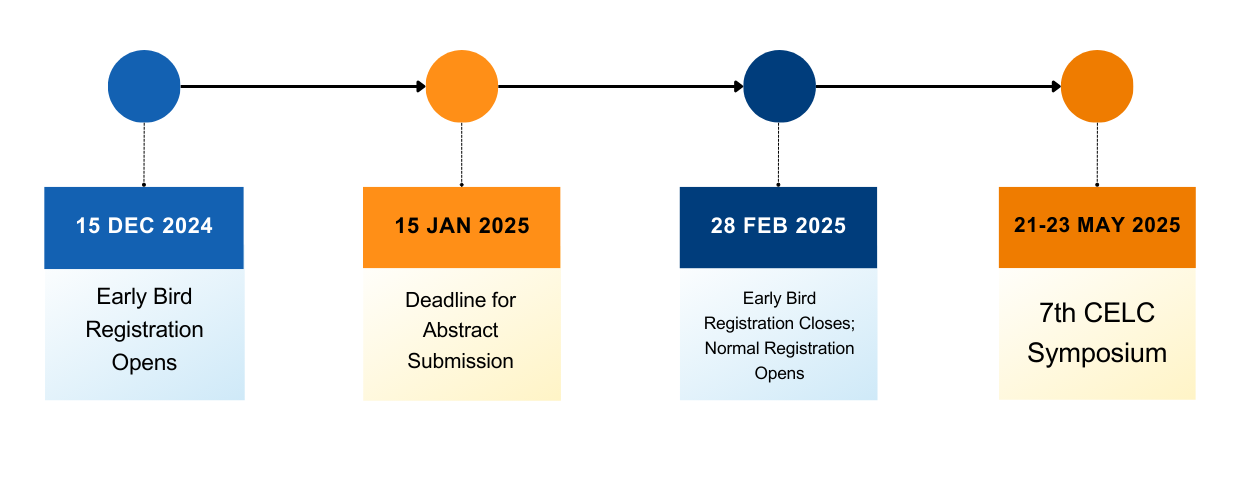
Call for Abstracts
The call for abstracts is now closed. Please look forward to the exciting line up of presentations at the Symposium!
Registration
Symposium Fees
| Normal Registration (by 2 May 2025) | SGD 450 |
| Non-NUS Full-time Student | SGD 180 |
| NUS Staff/Students | Free |
Registration is now closed—we look forward to seeing all registered participants at the Symposium from 21 to 23 May!
For any enquiries regarding registration, please contact celcsymposium@nus.edu.sg
Access & Accommodation
Getting to the Symposium
The Symposium will be held at the Stephen Riady Centre in University Town, National University of Singapore.
Please refer to the linked guide here for directions to the Symposium venue.

Accommodation
The 7th CELC Symposium provides suggestions on where to stay, which can be found here.
Invitation for Sponsorship and Collaboration
Sponsorships
The 7th CELC Symposium is sincerely looking for sponsors to partner with us to help widen the impact of the Symposium. We cordially invite you to lend strength in encouraging the participation of educators who may contribute to our discussion on “Gearing Up Future-ready Learners”, and to facilitate our smooth running of the event.
Sponsorship received will be used to fund
- Registration fees of participants who require financial assistance
- Other Symposium operational costs
In return for your sponsorship, the 7th CELC Symposium will
- Acknowledge your contribution officially at the Symposium
- Invite you to a networking dinner with Symposium participants for one representative for each sponsor
Industry Collaborators
The 7th CELC Symposium is sincerely looking for education industry stakeholders to collaborate with us to make the Symposium a meaningful and impactful one. We cordially invite you to join in our discussion on “Gearing Up Future-ready Learners” and be a part of the evolving English Language and Communication higher education landscape.
We are inviting Publishers, EdTech Companies and all relevant stakeholders to join us in the following:
- Product demonstration and presentation
-
- Formally showcase your products to a seated audience and demonstrate how they can be included in class to enhance participation and facilitate independent learning or share about upcoming developments and how they will influence learning and teaching in English Language and Communication.
- SGD1,000 for a 15-minute session
- Interactive booth
-
- SGD1,000 for a booth on one day of the Symposium
-
- Display your products and materials to all Symposium participants in a more casual setting and interact with them up close. Basic equipment (table, chair and signage stand) will be provided for your booth, which Symposium participants may visit throughout the day.
- Presentation and booth bundle
-
- Combine the power of a formal 15-minute product demonstration with the personal touch of an interactive booth to maximise your impact. This package ensures both broad visibility and meaningful interactions, providing the best of both worlds. Inclusive of the same entitlements as mentioned above.
- SGD1,500 for a presentation slot and a booth,
All packages will include an invitation to a networking dinner with Symposium participants for one representative for each collaborator, as well as access to all presentation sessions.
If you are interested to join us/collaborate with us, please contact celcsymposium@nus.edu.sg for more details.
Contact Us
Email: celcsymposium@nus.edu.sg
Organising Committee
Symposium Co-Chairs
Misty So-Sum Wai-Cook, Gene Segarra Navera
Steering Committee Members
Nina Venkataraman, Lee Ming Cherk
Hoong Shao Ting, Sylvia Sim Swee Choo
Jenson Jonathan Amrit Deokiesingh, Cao Feng
Jonathan Phan, Susan Lee Mien San
Aileen Lam, Jodie Luu
Khairul Anwar Bin Rosawi