
-
Setting the pace for Nature-based Solutions in Southeast Asia
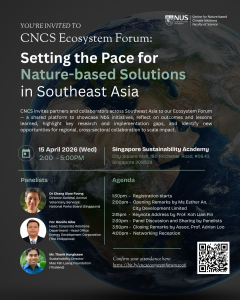
CNCS invited partners and collaborators across Southeast Asia to our Ecosystem Forum — a shared platform to showcase NbS initiatives, reflect on outcomes and lessons learned, highlight key research and implementation gaps, and identify new opportunities for regional, cross-sectoral collaboration to scale impact.
Published 15 April 2026 -
Reboot Development: The Economics of a Liveable Planet
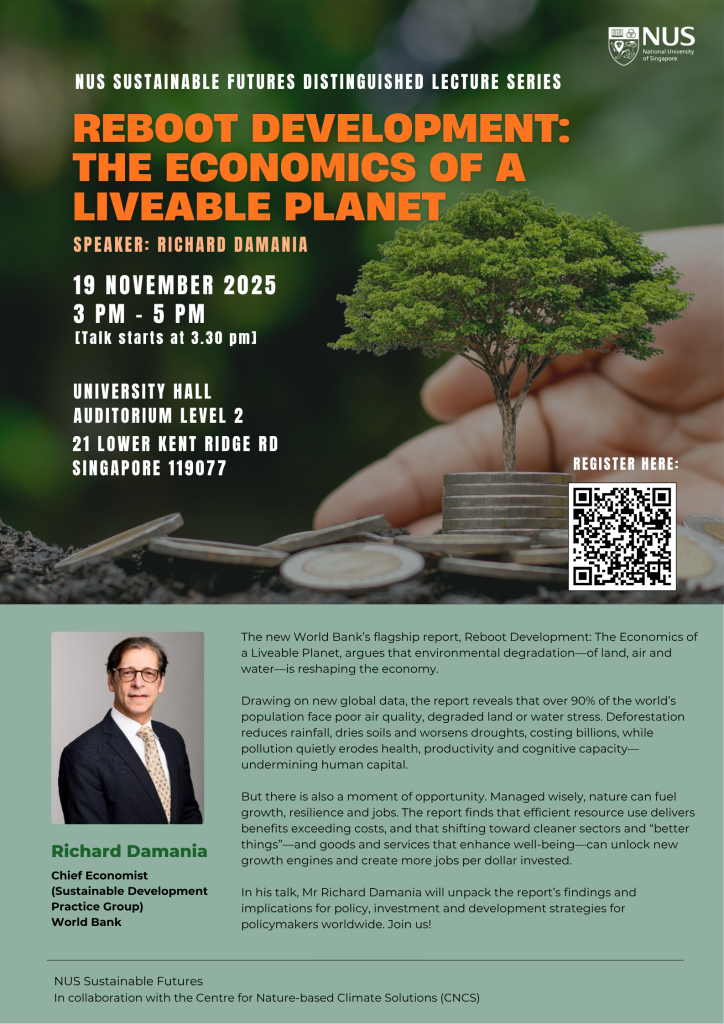
The Centre co-hosts this talk in the NUS Sustainable Futures (NSF) Distinguished Lecture Series, where Richard Damania, Chief Economist at the World Bank, presents on their new flagship report. Associate Professor Román Carrasco, NSF Co-Director, also sits down with Richard for a fireside chat and audience Q&A segment.
Published November 2025 -
How stories shape the planet: What I've learned about communicating science from 25 years of Mongabay
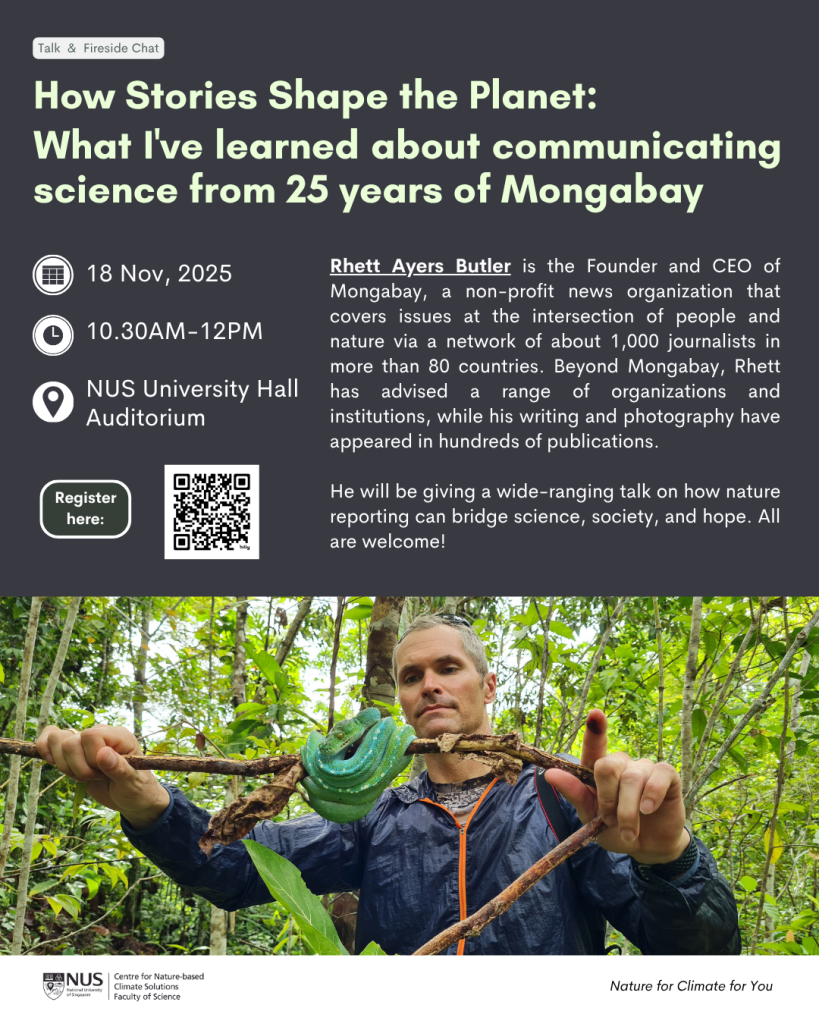
Drawing on 25 years of experience leading one of the world’s largest environmental newsrooms, Rhett Ayers Butler shares lessons from Mongabay’s evolution—from a one-person website into a global, multilingual network reporting from more than 80 countries. The lecture explores how clear, compelling communication can translate complex science into stories that inform action and policy; how journalism can contribute to measurable real-world impact; and what scientists can learn from journalistic storytelling to reach broader audiences. Rhett also discusses the changing media landscape, including the challenges of polarization, misinformation, and news avoidance, and how approaches like solutions journalism can restore trust and agency. Blending personal reflection with practical insights, he offers a hopeful perspective on how storytelling, when done with empathy and evidence, can reconnect people with the natural world and one another. After his sharing, Rhett sits down for an interactive and cozy forest-side chat with the audience. He is joined by Sankar Ananthanarayanan, a PhD Candidate at the Theoretical Ecology Lab (NUS Department of Biological Sciences) and a Co-founder of the Herpetological Society of Singapore, who facilitates the conversation and Q&A with the audience.
Published November 2025 -
Should (some) individuals also understand and chart their path to net zero?
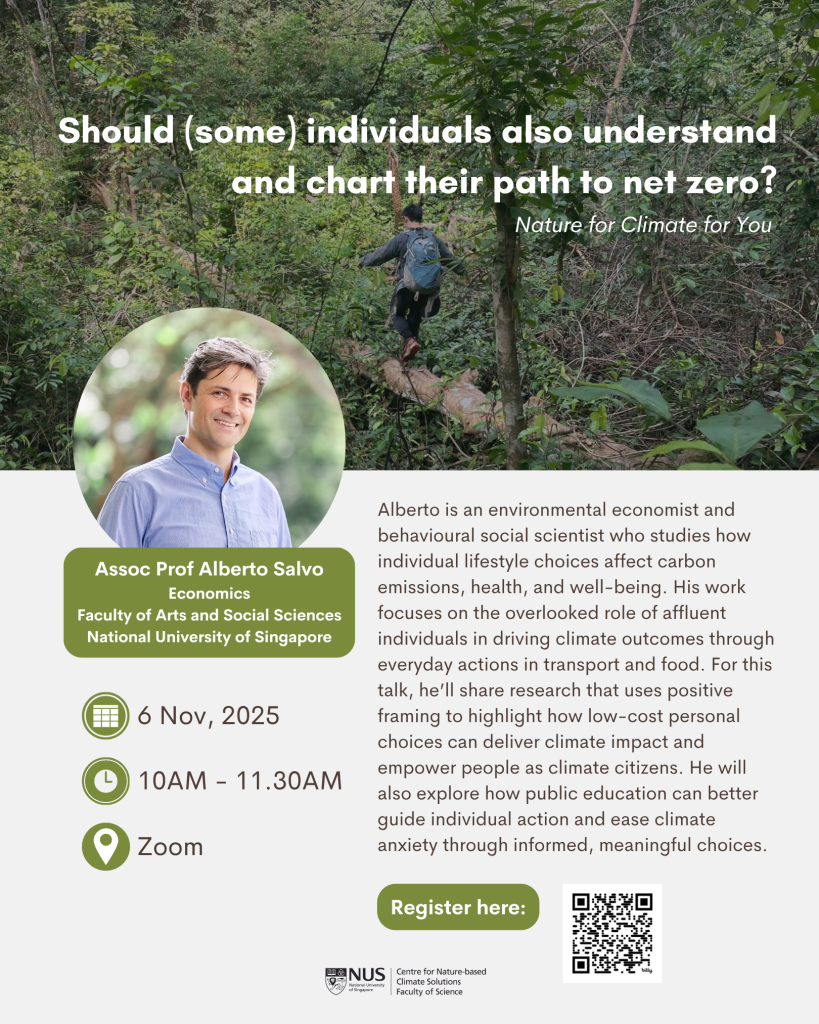
From national and local governments to firms large and small, various climate actors are increasingly learning and accounting for how their economic activity maps onto greenhouse-gas emissions. Yet the most numerous (and arguably most consequential) actors -- hundreds of millions of affluent individuals -- are too often overlooked and their role is underemphasized. Among their multiple roles, individuals as consumers pull supply chains; as citizens they back political leaders and embolden them to implement policies to accelerate the energy and food transitions in the coming decades. Yet public education has largely missed (i) which individual actions meaningfully reduce versus increase environmental damage, and (ii) how shifts in individual lifestyle choices -- often low cost or even personally beneficial -- can collectively drive positive change and ease climate anxiety. Associate Professor Alberto Salvo presents ongoing NUS research that uses positive framing to show how short run "downstream" choices in transport and food markets map onto carbon emissions and deliver health and nutrition co benefits, with the aim of reshaping understanding of individuals' "upstream" role as climate citizens. This webinar is the second in the series of our new programme, Nature for Climate for You.
Published November 2025 -
Climate and Ecosystem Science to inform Nature-based Solutions
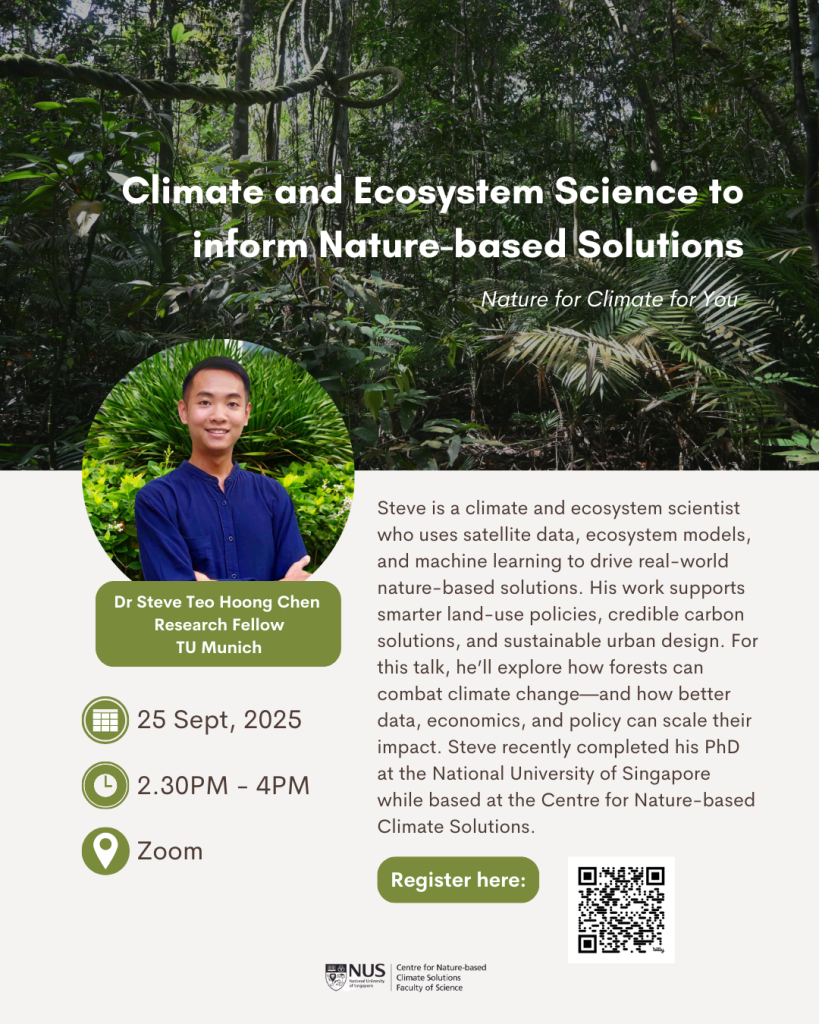
Steve is a climate and ecosystem scientist whose research powers smarter, science-based nature solutions for a changing world. By combining satellite data, ecosystem models, and machine learning, he connects the science of nature with real-world relevance—helping shape land-use policy, guide climate finance toward credible carbon solutions, and design cities that work with nature, not against it. In this webinar, he speaks about how forests can help combat climate change, and how smarter policies and economic tools can amplify their impact. Drawing on economics, climate science, and environmental data, his work evaluates the benefits and trade-offs of nature-based solutions. While these solutions are often highly effective, scaling them requires better data, thoughtful risk management, and stronger policy support. This webinar is the first in our new programme, Nature for Climate for You, which will be a series of online and offline activities featuring scientists, practitioners and advocates. It is a friendly space to learn and participate together!
Published September 2025 -
The Road Forward: Addressing Biodiversity Loss and Climate Change
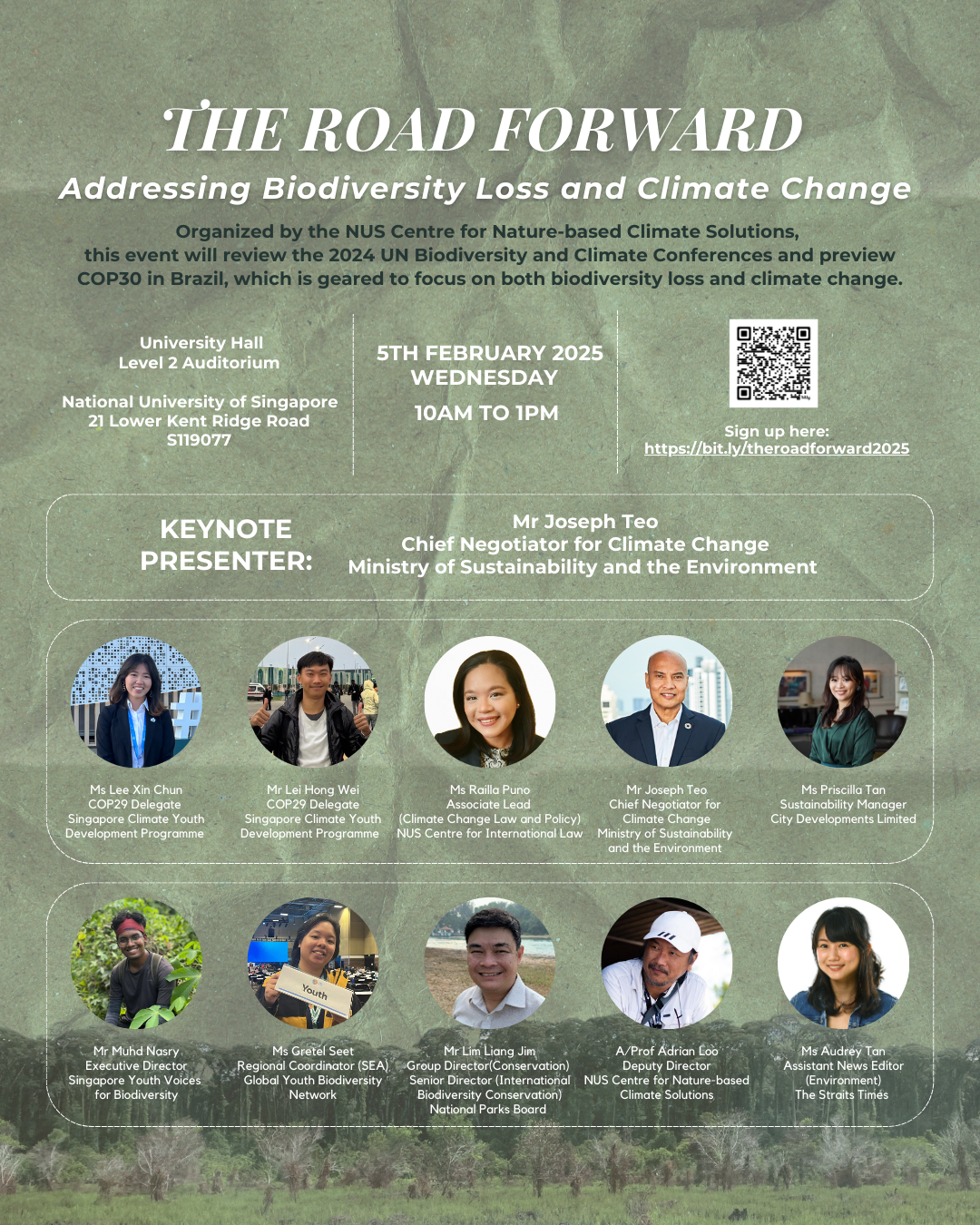
The conversations at the event focused on the main insights from COP16 and COP29, and their influence on the COP30 agenda, especially in addressing the twin planetary crises of climate change and biodiversity loss. The event highlighted the need for integrated solutions and global cooperation, while also acknowledging the importance of local contexts and the necessity for fair and ambitious actions going forward. Nearly 150 people registered for the event, which assembled a stellar cast of speakers.
Published February 2025 -
Lessons from COP and the Way Forward
Published November 2024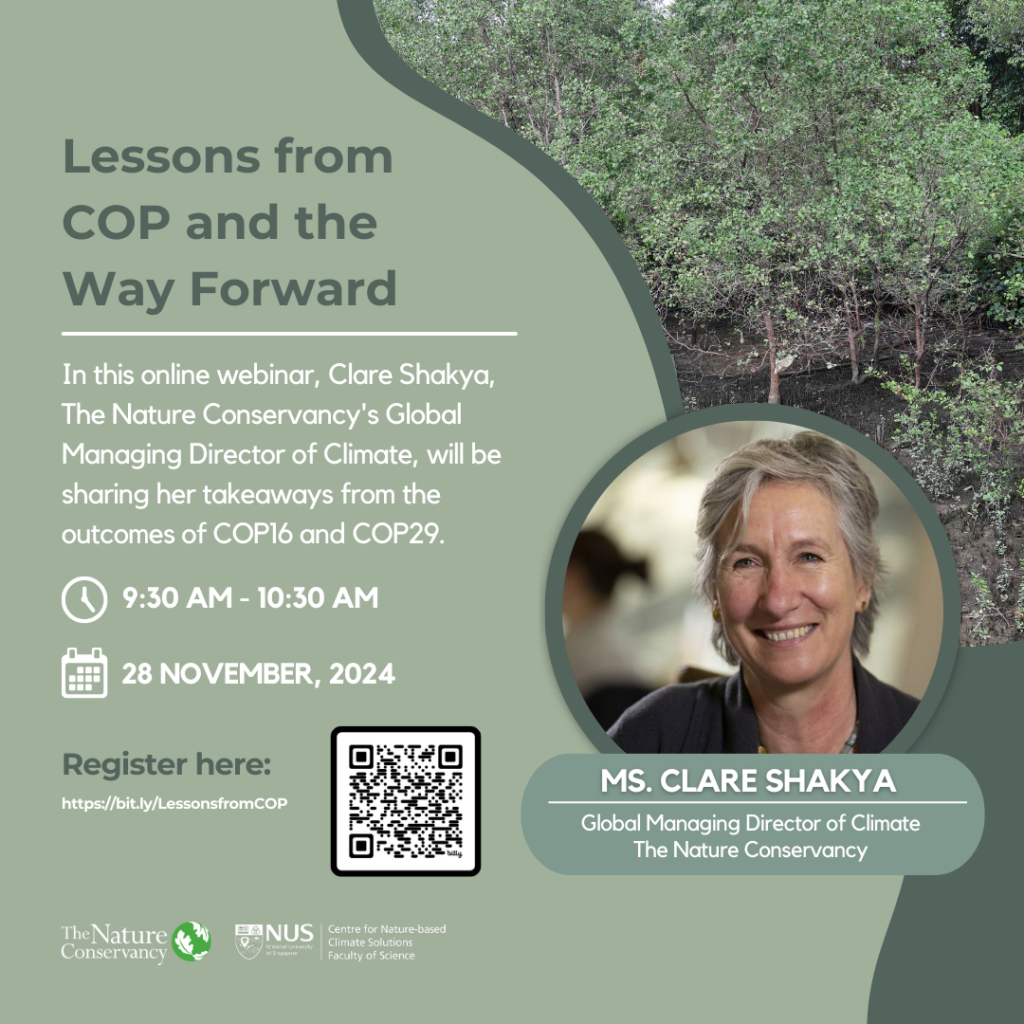
-
A Deep Dive into Nature for Climate
Published September 2024
-
NUS Decision Theatre Press Release
The NUS Decision Theatre was launched at COP28 on November 30.
Published November 2023 -
Why is COP28 so important?
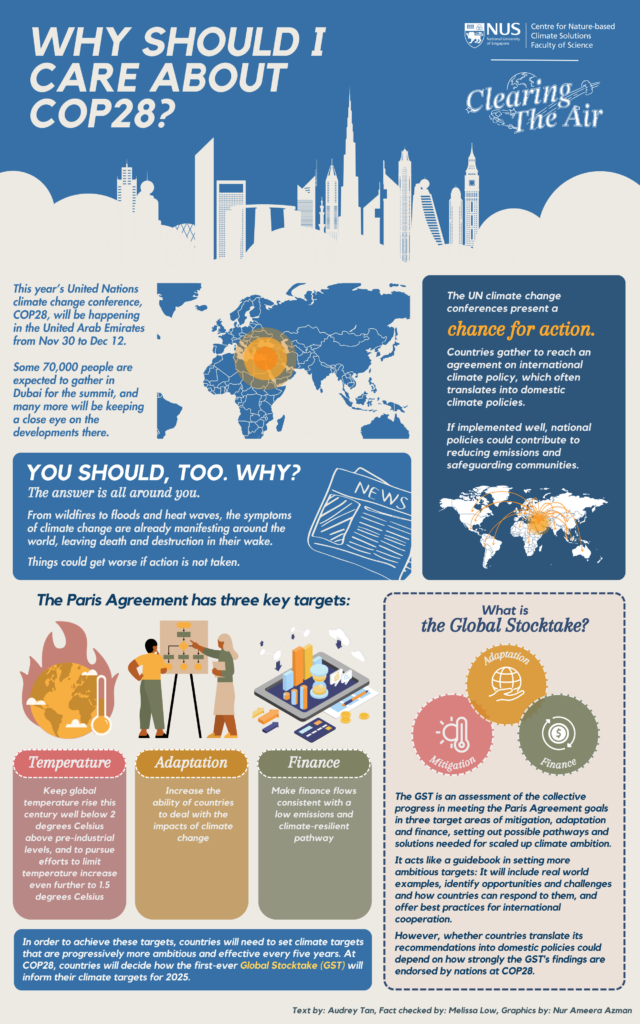

The annual United Nations climate change conference will take place in Dubai from Nov 30 to Dec 12, 2023. What differentiates this event from the numerous other sustainability conferences around the world, and what are some key issues that will be discussed there? Find out in these infographics.
Published November 2023 -
NUS at COP28
The NUS Centre for Nature-based Climate Solutions is leading the University’s participation in COP28.
Stay updated with the latest news and announcements from NUS at COP28.
Published November 2023 -
Voices from Asia, a COP28 podcast series from NUS
The NUS Centre for Nature-based Climate Solutions (CNCS) on Nov 3 launched a new podcast series, "Voices from Asia". Hosted by CNCS Science Communication and Outreach Lead Audrey Tan, this four-part series aims to connect the global discussions at the annual United Nations climate conference, COP28, with audiences across Asia. Each part of the series tackles a specific hot topic expected to be discussed at COP28. Tune in to "Voices from Asia" on Spotify or wherever you get your podcasts for insights, engaging discussions, and a deeper understanding of the key topics at COP28.
Published November 2023 -
In Brief | November 2023
The Global Stocktake Recognises the Role of Protecting Nature. At COP28, policymakers must respond.
The world is facing a planetary emergency wrought by the twin crises of climate change and biodiversity loss. Of the two, it is climate change that has taken centre stage in international discourse on the environmental woes of the planet – for good reason. Over the past year, extreme weather events bearing the fingerprints of climate change have wreaked death and destruction around the world, from heatwaves in Europe to floods in Africa.
These events come amid dire warnings from the Intergovernmental Panel on Climate Change (IPCC), the United Nations’ (UN) climate science body, on escalating climate impact due to rising emissions. These developments will add pressure on countries gathering in Dubai in December 2023 for COP28, the UN climate change conference, to secure an ambitious outcome that will help avert catastrophic climate impact. But the world should not take its eye off the other impending crisis of biodiversity loss at COP28.
There are multiple drivers of biodiversity loss, including climate change, overexploitation, habitat loss, pollution, and invasive species. With one million species expected to face extinction in the coming decades, the planet is losing both her richness and abundance of life — with implications for climate action.
Read our brief to find out how research relates to global discussions and how science can contribute to policy decisions to address the planetary crises.
-
Outlook on Climate and Nature for Asia
Some 150 policymakers, academics, philanthropists, business representatives and government officials from Singapore and the region gathered for the closed-door symposium. 3 emerging issues at the nature-climate nexus relevant for the Asia Pacific were discussed: biodiversity credits, emerging ocean economy & compounding risks of biodiversity loss and climate change. With growing recognition of the role of nature in tackling the climate crisis, this event aimed to build regional capacity on upcoming issues of concern for Asia ahead of COP28, where discussions on the interconnected climate and biodiversity crises are set to continue. By bringing together scientists with other stakeholders involved in sustainability, this event was also geared at promoting the development of new partnerships and collaborations that could help in the development of solutions to address the twin planetary crises of climate change and biodiversity loss.
Published October 2023 -
Cocktails and Conservation

In conjunction with Singapore’s GoGreen month in July, CNCS and the Sentosa Development Corporation organised a networking event geared at fostering greater interactions between scientists researching Southeast Asia’s rich natural capital and professionals from the tourism and events sector. It aimed to provide an opportunity for Singapore’s growing global carbon services industry and firms exploring carbon credits as a route to net-zero to interact with experts from CNCS and discuss these issues. At this event sponsored by Rumours Beach Club, researchers, policy makers, and business owners working at the climate-nature nexus shared more about their work in a fun and relaxed setting by the pool, over nature-themed cocktails. Such partnerships can help to boost the translation of scientific findings to real world scenarios; and ensure corporate decisions are girded in robust science.
Published July 2023 -
CNCS x Pulitzer Center media briefing on carbon markets
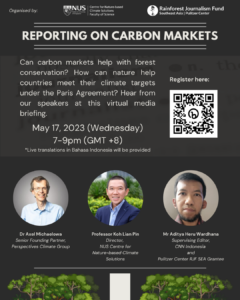
CNCS and the Pulitzer Center’s Rainforest Journalism Fund Southeast Asia organised a virtual media briefing on carbon markets for journalists reporting on rainforest issues in the region. The session provided an overview on the development of carbon markets and how they relate to the Paris Agreement on climate change. The event also featured a discussion on the other co-benefits of nature conservation as well as the benefits that carbon projects can offer local communities if done well. The aim of the event was to provide journalists reporting on rainforests in the region with greater understanding of how forestry issues intersect with climate change negotiations, given the rise of carbon markets and the spread of misinformation about such issues.
Published May 2023 -
The Greatest Shows of Earth
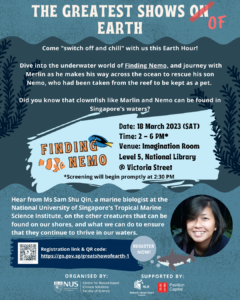
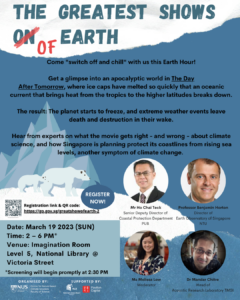
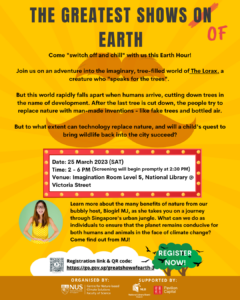
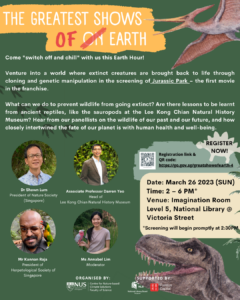
In celebration of Earth Hour in March, the NUS Centre for Nature-based Climate Solutions (CNCS) organised a series of four movie screenings with environmental themes at the National Library’s Victoria Street premises. Activities such as panel discussions, interactive question and answer sessions, and even a bingo session, were held after each screening, to help participants relate the key messages in the movie to Singapore. For example, after the screening of The Lorax on March 25, popular science communicator Biogirl MJ from Instagram channel @justkeepthinkingsg helped participants learn more about Singapore’s very own native wildlife through a fun bingo game. The movie had depicted a little boy’s quest to bring nature back into his built-up city. Other movies screened included Finding Nemo, The Day After Tomorrow, and Jurassic Park. Participants were provided a comfortable setting to relax on colourful bean bags during the screenings and had snacks to munch on such as our traditional kacang putih. The event aimed to use popular culture as a hook to get people more interested in our natural world and to encourage them to explore these issues further. This event was supported by Pavilion Capital and the National Library Board.
Published March 2023 -
What to expect at COP27
Melissa Low, Andre Chan
What's on the negotiating table for COP27? We explain the key areas of negotiations expected to be at play at COP27, including loss & damage, climate finance, and mitigation ambition.
Published October 2022 -
A History of NUS at COP
NUS Sustainability