

REx Workshops
The Uniqueness of the Research Experience programme lies in its array of selected workshops that have been carefully curated to suit the research needs and interests of student researchers.
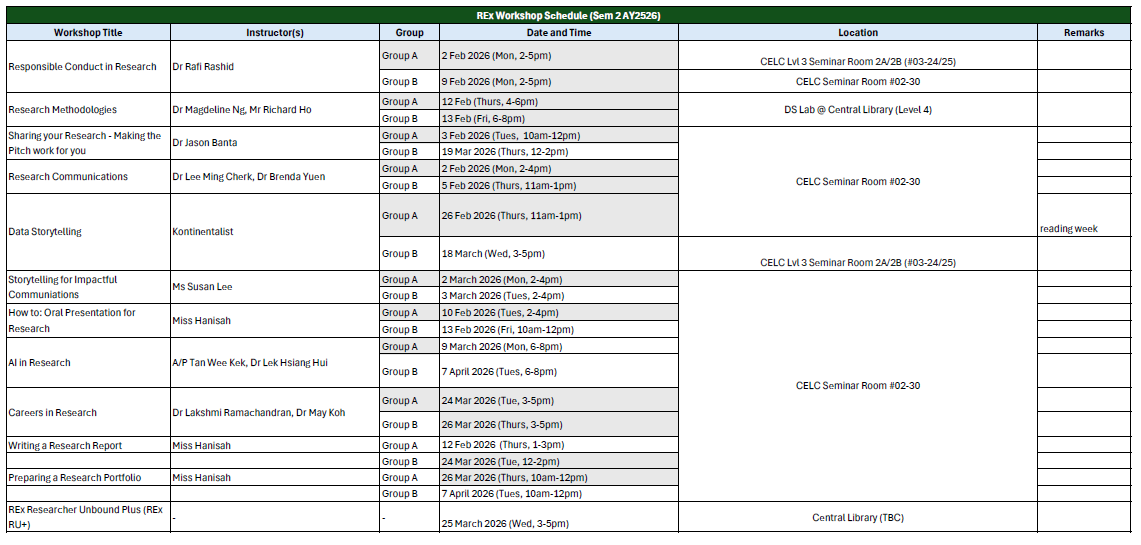
About the workshops
- Responsible Conduct in Research
Instructor(s): Dr Rafi Rashid
This workshop will introduce REx Fellows to ethical issues in research, e.g. data management, publication practices, authorship criteria, research integrity, misconduct, questionable research practices, conflicts of interest. Fellows will learn how to apply ethical principles and exercise reasoned judgement when facing ethical problems or dilemmas in research-related situations.
- Research Methodologies
Instructor(s): Dr Magdeline Ng, Mr Richard Ho
REx Fellows will learn about the various types of methodologies available such as qualitative, quantitative and mixed methods in research, how to select a suitable method to conduct research and how to evaluate the credibility of a research work. REx Fellows will also be enhancing their research skills when learning about the different types of databases available, how to retrieve key literature articles from these databases, what are the latest research tools and how to use them for their research.
- Ideate – To define or scope ideas to show novelty or identify gaps in research (by using effective search techniques)
- Search – To adapt various search strategies using different sources
- Measure and Enhance – To understand the basics of Scholarly Communication: publishing matters, research impact and research data management
- Overview of Research Methods in HASS or STEM
- Sharing Your Research: Making the Pitch work for you.
Instructor(s): Dr Jason Banta
Sharing your ideas should be a logical part of your own research plan! This workshop will help you develop a modular approach to sharing your ideas. By focusing on essential elements of good research, such as a rational for your work, an objective statement of your research goals, and an understanding of the implications of your ideas, we will develop a set of moves that you can use to describe your work in 3,5, or 8 minutes.
In this workshop, you will:
1) Identify the essential elements of your research for sharing ideas.
2) Work on isolating the most impactful parts of your research to leave an impression on your audience.
3) Practice sharing technical expertise with non-specialist audiences.
4) Leveraging storytelling to create a memorable impression on your audience.
- Research Communications
Instructor(s): Dr Lee Ming Cherk, Ms Brenda Yuen
In this two-hour interactive workshop, REx Fellows will be introduced to the practice of communicating research findings in semi-formal written texts, such as news articles and blogposts, to non-specialist readers in an effective and engaging manner.
By the end of the workshop, participants will be able to:
- identify the purpose, audience, and content suited for formal and semi-formal types of written communication; and
- use language and style that are appropriate to the semi-formal type of written communication.
The workshop is conducted through mini-lectures, critical evaluation of exemplars, and participants’ writing practice in explaining their own research findings for non-specialist readers. Before the workshops, participants are expected to write and submit a short academic text (of no more than 150 words) about their own research. During the workshop, they will learn how to turn their submission into a piece of semi-formal written communication.
- Data Storytelling
Instructor(s): Kontinentalist
This workshop is designed for students who want to develop their skills in using data visualisations and narrative structures to tell their stories. It will cover techniques for effective data visualisation (e.g. chart hygiene and effective use of colours), storytelling tips and tricks, and how to understand your audience.
a) Storytelling and persuasion:
- The power and importance of storytelling
- The role of the data storyteller
- Understanding your audience
b) What are the essentials for a good storytelling:
- How to handle and curate your data
- Understanding the types of data stories
- Storyboarding and story structures
- Storytelling for Impactful Communication
Instructor(s): Ms Susan Lee
If you agree that complex concepts can be communicated with simplicity, this workshop is for you. In the hands-on session, you will learn to create suitable story arcs and use rhetorical strategies to unpack complex ideas into relatable and useful information.
To craft compelling stories, we will first identify the target audience and develop authentic audience personas for the stories. We will analyse the functions of figurative language (e.g. imagery, analogy, metaphor, similes) for explaining concepts and scenarios in the context of your story. You may bring an example from your research to apply rhetorical strategies and develop your story. At the end of the workshop, participants will be able to
a Analyse the target audience of your research pitch.
b Apply selected rhetorical strategies to simplify explanations of a concept or scenario for the target audience.
c Craft a story that integrates the use of rhetorical strategies to communicate effectively with the target audience.
- How to: Oral Presentation for Research
Instructor: Miss Hanisah
This workshop provides students with the essential skills to effectively deliver oral presentations of their research. Through practical exercises and guided instruction, participants will learn how to plan, organise, and present their research findings clearly and confidently. Topics include structuring content, designing visual aids, speaking techniques and audience engagement. By the end of the course, students will be able to communicate their research in a professional and compelling way suitable for academic and professional settings.
- AI in Research
Instructor(s): A/P Tan Wee Kek, Dr Lek Hsiang Hui
Artificial Intelligence (AI), in particular generative AI tools, will transform the way students learn and conduct research. This two-hour workshop exposes students to various opportunities to apply AI tools in research and cautions against potential pitfalls. Students will be imparted with knowledge and skills to leverage on AI tools at each stage of the research process, namely:
- Use of AI tools in formulating and designing research problem;
- Use of AI tools in summarising research papers and conducting literature reviews;
- Use of AI tools in data collection and analysis; and
- Use of AI tools as an aid in writing research report.
- Micro-lectures will be supplemented with various hands-on activities.
- Careers in Research
Instructor(s): Dr Lakshmi Ramachandran, Dr May Koh
This two-hour workshop will be conducted by career advisors from Centre of Future Ready Graduates (CFG). REx Fellows will get insights as to what constitutes research and how to kickstart a career in research. Instructors will share their own journey from graduate school to early careers post-PhD, and insights will be shed on differences between academia, industry and entrepreneurship, important core skills and attributes needed as well as employment opportunities for each. Tips will be shared on how to gain relevant research exposure via internships or undergraduate research experience such as UROP or FYP. REx Fellows will get to do some hands-on experiences to identify their interests and to explore potential career paths.
In this workshop, students will:
- Explore the options and career pathways in research and innovation, including academia, industry and entrepreneurship.
- Learn how to prepare for a career in research and innovation Gain insights into Singapore’s research and innovation landscape.
- Reflect on their potential career paths in research and innovation.
- Writing a Research Report
Instructor: Miss Hanisah
In this workshop, students will be introduced to the format and writing styles of a scientific report.
Learning Outcomes
- To be familiar with the typical structure of a scientific report (i.e. IMRAD) and writing styles for each section
- Effective ways to use figures and tables to enhance readability of report
- Familiar with different citation styles, including in-text citations and reference list
- Preparing a Research Portfolio
Instructor: Miss Hanisah
In this workshop, REx Fellows will understand the importance of developing robust research portfolios for academia and industry. The workshop will go through key components of research portfolios and provide tips on how to go about structuring one to suit their needs. Lastly, some examples of research portfolio management and analysis will be provided.
- REx Researcher Unbound Plus (REx RU+)
Researcher Unbound Plus Series is an extension of RU programmes, designed to cultivate vibrant dialogues and networks and foster a collaborative environment where individuals from diverse disciplines can engage, share insights, and spark innovative ideas. Students enrolled in REx may either choose to attend the REx Researcher Unbound Plus Session to fulfil their REx Workshop requirement or present at the REx Researcher Unbound Plus Session to fulfil their REx Showcase requirement.
- Home
- REx Workshops