
Turning Bioresources into Value-Added Products
Biomass waste management is an increasingly important challenge, particularly in densely populated cities where land and resources are limited. In Singapore, this issue is especially pressing because the nation's only landfill, Semakau Landfill, has a finite lifespan.
As waste generation continues to grow, sustainable strategies that transform waste into valuable resources are urgently needed. Biomass wastes from horticultural activities, food processing, and other sectors contain abundant natural polymers such as lignin, cellulose, and starch that can serve as renewable building blocks for chemicals and materials. However, these components are often embedded within complex matrices that are difficult to process efficiently. The key challenge is therefore to develop technologies that can selectively extract and convert useful biomass constituents into value-added products while minimising energy consumption, chemical inputs, waste generation, and overall environmental impact.
A major focus of our research is the development of thermocatalytic processes for biomass valorisation. Catalysts accelerate chemical reactions, enabling biomass conversion under milder operating conditions, lower temperatures, and shorter processing times. Because biomass-derived feedstocks are rich in oxygen-containing functional groups, specialised catalysts are required to achieve selective transformations while maintaining high product yields and process efficiency.

"I am motivated by the opportunity to turn overlooked waste streams into valuable products, advancing sustainability while addressing pressing environmental challenge."
- Asst Prof Iris Yu
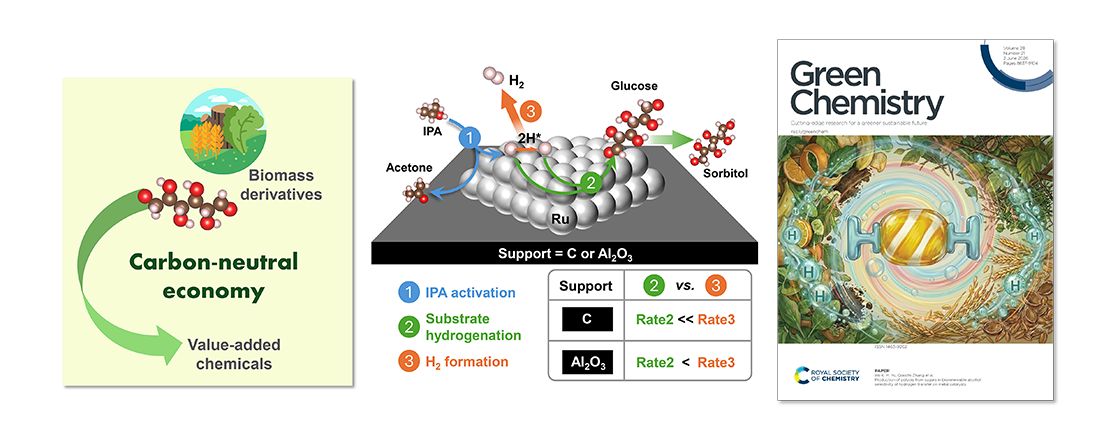
Beyond catalytic performance, our research also emphasises process safety and sustainability. Conventional hydrogenation processes often rely on high-pressure hydrogen gas, which presents storage, transportation, and operational challenges. We investigate alternative strategies that utilise liquid hydrogen donors, such as short-chain alcohols, as safer and more convenient hydrogen sources. These approaches can reduce infrastructure requirements while maintaining effective catalytic upgrading.
One representative example is our work on the catalytic transfer hydrogenation of biomass-derived sugars to produce polyols. By combining suitable catalysts with renewable alcohol-based hydrogen donors, sugars obtained from biomass can be transformed into valuable sugar alcohols under relatively mild conditions. Such products serve as important intermediates for food, pharmaceutical, and cosmetic industries.
A distinctive aspect of our research is the integration of microwave-assisted processing with catalytic biomass conversion. Microwaves generate heat directly within target materials, enabling rapid and energy-efficient heating that differs fundamentally from conventional conductive heating, where heat is first transferred through reactor walls. This approach has the potential to reduce energy losses and improve process intensification. While microwave technologies are widely used and demonstrated for organic synthesis and industrial drying, their application in biomass valorisation requires more fundamental research. Our work seeks to establish a scientific understanding of both the opportunities and limitations of microwave-assisted biomass processing, generating knowledge that can guide future industrial implementation.
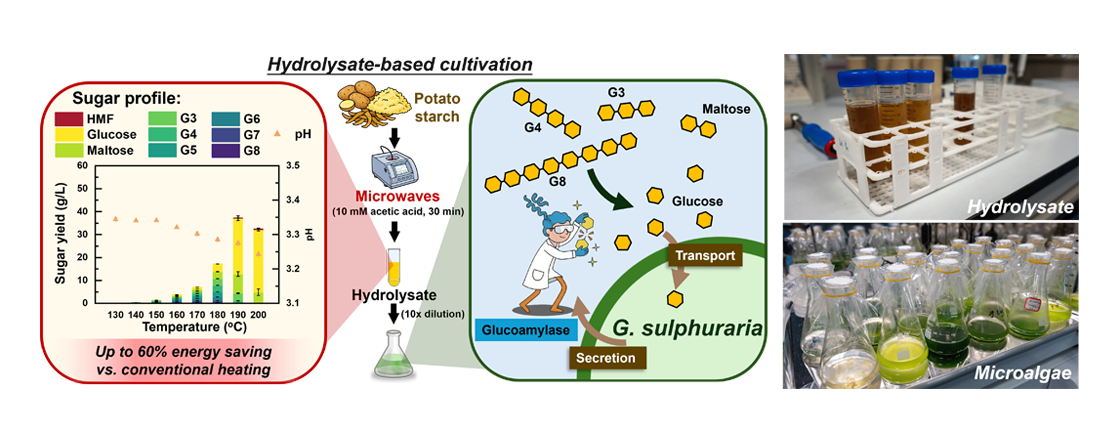
A recent example from our laboratory combines microwave-assisted biomass processing with microalgae cultivation. In this work, starch was subjected to microwave-assisted hydrolysis to produce a mixture of short-chain sugars. The latter was studied as a sustainable growth medium for cultivating microalgae, which can be harvested for algal lipids, pigments, etc. as value-added products. The use of microwaves in hydrolysis can achieve energy savings by up to 60% compared with conventional heating, demonstrating the benefit of the former.
Moving forward, our research will continue to advance microwave-assisted processing for sustainable biomass utilisation. A key objective is to integrate microwave heating with catalytic systems to achieve faster and more selective biomass conversions.
Please refer to our publications for more information:
- Liu, Z., Zhang, Q., Wang, J., Li, Z., Yu, I.K.M.* A starch-to-sorbitol biorefinery: Impact of oxygenated impurities on the catalytic transfer hydrogenation of starch hydrolysate Bioresource Technol. 2026, 459, 135267 [Abstract].
- Zhang, Q., Liu, Z., Li, X., Yu, I.K.M.* Production of polyols from sugars in biorenewable alcohol: Selectivity of hydrogen transfer on metal catalysts. Green Chem., 2026, 28, 8781–8791 [Abstract].
- Li, Z., Zhang, Q., Yu, I.K.M.* Towards sustainable microalgal farming: Galdieria sulphuraria cultivation on readily available short-chain sugars. Eng. J. 2026, 528, 172420 [Abstract].
For more details, please contact
E-mail: irisyu@nus.edu.sg
Research Group: Biorefinery Laboratory at NUS | Iris Yu