
Precision Tools to Sense and Protect Living Plants
OUR MOTIVATION: Safeguarding crops in a changing climate
Plants are exposed to a narrow set of conditions they can tolerate, and climate change is pushing them outside it. Rising temperatures disrupt pollination and grain filling, longer dry spells force leaf pores to close and starve the plant of carbon dioxide, seawater intrusion raises salt levels in soil and irrigation water, and warmer, wetter seasons spread bacterial and fungal disease faster. Meanwhile, the global population continues to grow. The pressure is sharpest for countries such as Singapore, which imports more than ninety per cent of its food. New technologies are needed to help crops withstand these stresses and to secure future food supply.
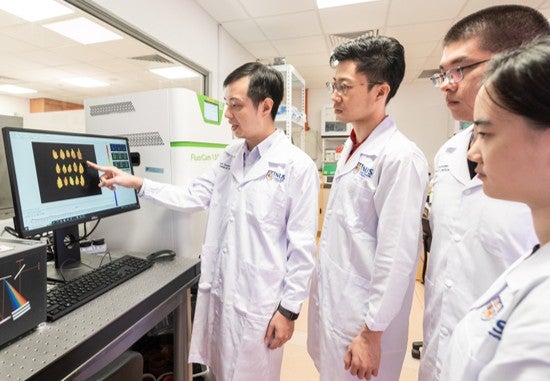
“Our work on plant nanotechnology aims to bridge communication between humans and plants, so we can understand their needs more quickly and respond more sustainably.”
Asst. Prof. Tedrick Lew
THE INNOVATION: Precision delivery and real-time sensing for plant health
Asst. Prof. Tedrick Lew and the research team address this challenge by combining two capabilities that are usually developed separately. The first is precision delivery: most agrochemicals sprayed onto a field never reach the tissue that needs them, so the team designs tiny biodegradable nanoparticles that carry active ingredients to specific cells, allowing a smaller dose to give better protection. The second is continuous sensing of plant health: wearable and implantable sensors report a plant’s condition in real time, revealing heat, drought, salt or disease stress days before leaves wilt or yellow.
Linking early detection to targeted treatment and intervention distinguishes the team’s approach from conventional detection techniques which require grinding of the plant tissues to extract plant metabolites, precluding any real-time monitoring approaches.
Targeting treatment to the plant doorway of infection
Nature Communications, 16(1), 4816 (2025)
Leaves are covered in microscopic pores called stomata that let air in and water vapor out, and many disease-causing bacteria use these same pores as their entry route. The research team asked whether antimicrobial nanoparticles could be placed precisely at that doorway.
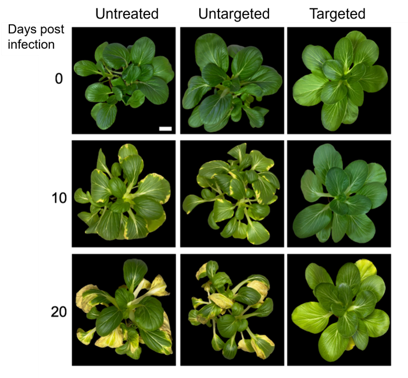
In a 2025 study published in Nature Communications, they designed zinc-based particles roughly a thousand times thinner than a human hair and coated them with recognition molecules that bind only to the cells surrounding the pores. Microscopy confirmed the nanoparticles found their target in five different plant species upon simple spraying. The particles were then filled with a natural plant-derived antibacterial compound and tested against a common bacterial crop pathogen. Treated plants carried 20 times fewer bacteria than plants given the same compound without targeting, while their pores continued to open, close and support photosynthesis normally.
These findings show that precisely placing nanoparticles at the point of entry offers stronger protection from the same quantity of active ingredient.
Together, the two studies show that plant treatment can be designed around both its destination and its environment.
Delivering treatment to plants underwater and in wet conditions
Nature Communications, 16, 10993 (2025)
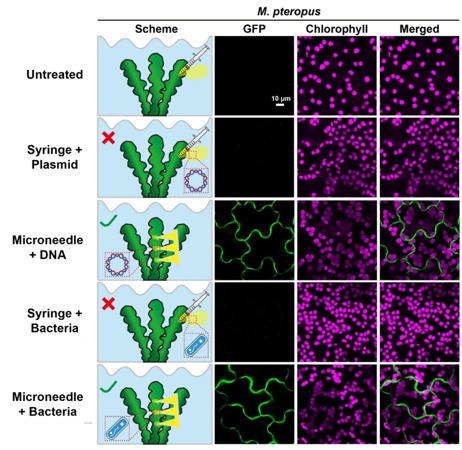
A second 2025 Nature Communications study tackles a different obstacle: sprays and injections wash away in heavy rain, flooded fields and aquatic farming systems. The team designed a small patch covered in microscopic needles, each holding its cargo inside a water-resistant shell. The shell keeps water out long enough for the needle to enter plant tissue, after which the plant’s own fluids trigger release; adjusting the shell composition controls the timing. The patch successfully delivered proteins, DNA, nanoparticles, plant hormones and even live growth-promoting bacteria into both land and aquatic plants.
In a functional test, it delivered a salt-tolerance gene into a fully submerged aquatic crop. Under salty conditions, treated plants stayed greener, photosynthesized more efficiently and showed less stress damage than untreated plants, while conventional syringe delivery failed underwater.
From Lab to Farm
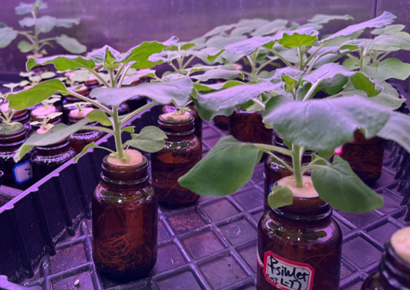
Both technologies are currently laboratory demonstrations, and the next step is to prove them in real growing environments, where temperature, humidity, light, soil and crop variety change from day to day.
The team is working to manufacture the particles, patches and sensors at larger scale and lower cost, to confirm that they remain safe for plants, consumers and soil organisms over repeated use, and to validate them in commercial farms and indoor growing facilities.
A longer-term goal is to close the loop between the two technologies, so that a sensor detecting early stress automatically triggers a precisely targeted treatment. Partnerships with local growers and agri-technology companies will be central to this stage.
For more details
Asst. Prof. Tedrick Thomas Salim Lew
E-mail: tedrick@nus.edu.sg
Research Group: www.lewlab.org