
Data Literacy for Everyday Work
The Data Literacy Programme (DLP) equips E&A staff with practical skills and knowledge to confidently interpret, communicate, and apply data in everyday workplace settings. Designed for adult learners from diverse professional backgrounds, the programme emphasises hands-on and workplace-relevant learning that supports better decision-making, collaboration, and problem-solving across functions.
Through accessible and practice-oriented learning experiences, participants develop the confidence to work with data meaningfully, regardless of prior technical experience. As learners progress, they may pursue stackable micro-credentials that support continuous professional development and progression towards advanced qualifications in Applied Data Science.
Aligned with national workforce initiatives such as the SkillsFuture Singapore and the Infocomm Media Development Authority (IMDA) Skills Framework for Infocom Technology, the DLP reflects NUS’ commitment to lifelong learning and building a future-ready workforce.
Adult-centric Programme
Your Learning Pathway to the MSc in Applied Data Science (ADS)
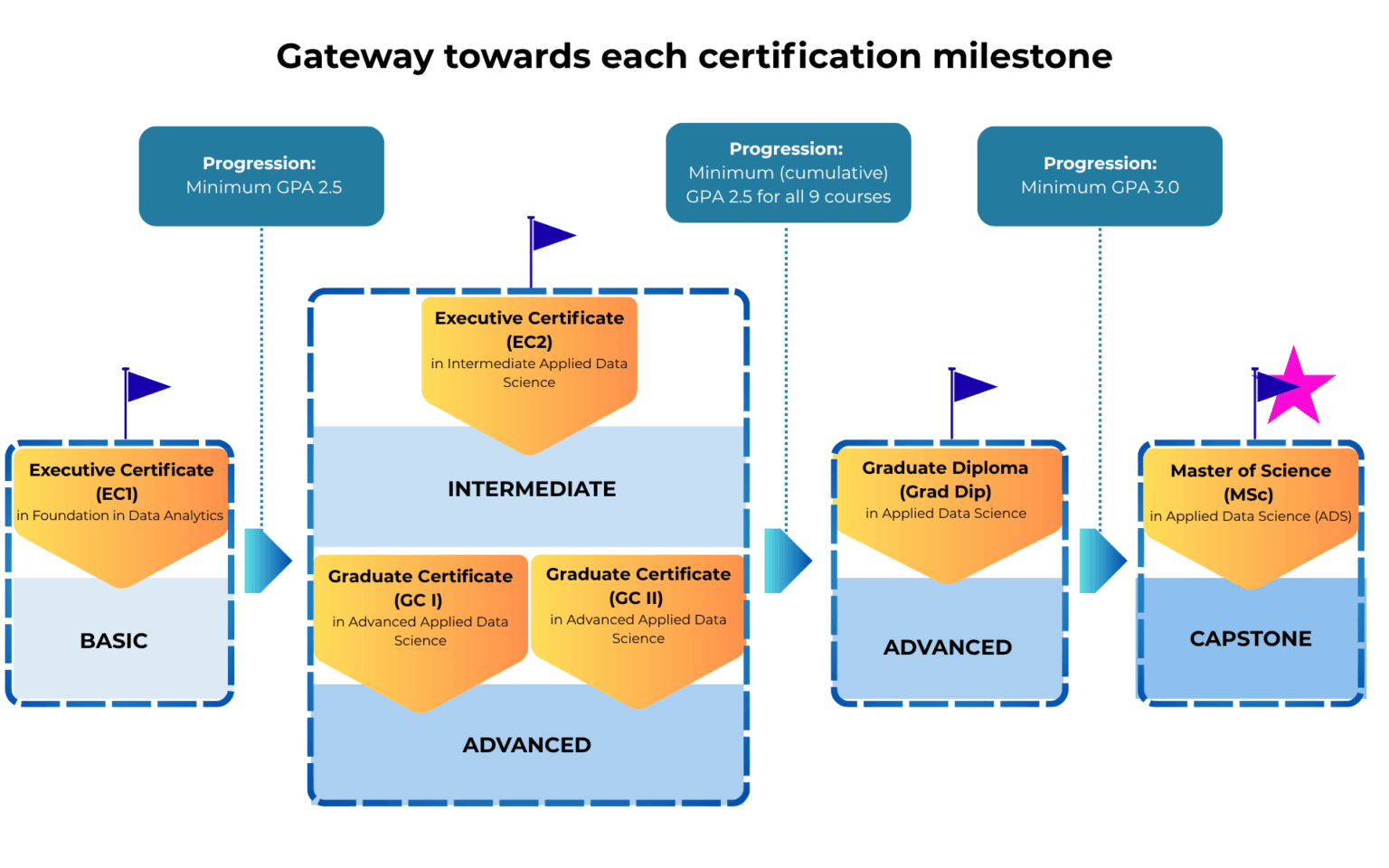
The DLP provides an adult-centric structured pathway for workforce transformation through stackable, credit-bearing micro-credentials and flexible workplace-based learning. This open-funnel programme enables Executive and Administrative (E&A) staff to personalise their learning pathways based on their functions and professional development needs, while continuing to work full-time.
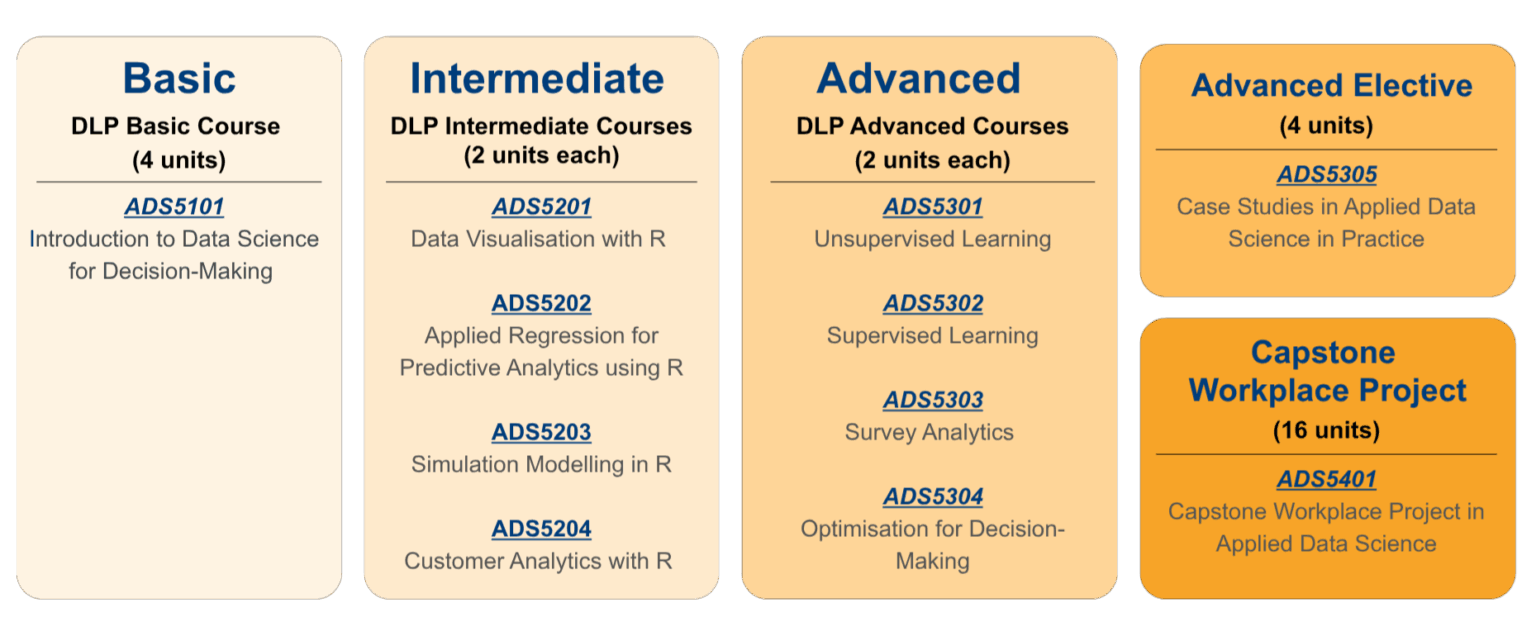
The DLP Basic course is compulsory for all E&A staff. This reflects NUS’s belief that data literacy is a core organisational capability that every staff member should possess. Establishing a common foundation in data interpretation, analytics, and evidence-based thinking strengthens cross-functional collaboration, improves decision-making, and supports a more data-informed culture across the University.
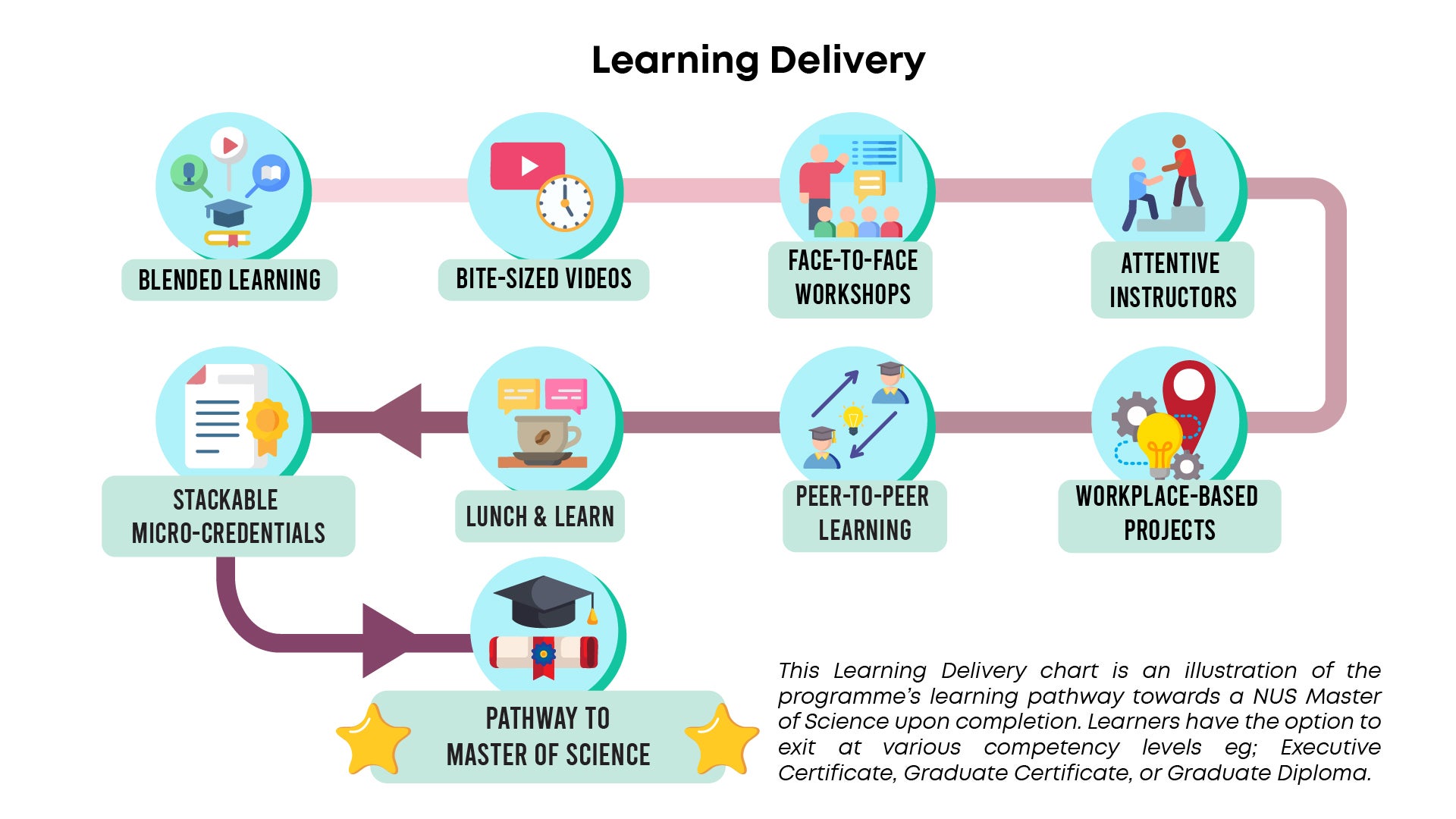
Beyond the foundational level, the DLP adopts a modular and stackable structure comprising intermediate and advanced courses, with multiple exit points and micro-credentials awarded along the way, allowing learners to progressively deepen their competencies at a self-defined pace. As learners progress through the courses, they may attain Executive Certificates, Graduate Certificates, and a Graduate Diploma, which can subsequently be stacked towards the NUS MSc in Applied Data Science.
Delivered through a blended-learning approach that combines bite-sized e-learning, interactive face-to-face workshops, and workplace-based group projects, the programme promotes lifelong learning while preparing staff to contribute meaningfully to NUS and Singapore’s growing AI-enabled and data-driven economy.
Learn your way to a Master of Science degree
in Applied Data Science
Learn your way to a Master of Science degree
in Applied Data Science

ASSOC PROF LIM TIONG WEE
PROGRAMME DIRECTOR

DR QIAN JIANG
SENIOR LECTURER

DR THAM JO YEW
SENIOR LECTURER

DR AMRITA PAL
LECTURER

MS EVELYN ANG
LECTURER

DR ISMAIL HANIF
LECTURER

DR LIU YIQUN
LECTURER

MR IVAN TAN
INSTRUCTOR

MS PEARLYN HO
INSTRUCTOR

Assoc Prof Lim Tiong Wee
(DLP Programme Director)

DLP Basic Course

NUS staff learners who have attended the Data Literacy Programme

DLP Intermediate Course
Explore the Programme Across Three Levels
Designed to support progressive learning, from foundational concepts to advanced applications
Basic
ADS5101: Introduction to Data Science for Decision-Making
Every business generates data – but not every business knows how to leverage it for success. In today’s fast-paced world, making informed decisions based on data is no longer optional; it’s a competitive advantage. This course is designed for professionals who want to unlock the power of data without having a technical or mathematical background. You will gain practical, hands-on experience in analysing and interpreting data, using everyday tools like Microsoft Excel to uncover insights that drive smarter workplace strategies. By the end of this course, you will confidently replace gut-feel decision-making with data-backed insights, identify hidden opportunities, and develop strategies to enhance productivity, efficiency, and business performance.
For more information on this course, please visit NUS Mods.


Intermediate
Introduction
The DLP Intermediate Level will allow you to develop data analytics skills to ally with your domain knowledge. These skills can make your work more efficient and enable you to get the most out of your data. The particular skills you will learn in the class, in terms of the IMDA Skills Framework for Infocomm Technology are Data analytics, Data engineering and Data visualisation. These are essential skills for a Data Analyst. Whether you go on to become a Data Scientist/Data Engineer or not, these skills will hold you in good stead in a 21st century workplace.
There are four courses in the DLP Intermediate level: (Please click on each title to learn more)
ADS5201: Data Visualisation with R
ADS5202: Applied Regression for Predictive Analytics using R
Advanced
Introduction
The DLP Advanced Level is a continuation of the DLP Intermediate Level and will allow you to develop greater proficiency in the data analytics skills that ally with your domain knowledge. These skills can make your work more efficient and enable you to get the most out of your data. The particular skills you will learn in the class, in terms of the IMDA Skills Framework for Infocomm Technology, are Data analytics, Data engineering and Data visualisation. These are essential skills for a Data Analyst. Whether you go on to become a Data Scientist/Data Engineer or not, these skills will hold you in good stead in a 21st-century workplace.
There are four courses in the DLP Advanced level: (Please click on each title to learn more)
ADS5301 – Unsupervised Learning
ADS5303 – Survey Analytics
ADS5304 – Optimisation for Decision-Making

Data Literacy Skills Recognition Scheme
The Skills Recognition Scheme (SRS) formally recognises E&A staff who demonstrate and apply advanced data competencies in the workplace. Complementing the DLP learning pathway, the Scheme provides E&A staff with opportunities for professional recognition, skills validation, portfolio development, and career growth through the application of data and AI capabilities in real work contexts.
Staff who complete the Graduate Certificate may be eligible for the secondary job title of Associate Data Scientist, while staff who complete the MSc Applied Data Science may be eligible for the secondary job title of Data Scientist, alongside a skills allowance that recognises the sustained application of these competencies in the workplace.
Through structured development and recognition pathways, the SRS supports continuous upskilling, lifelong learning, and broader organisational innovation across the University.