Inspired for Regional Impact
Two Master in International Affairs graduates are reaching their communities and serving pressing needs around them, having received strong support from the Low Tuck Kwong Foundation Scholarship.
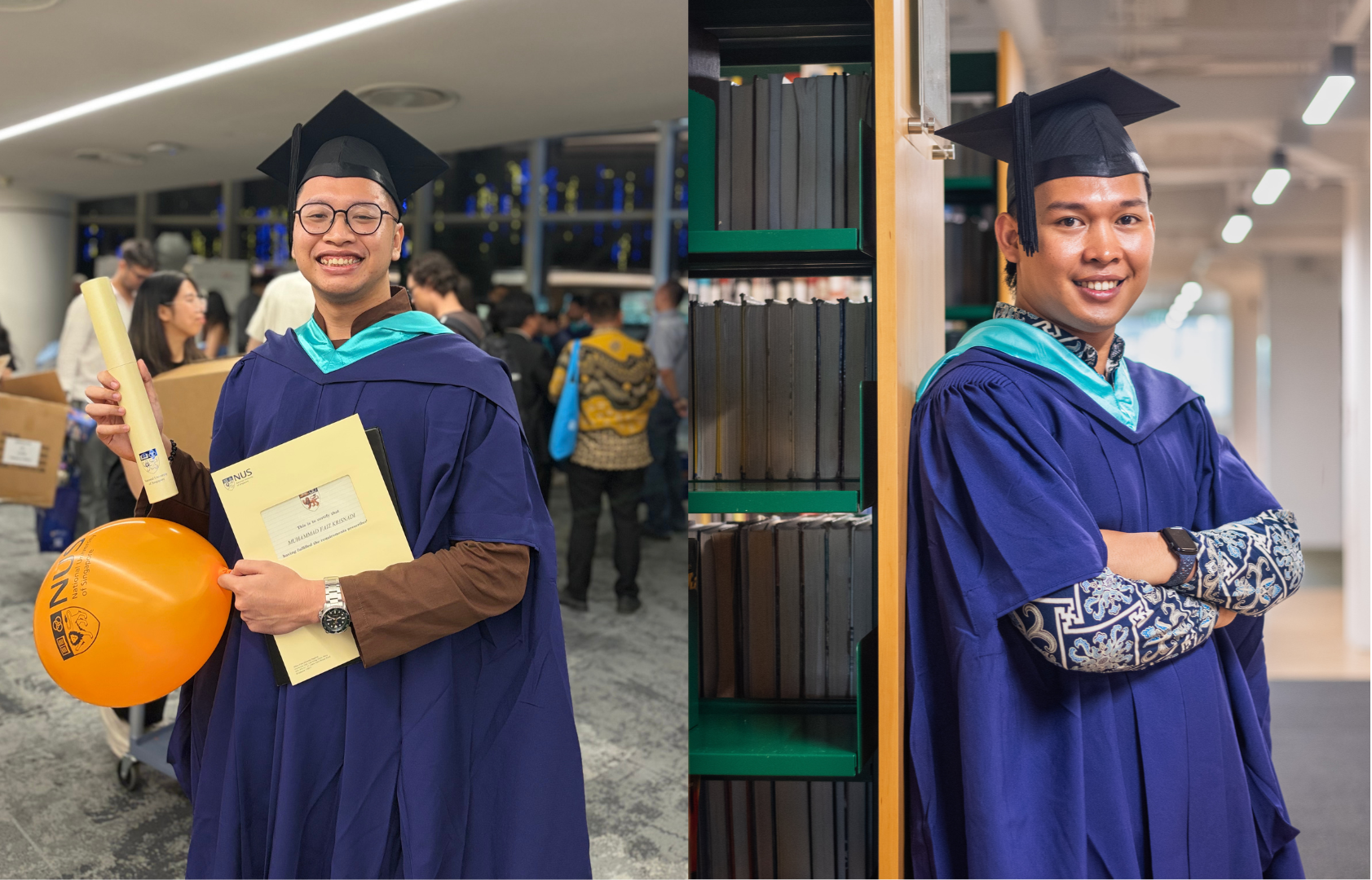
Faiz Krisnadi (left) and Hafiz Maruf Akbar (right).
From building Indonesia's first AI-powered flood map to coordinating disaster relief in Aceh, Faiz Krisnadi and Hafiz Maruf Akbar have turned their personal experiences into regional impact. Supported by the Low Tuck Kwong Foundation Scholarship at the Lee Kuan Yew School of Public Policy (LKYSPP), the Master in International Affairs graduates have chosen to use their skills and knowhow to give back to the communities around them.
Faiz Krisnadi: Pursuing Research with Real-World Impact
In a village in Central Java, Faiz Krisnadi passed the same hawkers every day after school. He would chat with them, stopping to see what they were selling: snacks, drinks, ice cream and inexpensive toys that children could afford.
To him, the sellers were simply a fixture of his childhood. Years of policy studies later, he saw them differently. People caught in a cycle of day-to-day survival, with no means to plan for the future. Unequal access to opportunity and uneven levels of literacy weren’t isolated struggles, but systemic issues stemming from policies that never quite fit their lives.
Faiz (first from left) with his family in Klaten, Central Java before beginning his studies at LKYSPP.
“A policy problem can remain hidden precisely because everyone around it has learned to treat it as ordinary,” he explained.
Recognising these overlooked issues was only the first step. To bridge the societal gap, Faiz needed the right knowhow. He found it in the Master in International Affairs programme at LKYSPP. The programme combines international relations knowledge with the practical tools of public policy.
The Low Tuck Kwong Foundation Scholarship empowered Faiz to answer his calling. It covered the full cost of his studies, including tuition fees, flights, insurance, visa expenses, a settling-in allowance, and a stipend for living costs.
He vividly remembers receiving the scholarship offer and thinking it was too good to be true. He asked colleagues to read the email too, just to make sure it was really his.
“For someone from my background, admission to a school like LKYSPP could easily have remained an opportunity visible from a distance but financially out of reach,” Faiz said. “The Scholarship turned that opportunity into an education I could actually undertake, and gave me room to make the fullest use of it.”
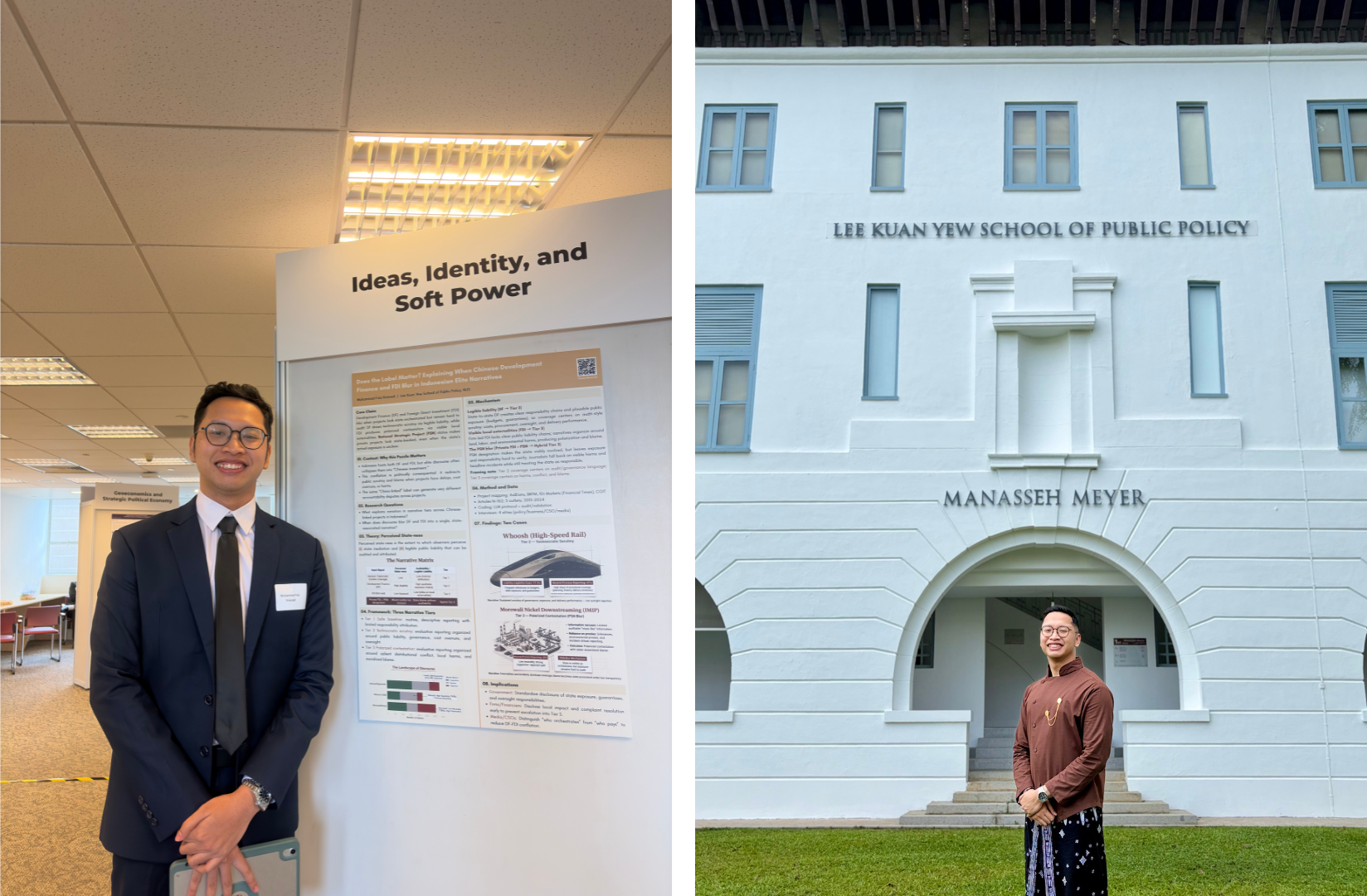
Supported by the Low Tuck Kwong Scholarship, Faiz enjoyed the opportunity to pursue the Master in International Affairs programme at LKYSPP.
Today, Faiz applies data, technology and interdisciplinary thinking to tackle issues of systemic inequality. His work spans climate resilience and social policy, from creating Indonesia’s first AI-powered historical flood map to an award-winning proposal that protects unpaid caregivers.
When devastating flooding struck Indonesia in late 2025, Faiz turned to Google’s Groundsource, which taps on artificial intelligence to turn decades of news reports and public archives into structured flood records.
With that data in hand, Faiz started building the Indonesia Flood Map. Launched in March 2026, it’s a free interactive platform charting about 26 years of flood events across his home country. Its purpose is to make long-term patterns easier to investigate and help researchers, officials, and communities better prepare for future floods.
Not all problems leave a visible trail the way floods do. Faiz’s latest project took on the quiet, invisible costs borne by caregivers. The Care Sovereignty Protocol grew out of his academic work, conversations with classmates juggling motherhood, and observations on family life in Singapore’s public housing estates.
Caregivers often have no safety net, whether they’re raising a child, looking after an ageing parent or caring for a family member with a disability. Under the proposal, they’d earn pension credits that follow them no matter their job or marital status.
The idea resonated beyond the classroom to reach a global audience. Selected from thousands worldwide, Faiz became one of three finalists to present onstage at the St. Gallen Symposium in Switzerland in 2026. He ended up clinching second place in the competition.

Faiz placed second at the St. Gallen Symposium with his presentation of the Care Sovereignty Protocol.
It’s a long way from a village in Central Java to a stage in Switzerland. That journey started with a scholarship that gave him the freedom to focus on learning and creating.
In a sense, Faiz’s projects are his way of paying it forward. He hopes to do work that doesn’t just sit in a research journal, but improves how people live.
“The Scholarship meant I did not have to choose between the programme that best matched my ambitions and what was financially feasible,” he said. “It allowed me to choose the education, community, and regional setting that felt right for the work I hoped to pursue.”
Hafiz Maruf Akbar: From kampung boy to Master’s holder
When Hafiz Maruf Akbar’s hometown of Aceh was hit by one of the most devastating tsunami in history that killed over 170,000 in 2004, he was only four years old. Yet, the tragic destruction of his hometown remains seared in his mind.
Beyond rebuilding the flattened village, the global attention that followed piqued his interest in the world.
“As a child, I could not fully understand the scale of what had happened, but I remember seeing people from all over the world coming to Aceh to help us rebuild,” he said. “It made me realise that my small hometown was connected to something much bigger. I kept wondering: how does the world work, and how do people come together in times of crisis?”
The self-professed “kampung boy” lived in Aceh for the first 17 years of his life, finishing his high school education there, before moving to Jakarta to pursue a Bachelor in International Affairs on a scholarship at Universitas Islam Negeri Syarif Hidayatullah.
“We realised that the disparity in the quality of education between the rural areas and the capital was very huge,” he explained. “If I wanted to grow and expose myself to more opportunities, I knew I had to leave Aceh and continue my education elsewhere.”
His move to Jakarta also paved the way for his younger brother, who later joined him in the capital to attend high school on a scholarship. For the family, education became a way to look beyond the limits of what was available in Aceh.
For him, leaving home was part of merantau, an Indonesian word commonly used in Sumatra that captures the idea of venturing beyond one’s hometown in search of knowledge and success before eventually returning to the community to give back.
After graduation, Hafiz worked in Indonesia as a policy analyst in the private sector for one-and-a-half years. The role gave him a closer look at how policy decisions could shape lives and communities — but it also made him realise how much more he wanted to learn and deepen his understanding of international affairs, sharpen his policy skills.
This led him to enrol at the LKYSPP in 2024 to pursue a Master in International Affairs on the Low Tuck Kwong Foundation Scholarship.
LKYSPP stood out to him for its strong focus on Southeast Asia, a region he had grown up in but wanted to understand more deeply.
“Coming from Indonesia, I wanted to study international affairs from a Southeast Asian perspective, not just through theories developed elsewhere,” he said. “Singapore is at the heart of the region, and LKYSPP gave me the chance to learn from professors and classmates who brought different experiences from across Asia and beyond.”

Hafiz (far right) organised fund raisers and liaised with the authorities to help residents in who were affected by floods in Aceh in December 2025.
The skills he picked up proved useful when he returned to his hometown. When severe flooding struck Aceh in 2025, Hafiz was on the ground as a volunteer liaison, helping draft letters to the Indonesian government to allow the international community to enter and assist with relief efforts.
Outside of academics, he was heavily involved in the School’s football tournaments and was also Resident Assistant (RA) at College Green, the dedicated university housing for NUS postgraduate students.
One particularly unforgettable moment as an RA involved dealing with wildlife on campus. “Together with the relevant authorities, we successfully secured a baby cobra and also handled a monitor lizard situation,” said Hafiz with a laugh. “It certainly wasn't in the job description, but it's a story I'll never forget!”
With merantau in mind and his family’s support, he completed his Master’s Programme and was conferred the Dean’s Leadership Award at LKYSPP in 2026, an honour recognising his leadership contributions both within the School and the wider community.

Living at College Green, Hafiz enjoyed a more immersive student life experience both inside and outside the classroom. (Left) A festive get together with peers, and (right) receiving the winner’s trophy for a friendly football tournament from Professor Joseph Liow, Dean of LKYSPP.
Hafiz, who is considering a career in international development, credits the School with equipping him with useful skills and experiences.
“Through coursework, interaction with diverse classmates, and real-world experiences like the Aceh flood response, I've developed a deeper understanding of how policy, humanitarian action, and development intersect,” he said.
Hafiz's story was first published on 9 July 2026 on NUS News as part of its Commencement 2026 coverage. Click here for more NUS News stories.
Empower more students like Faiz and Hafiz by making a gift to LKYSPP's Pooled Scholarship Fund. Your support translates knowledge into impact across borders and regions.