
I am Sangeetha, a year 3 student in NUS majoring in social work. I signed up for SW3105 believing that I had already understood community work in the context of social work. SW3105 focuses on community work in the field of social work, where we collaborate with members of the community to incorporate services and programmes together with them. Typically, community work involves connecting with members of a particular estate and understanding their needs as one community. Upon building sufficient rapport, trust and interpersonal relationships with the residents, there may be opportunities to enhance community bonding and social cohesiveness to improve the quality of well-being amongst residents residing in the community. As a community worker, you go in, you listen, you work together with people, and you have fun in the community. I pictured it as something warm, familiar and light-hearted. To my surprise, I left the course with more questions than straightforward answers, and found the experience deeply uncomfortable but somehow necessary in becoming a social worker.
The course introduced us to the concept of “bumping spaces”, one of my biggest takeaways from last semester. The informal, unplanned corners of community life where real conversations happen. A corridor, a void deck, a wet market, a playground, a walkway, a bus stop, the minute before a conversation happens. It was in those spaces, during our bumping spaces interviews, where we heard the lived experience of community members navigating real life stressors, some even living in urban poverty. The quiet exhaustion behind their narratives, the way they shared about falling between the cracks of the systemic barriers, expanded my understanding of the challenges of an ordinary Singaporean. Those conversations were not a part of just any assignment. They shaped the personal values, worldviews and perspectives I bring to my everyday experiences.
Tutorials usually give us students an experience of applying our learnt theories into practice. However, for SW3105, the discussion group exercises took form in terms of allowing us to integrate concepts autonomously by sharing our views and questions of specific theories and the practices of community work in real work settings. One discussion group exercise that sticks with me till this moment is the multi-stakeholder role-play activity. Differing from the typical mundane tutorial lessons we’re often exposed to, the role-play activity simulated a real-life scenario where different organizations came together to talk about a common problem affecting the community. The exercise involved us being assigned to represent a different organization responding to a crisis. The situation comprised residents without shelter living at Kensington Park. My group took on the role of Family Service Centre (FSC) as a stakeholder involved in this matter. Around the same table, there were groups representing stakeholders such as National Parks, the Destitute Department, a voluntary organization, and the Social Service Office. Our task was to negotiate a timeline together with all the stakeholders to ensure the homeless residents occupying the spaces of the parks were able to evacuate the spaces safely. Moreover, we primarily had the responsibility to convey to different agencies that while it was important to ensure residents evacuate the spaces, it was necessary to comprehend their unmet needs and gaps in accessing resources in the community. Ultimately, it was critical that we provided residents with support to have shelters as they were rough sleepers. I thought it was a simple task. I mean, what’s there so complicated about this?
It was not simple.
Within minutes of commencing the activity and discussions on how to carry the task out, the tables became a tangle of timelines for institutions, eligibility criteria, and competing priorities. The Destitute Department came with a firm two-week deadline, and a list of conditions residents had to address. For instance, residents had to be drug-free, have employment, and remain intact with their family units before qualifying for help. This absolute factor – “being qualified to receive help” brought me to new realizations within moments, distracting me from my actual task. My instinct as part of the FSC was to slow down, enter the community, listen, and co-create. But there was no time or space for that. So, we took on the role of advocates, pushing back against barriers we felt were unjust, attempting to hold space for a community that was not present in the room for the discussion.
And that was the pressing concern. The community was not in the room.
It was then that I felt a sense of discomfort within me. We were describing what residents needed, what they may be feeling, what would be best for them, what we imagined they would want, without having even one resident present to confirm or contradict our representation of their voice. The ethics of social work were called into question in this very instance, as this went against client self-determination. A line from Paulo Freire came to mind where the work of liberation must be forged with, not for, the people it concerns. In trying to advocate for the residents of Kensington Park, we had recreated the very structure we were opposing. We were still the ones deciding, in their absence.
This was the most unsettling realization of the entire course.
It also clarifies something that I had felt, but not yet named, in those bumping spaces. When residents shared their stories of navigating systemic gaps such as financial inadequacy, the administrative burden of renewing assistance schemes, long waiting hours to receive services, and being turned away from one service to the next, there was often a weariness that went beyond the immediate hardship. It was the weariness of being spoken about, planned for, categorized, and redirected, without ever quite being spoken with. Hearing that, and then sitting at a negotiation without them, felt like a contradiction I could never ignore.
I came to understand that community work does not begin with solutions but with the ability to step back and resist the pull to gather answers from the people we are working with. It involves being comfortable with sitting with uncertainty longer than we might expect. It means trusting that the people we seek to serve already carry the expertise that no professional assessment can fully replicate. We need to truly believe in the capacities of community members and listen to them intently. That kind of restraint is something I haven’t mastered as an aspiring social worker. I am still learning its own form of practice.

Fig 1.1 – Residents at Yu Hua Village Market and Food Centre
The anxieties I observed within myself when engaging with institutional spaces were a major takeaway from SW3105. In the exercise, statutory authorities in the room felt heavier than ours. It was tempting to defer, to accept the constraints as given, to move on. But the lived experiences from the residents I met are staying with me. These narratives made it harder to treat systemic constraints as neutral realities. Working on our group project and collaborating with Fei Yue Community Services allowed us to understand the practical challenges and needs of Yu Hua residents, and to learn that many are isolated because of language barriers, health concerns and lower-resourced backgrounds.
The project required us to conduct bumping spaces interviews with residents in Yu Hua Village and understand some of their desired community activities, challenges that they encounter on a daily basis and suggestions to improve community integration. We learned the importance of being approachable as community workers on the grounds to be able to communicate with them and have the capacity to build rapport with them informally. Learning to advocate, calmly, persistently, without losing sight of why, while also remaining open to other organizations’ perspectives, is something I am still learning to do. I suspect I will be for a long time.
Moving ahead of SW3105, I ask myself whose absence I will notice at a table of negotiation, and what will I choose to do about it? I have no answers, but I’m growing to have the capacity to sit with the discomfort. After all, in social work, not knowing answers is often a sign that something real is at stake, requiring our attention. I will recommend this course to every aspiring social worker as the course educates us on the cruciality of journeying with people, partnering with them.
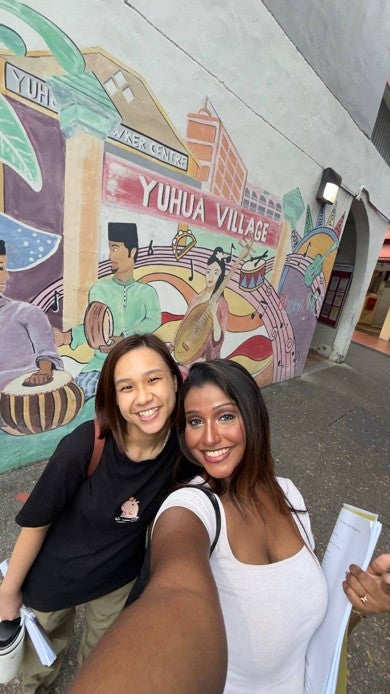
Fig 1.2 – My groupmate and I were doing our bumping spaces interviews with residents to understand their community involvement and well-being.
21 Lower Kent Ridge Road
Singapore 119077
+65 6516 6666