
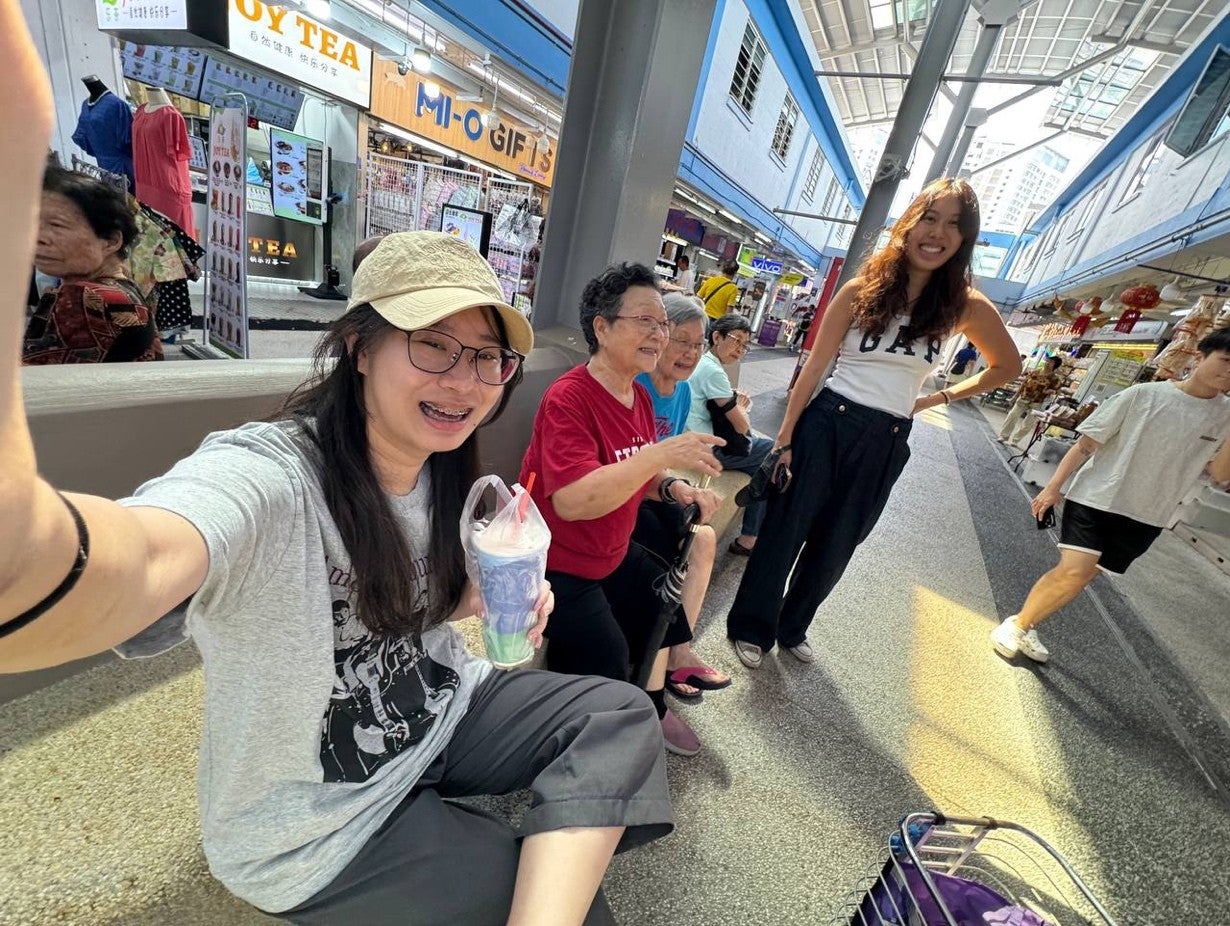
Group photo with the seniors
My name is Julianne, a final year Law and Business Double Degree Programme student in NUS. I chose GEN2008 (Purposeful and Productive Ageing in the Community) because I was intrigued by the concept of “purposeful and productive” ageing and believed that the field trips to the various active ageing centres and workplaces would give me the opportunity to decipher its meaning within Singapore’s ageing framework. This course required weekly interactive sessions with older adults involved in volunteering, employment, and social enterprises. Through sustained conversation, students were prompted to identify key needs and risks among the elderly, which would culminate into workable solutions for their communities.
Before embarking on GEN2008, I initially harboured the preconceived notion that ageing was chiefly about decline, social withdrawal, and dependence. This impression has been shaped by distant observation and dominant narratives of frailty and financial insecurity that are ‘inevitable’ in the later stages of life. More often than not, my perceptions of a generation so far from my own are infirmed by the media I consume online and on TV—recent political rallies portray that Singapore’s ageing discourse has been tilted toward healthcare and financial adequacy, while cultural and relational dimensions—like respect, purpose, independence, and intergenerational connection—are only nascent.
Honestly, I was not excited about spending two hours each week interacting with the elderly. But growth truly lives in places we don’t intend to go: GEN2008 actually taught me to be a lot more open-minded when interacting with people so seemingly different from ourselves. My intimate encounters with the elderly at the various active ageing centres dismantled the stigma in my mind—that the elderly are frail, dependent, and have lost their vitality.
To give an example, I learned that many elderly dislike being infantilised and pride themselves on being independent. At Lions Befrienders Bendemeer, I met a 60-year-old named Shirley, whose reflections revealed how damaging misperceptions can be. Before I had even spoken to her, I was amazed at how she radiated such vibrant and youthful energy, not just in her mannerisms but in the way she spoke about her life. She recounted her participation in Hockey matches organised for the elderly in the community centres (and how enthusiastically competitive old people were at sports) and how she was a Lions Befriender leader during community art sessions.
When I inquired about the extent of her interactions with younger people, she described how well-intentioned school groups and volunteers often treat seniors as children, assuming incompetence. For someone like Shirley, who once led an active professional life, retirement already entailed a blow to the self-esteem. Being infantilised clearly contradicted her continued vitality. Shirley also highlighted the irony of prevailing narratives: despite being labelled dependent, many older persons actively support younger generations by staying fit, volunteering, and cushioning family burdens. She herself continues to care for her special-needs adult son. These insights expose a key micro-level gap: youth empathy often manifests as pity, reinforcing the stigma of decline.
Besides having my perceptions of the elderly reshaped, my beliefs about the ageing framework were also significantly affected. I always believed that Singapore had a near-perfect active ageing narrative—MediShield, active ageing centres, financial schemes. But being on the ground and speaking to the elderly revealed a different side to the story. I met 70-year-old *Mr Leong, a volunteer leader at Lions Befrienders Tampines. He poked holes in the seemingly perfect fabric of Singapore’s active ageing support from the government; financial schemes had inflexible criteria that left many falling through the cracks. Another elderly at ACES Singapore griped that the activities at the active ageing centres were skewed towards women (arts and crafts, dancing, singing, cooking) and rarely appealed to men. This was confirmed by my observations that most of the participants at active ageing centres were women. It made me realise that despite the assertions online and at political rallies that Singapore’s active ageing system is one of the best in the world, my insights from the GEN2008 sessions belied this impression. While Singapore’s active ageing framework is undeniably adequate, it falls short on many other aspects of ageing which I have come to learn are just as, if not more, important as being able to stay afloat financially and to reduce chances of injury.
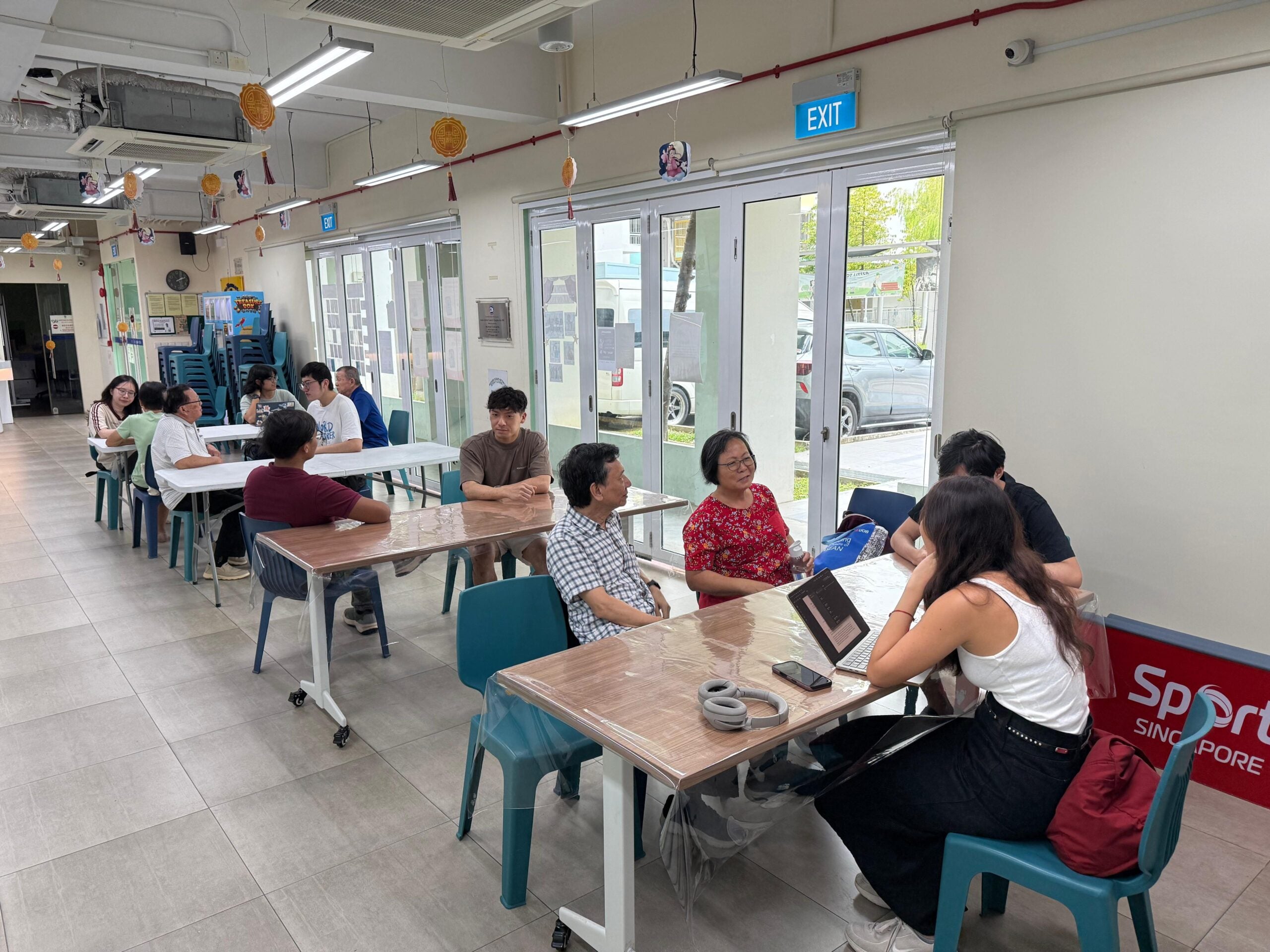
Chit Chat session with the seniors
From my GEN2008 sessions with the elderly, I’ve come to learn that ageing is beautifully multi-faceted, and so much more needs to be done for our elderly to age productively. ‘Productivity’ should no longer measured by the basic yardstick of having one’s physiological needs met alone but should be extended to assess how self-fulfilled and enriched one is in their personal life. Singapore’s ageing population doesn’t just want a safety net in the event they fall; they want to be empowered in what should be the golden years of their life.
GEN2008 positioned me perfectly, as an innovative and problem-solving student at NUS, to take my perspectives, both old and new, and coalesce them to find new solutions to problems that could’ve only been unearthed from my chats with the elderly. My group and I came up with Silver Microfunds (inspired by those in Japan) to empower the elderly with entrepreneurial sparks; we suggested inter-generational bonding activities at the active ageing centres between the elderly and their grandchildren to foster stronger connections; we designed “Men in Motion” programmes to counter male disengagement in community-based activities by expanding the current scope of activities available. It has been a thought-provoking call to redefine ‘productive ageing’ and empowered me, and likely the rest of my course mates to use these fresh insights to rethink how we should interact with generations so different from our own, and as working adults, pave a better journey for ageing.
21 Lower Kent Ridge Road
Singapore 119077
+65 6516 6666