
Computer Science students are taught to think systematically and problem-solve. When an algorithm is too slow, we find a better data structure. When there is a bug, we debug it. As a Year 4 Computer Science student, I naturally thought befriending would work in the same way: identify the problem, propose a solution, optimise the outcome. Thus, I approached GEN2060 Reconnect SeniorsSG, where students befriend isolated seniors, in the same way I approach most things in university – with a competitive mindset and a desire to do well and deliver something impressive. I was ready to find a good challenge and solve it. After all, this was a graded course that would fulfil the Communities and Engagement Pillar. How do I “solve this” to get good results?
That was before I met Mdm Chan.
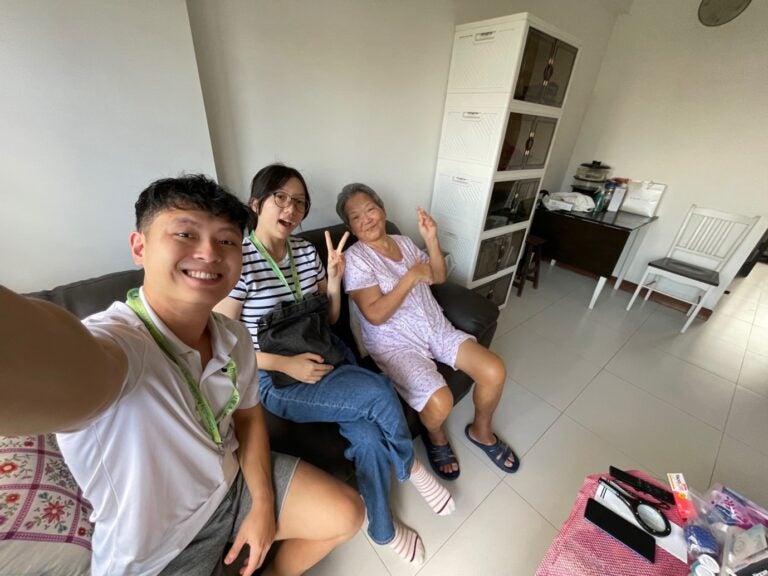
With Mdm Chan during one of our visits
Mdm Chan is in her sixties and lives alone. Her niece handles her groceries, her sister provides support, and her basic needs are well taken care of. What became clear quite quickly within our first few interactions was that Mdm Chan did not really need the provision of more services. What she needed more was companionship – someone to talk and share stories with.
However, I did not realise this initially. My first phone calls with her were awkward and brief – I would mainly call to schedule visits, ask “how are you?”, get a standard “good, good” in response, and the conversation would end. My questions were always generic: “还好吗?” (Is everything alright?), “需要帮忙吗?” (Do you need help?). I was always trying to find a problem, so I could proceed to the next stage of offering solutions. I always felt like I should have said more, but my mind would go blank when no problems were uncovered.
Over time, I realised that Mdm Chan enjoys talking. Our best conversations take place when I ask about her past experiences. She lights up when talking about her time working at NTUC, especially the company trips to China for conferences. She talks fondly about having free time to explore Chinese cities. Those were clearly happier, more carefree days for her. Near her doorstep, she has a photo of herself standing on top of a hill, on display almost like a trophy. These conversations about travel showed me what really connected with her: memories of mobility, independence, and exploration.
When Mdm Chan mentioned missing travel, my Computer Science brain immediately kicked in. The problem? Mdm Chan misses travelling, but cannot do so because of mobility issues. The solution? I suggested that we could visit Bukit Timah Hill nearby. When she said “走路不方便” (It’s not convenient for me to walk), I proposed using a wheelchair so she could still experience being outdoors.
Her reaction was immediate and clear – she did not like the idea at all. She explained that relying on a wheelchair would confirm that she could no longer walk independently, and she saw it as a point of no return. For someone who values being strong and independent, using a wheelchair felt like a sign of defeat, of giving up.
That’s when it hit me. I had fallen into my usual problem-solving mindset. I saw a constraint (mobility) and immediately proposed a technical solution (wheelchair). However, Mdm Chan did not want her “problem” fixed. She wanted her choice to stay independent respected, even within mobility constraints.
I realised that the root issue preventing our relationship from developing was that I was approaching befriending with a systematic mindset rather than focusing on just being present. There was also pressure from knowing this was part of a graded course, which made me feel like I needed to “do something visible” instead of recognising that just being present might be the most valuable thing I could offer.
In Computer Science, we always have to actively search for the solution. Given an assignment to develop a good application, you do your research, test your hypothesis, and try different approaches. When your code does not work, you fix it. In contrast, dealing with humans is completely different from dealing with assignments. When there is something to do with the heart, sometimes the best approach is to just be present, and let the solution unfold itself.
This realisation changed everything. I started showing up at befriending visits for the sake of connecting with Mdm Chan, not for the sake of completing my coursework. I let go of the hidden agenda to find problems I could solve. Instead, I learned to go with an open heart – to be proactive when help is needed, and not push my own solutions forward.
As a result, the questions I asked Mdm Chan changed too. Instead of generic check-ins hoping to find tasks she needed help with, I started remembering the little details and asking about them: when her next doctor visit would be, was she still actively participating in HAPPY programme exercises, how her niece and her niece’s son were doing. When she brings up her past travels, I ask her to recollect more details. These days, we also talk about her current activities – since she does not want to travel now, she enjoys social media. Sometimes, I share news about AI-generated videos or scam calls to watch out for, and she would pull out her spectacles and lean in, asking questions, showing she was genuinely engaged.
Ever since this shift in mindset, our conversations have flowed better, and Mdm Chan has opened up more. With this, I realised I had hit the real learning goal of this course – genuinely making the human connection.
What this experience has taught me was that the most valuable thing I can offer is not my skills or solutions, but simply my presence and genuine interest in someone’s story. Moving forward, I will approach others with an open heart, whether in my future work or relationships, by being present without expecting anything in return. I will let them guide the conversations while staying present and responsive, and form the connection before jumping into problem-solving.
Good human connection is not about optimising or solving problems – it is about creating space for another person to feel heard and valued. For Mdm Chan, my genuine interest in her stories and just being there mattered more than any activity I could arrange or problem I could solve. Sometimes, the best solution really is the simplest one, right in front of us – and we just need to be present enough to see it.
21 Lower Kent Ridge Road
Singapore 119077
+65 6516 6666