
I am Calista Wong, a Year 2 Computer Science student who chose to read GEN2050Y Teach SG as it resonated with my belief that everyone is deserving of help and has the potential to improve. The service-work preparation for the course involved 2-3 weeks of training and planning, followed by six months of weekly service sessions at Kranji Primary School. My initial expectations for choosing this programme were driven by my desire to give back in the form of teaching and providing support. Unexpectedly, the programme challenged my preconceptions and revealed overlooked societal opportunities. Beyond reigniting my passion for teaching, it reshaped my understanding of engaging communities and its broader impact on society, volunteers, and individuals — including myself.
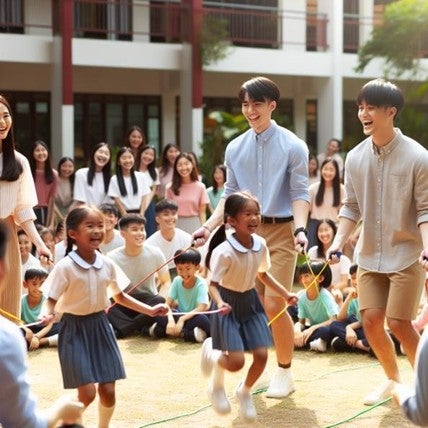
Raiza RIFAAIE, Mentoring activity. AI-generated (Dall-E).
Globally and specifically in Singapore, community service is commonly branded as charity or giving back to the community. I, too, largely viewed it as such. I once believed a utopian society wouldn’t need community service. In retrospect, there is a lot more nuance to community service and its value to a community. With that in mind, I very much appreciate that GEN2050Y is housed under the more aptly named ‘Communities & Engagement (C&E)’ pillar in the NUS curriculum, rather than the more traditional notion of ‘Community Service’.
Reflecting on my experiences in this programme, I now see C&E as essential for building social capital, fostering trust, and enhancing collaboration, all of which strengthen community resilience. Through mentoring activities, we create a network of mutual support and shared knowledge. As mentees grow in confidence and skills, they contribute to a more resilient community, while we, as undergraduate volunteers, develop a stronger sense of purpose and self-efficacy. These experiences also help us cultivate valuable interpersonal skills and insights — skills we may not actively develop elsewhere.
Another undervalued benefit of volunteering is the shared experience and interactions we gain. As I learned about the power of collective experience in providing support to my mentees, I realized that C&E offers the same platform. In such a short time, the opportunity to interact with teachers, mentees, and fellow mentors — people we might not have otherwise encountered — is priceless. While often viewed as “giving back,” C&E benefits all participants by creating an environment of cooperation, where both mentors and mentees grow and strengthen their connections within the community.
Our mentees, aged 9-12, were identified by teachers as needing extra academic or emotional support due to various challenges, including disinterest, social anxiety, and hyperactivity. Youth development is a persistent issue due to its complexity and lack of standardisation. Interacting with them firsthand, I felt both sadness and frustration, knowing that many others like them might be overlooked.
It’s not always due to a lack of effort — sometimes, it’s a lack of education, information, or financial means. Those with privilege and resources should take the initiative to bridge these gaps through support and education. We chose activities which encourage creative expression beyond verbal communication. I found the sign language session particularly impactful — those who were timid or soft-spoken became noticeably more engaged and expressive. Even weeks after, they eagerly shared signs which they had learned in their own time. Their newfound intrinsic motivation was deeply moving to witness.
It was not just the mentees who grew over the course of our mentorship journey. Coming into GEN2050Y, I was initially intimidated because I felt that my awkward and serious nature would present difficulties in being a good mentor. I had always imagined that an energetic and sociable personality would be best suited for working with children and I admired how easily they connected with such individuals. However, being a role model for the mentees pushed me to continuously reflect on how I presented myself, refining my values and morals beyond the programme. I grew more self-aware, catching moments where I made comments that may be misinterpreted. On reflection, it took mentoring others for me to realise that sensitivity and awareness should not be situational, but consistent.
Another incident made me realise how mentors need not be perfect. During our rope-skipping session, I initially felt embarrassed as I struggled with it. However, that feeling quickly turned into motivation as I realised I had to be vulnerable and push myself out of my comfort zone, for the mentees to step out of theirs. How else could I expect them to practice with confidence? The experience also gave me cognitive dissonance, a necessity to improve my emotional intelligence and my critical thinking.
Through these sessions, I saw reflections of my past self in many mentees. For example, I recognised values I once held but no longer do, as well as flaws I have learned to embrace and overcome. This gave me affirmation and reflection, realising how I have developed and how I want to continue developing. This naturally bled into my guidance for my mentees and made it easier to put myself in their shoes. I used to trust and seek help more easily, but as I grew older, I became more guarded and reluctant to rely on others. Some of my mentees had no hesitation in asking questions or seeking guidance, which made me reflect on how openness is a strength rather than a weakness.
Overall, I am extremely grateful and proud to have been part of GEN2050Y along the support from my teachers, supervisors, my teammates and the mentee-friends. It brought me insights and valuable interpersonal skills and gave me a platform to work with people of different backgrounds. Despite juggling other academic responsibilities and commitments, my teammates and I found the mentoring sessions a sanctuary from the routine stress. Ending my service was bittersweet, but it left me motivated for future volunteering opportunities as I strive to continue giving back.

Group photo with fellow mentors. Photograph by Calista Wong
21 Lower Kent Ridge Road
Singapore 119077
+65 6516 6666