
A Journey into Human-Centric Service
Hello! I am Yu Wei, and I am an NUS undergraduate studying Mechanical Engineering, with a Second Major in Innovation & Design and a Minor in Computing. When I enrolled into CDE2001 Innovation and Design for Communities in my 3rd year, I thought I would be learning about design and doing a small engineering project that would not make it out of the classroom. What I didn’t expect was how deeply the experience would reshape my understanding of empathy, community service, and the intersection of design, engineering and social impact.
CDE2001 is a design-focused community engagement course, designed to facilitate community-based engagement and learning for College of Design and Engineering (CDE) students through transformation of living spaces for the underprivileged communities. Throughout the course, we learnt from several professors that have led projects and conducted research in community service and social impact during lectures. While different teams were allowed to partner with various community organisations, we partnered with Lions Befrienders, an organisation dedicated to providing friendship and care for seniors. Through them, my team and I were introduced to Mr. Hassan and Mdm Rose—a couple who would teach us about the impact that user-centric designs can have, more than any textbook could.
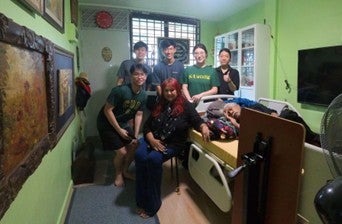
Photo with Mdm Rose and Mr. Hassan
Mr. Hassan is an 88-year-old retiree and a lifelong learner. In his early days, he explored entrepreneurship, was a writer and a water-skiing coach. In his free time, he also enjoyed physical activities such as diving and camping. However, due to a fall and further health complications, he currently faces mobility issues that confine him to a hospital bed in their house. His wife, Mdm Rose, acts as his primary caregiver, balancing her love for him with the immense physical and emotional strain that caregiving often entails. They were both facing the constraints of a small living space in a rental flat. Our goal seemed straightforward on paper: to improve their living environment and well-being. However, as we stepped into their lives, we realised that “improving” a space isn’t just about designing and remodelling it; it’s about connection.
Understanding the Heart of a Home Beyond Functionality
In the early stages, we relied heavily on the design framework taught in our lectures—specifically the idea that human-centred design must start with the user and end with a solution that genuinely fits them. We quickly learned that technical perfection means very little if it doesn’t account for how a space makes someone feel.
For instance, our initial instinct was to declutter Mr. Hassan’s space to maximise efficiency. It seemed like the logical, practical choice. However, through our conversations and continuous dialogue, we discovered that Mr. Hassan didn’t just want empty space; he wanted to see and access the things he loved. He had a deep attachment to his personal items, particularly his watch collection.
Realising this, we pivoted. We moved away from our own assumptions of “good design” and instead created custom furniture that included specific displays for his watches. This wasn’t just storage; it was a morale booster—a way for him to connect with his identity and passion every day. For Mdm Rose, we introduced a simple dressing table, which after consultation with our professor, we decided was a good way to help alleviate her caregiver fatigue. It was a small addition, yet the feedback from her was tremendously positive. It offered her a private space for self-care, acknowledging her needs as an individual, not just a caregiver.
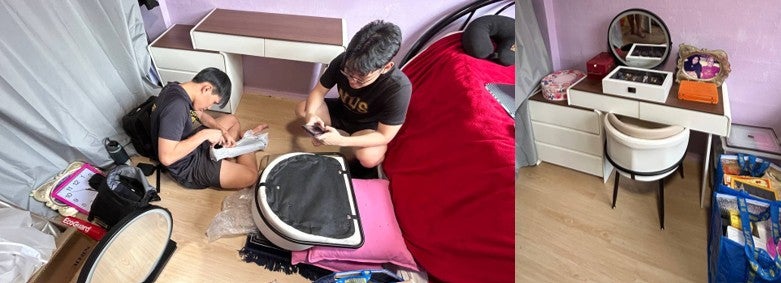
Putting together the dressing table for Mdm Rose’s bedroom
While decluttering the house to allow Mr. Hassan to move around more easily is a primary goal of our project, we also recognise the value of creating more shared moments for Mr. Hassan and Mdm Rose. This led us to the idea of incorporating a foldable table that can slide into the side of Mr. Hassan’s hospital bed, where he spends most of his time. This setup will enable them to share meals while they watch television together.
Abandoning Assumptions and Stereotypes
This journey also forced us to confront our own biases. Drawing from what we learnt from course lectures, our group made sure to adopt participatory methods, emphasising co-creation and sustained listening. In particular, the practice of casual interviews and informal conversations unearthed quieter but critical needs like Mdm Rose’s caregiver fatigue and her desire for maintaining her routine habits. This approach strengthened our mindset that empowerment and sustained community feedback are essential for meaningful outcomes.
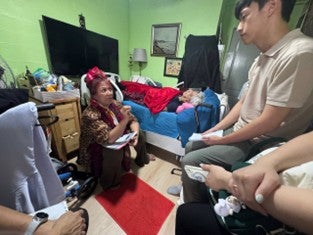
User Interview with Mdm Rose
It became clear that the daily challenges Mr. Hassan and Mdm Rose faced were not merely results of individual choices but were shaped by broader structural factors—space limitations, financial constraints, and service gaps. We learned that things like “clutter” or “routine” are often coping mechanisms or necessities in a world that isn’t built for ageing bodies.
Recognising this fuelled our commitment towards advocacy. We realised that design isn’t just about ergonomics; it’s about dignity. By shifting furniture for better access or introducing a foldable table for the couple to dine together, we weren’t just moving wood and metal; we were trying to give them back a sense of control and comfort in their own home.
Insights To Keep Close To My Heart
The most profound takeaway from this project was the power of humility and co-creation. As research on community care suggests, direct observation and co-design with seniors lead to solutions that significantly improve independence and satisfaction. We saw this firsthand.
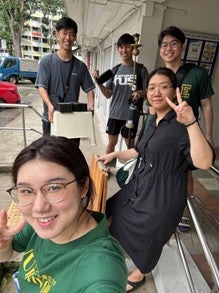
My CDE2001 Project teammates
Mdm Rose’s struggle with caregiver fatigue reminded us that behind every senior we aim to help, there is often a silent support system that needs care too. Organisations like Lions Befrienders are invaluable in bridging this gap, offering psychological support that enables seniors to age in place meaningfully.
Ultimately, this service-learning experience taught me that effective care requires us to really listen to the quiet needs that aren’t always voiced outright. Whether it was Mr. Hassan’s pride in his collection or Mdm Rose’s need for a moment of respite, these insights could only be found through genuine human connection. It is a lesson in empathy I will carry with me long after this CDE2001 project. For CDE juniors who are looking to contribute socially during their university years while understand the basics of user-centred engineering design, I will recommend CDE2001 as the course to fulfil the Communities and Engagement Pillar.
21 Lower Kent Ridge Road
Singapore 119077
+65 6516 6666