
I signed up for GEN2061 Support Healthy AgeingSG with a simple goal: to complete the graduation requirement and learn more about how Singapore supports its seniors through door-to-door outreach as a Silver Generation Ambassador (SGA). As someone who grew up being cared for by my grandparents and who had recently become a Singapore citizen, the course felt like a way to understand the policies and programmes that might one day support people like them here. What I did not expect was how quickly the work would feel personal. As an SGA, I became a bridge — not just between the university and the community, but between government schemes and the seniors who needed them. I learned that empowerment is not a slogan; it is finding the next step someone can take today.
One home visit remains with me even now. We met an elderly lady, Auntie Lim, who had become increasingly isolated. She feared falling in her flat and admitted she had not had a proper check-up in years. Her children were busy, and the world of government support and medical appointments felt like a maze. We sat at her kitchen table and opened the SGA brochure. The visit was not about handing Auntie Lim a pamphlet; it was about opening a door.
We started with her immediate fear: falling. I explained the Enhancement for Active Seniors (EASE) programme , which could install grab bars in her toilet and provide slip-resistant flooring. Her eyes lit up — this was a tangible solution to a daily fear. I then explained Healthier SG, where seniors enrol with a family clinic to focus on preventive care and chronic disease management. Together, we looked up a nearby clinic. Because the clinic participates in CHAS, we also discussed how subsidies could reduce the cost of visits. Finally, we looked beyond safety and screenings to connection. I shared the AIC Wellness Programme at the neighbourhood Active Ageing Centre (AAC) — group activities, check-ins, and a reason to step out. A few weeks later, we learned she had started attending social activities there.
Moments like that taught me that empowerment is practical. It is moving from “I’m scared to shower” to “I know how to get a grab bar.” It is the relief on a senior’s face when they realise government support is no longer a distant concept, but something they can actively access.
Serving as an SGA also sent a lesson home, 5000 kilometres away. I was raised by my grandparents in China. In the past two years, both of my grandfathers passed away. One grandmother now has mobility challenges, and my other is living with dementia. Being far away turned love into worries I could not act on, but my service work gave me a way forward.
Through our visits, I learned the principles of safer ageing: install grab bars where falls are likely; use mobility aids appropriately; keep up with influenza and pneumococcal vaccinations; clear trip hazards; and build simple routines that reduce risk. My hometown does not have EASE or the same subsidy structures, but the concepts could cross borders. I called my mum, and we walked through where to place bars, how to reorganise the home, which hospital to ask about the vaccinations, and how to make these changes reality within a week, not “someday”. We also discussed longer-term planning — when mobility aids would become helpful, and how to prepare for future care needs. While the policies differ from country to country, the care we can offer our seniors is the same.
Volunteering also changed how I understood citizenship. I came to Singapore alone at 15 and became a citizen last year for practical reasons. Through SGA, I saw another layer: how a nation’s plans translated into action through a neighbour’s next step. Seeing programmes like EASE, Healthier SG, CHAS, and AACs translate into safer homes and steadier routines made me feel genuinely connected and rooted here. I realised that service work no longer only meant fulfilling a requirement to me; I was participating in a community.
There is a quiet generosity in the seniors we meet. Many of them, even while managing their own challenges, still ask if we’ve eaten and wish us well in our studies. I arrived prepared to share information; I left each visit with patience, warmth, and a reminder that care is reciprocal.
If I had to summarise what I have received from GEN2061, it would be empowerment to turn concern into actionable next steps, which in turn empowers those around me. For someone like Auntie Lim, that could be an EASE request, a Healthier SG enrolment, and a first AAC visit. For my grandmother, it was a phone call that became an executable plan. For me, it was the decision to continue volunteering beyond the required hours.
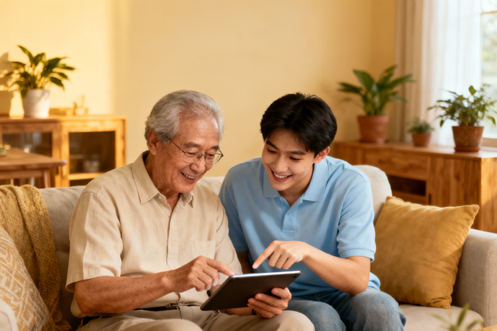
Nur Shazana, Empowerment through learning, AI generated (OpenArt)
GEN2061 began as a checkbox, but it became a bridge — between policy and people, Singapore and my hometown, and learning and belonging. The most powerful changes often start not with a grand gesture, but with a conversation at a kitchen table, a brochure, and a plan someone could follow tomorrow.
21 Lower Kent Ridge Road
Singapore 119077
+65 6516 6666