
As part of the service-learning course GEN2062 Community Activities for Seniors, six of us, all of different nationalities, came together each week to prepare activities for seniors, spending time learning, laughing, and connecting across generations. Our cultural diversity not only shaped how we worked together, but also how we engaged with the seniors. With students from different nationalities in our group, our diverse perspectives shaped how we see the world and how we engaged with the seniors. Though we were initially worried about the language barrier, those fears quickly faded as to our surprise, communication flowed naturally in different tongues, shared gestures, and smiles – a reminder that connection transcends words. The exchange of cultures was eye-opening for both international and local students as well as the seniors, with each session becoming a rich exchange of traditions and perspectives where both young and old had something valuable to share. Instead of being a barrier, our cultural diversity became a bridge connecting cultures across generations, helping seniors feel connected to a changing world, while their wisdom greatly enriched our learning.
Dahyun: My greatest challenge lay in connecting with the seniors. As an international student, I have often experienced misunderstandings with Singaporeans due to language differences. Even within the university context, there were times when I struggled to connect with my Singaporean friends. With these experiences, I doubted if the elderly – many of whom spoke mainly Chinese – would be able to connect with me. The fear of unknowingly offending the seniors caused me to keep my distance initially, and language felt like an unsurmountable barrier to me at that point.
However, I soon learned that communication went beyond words.
Surprisingly, the seniors approached me first. They greeted me cheerfully with “안녕하세요 (annyeonghaseyo – hello)” and asked how to say my name in Korean. Even when I could not reply in Chinese, they smiled warmly and continued engaging through gestures and laughter. Their openness and kindness challenged my belief that language fluency was essential for connection. Through this experience, I realised that forging international connections did not require speaking multiple languages – above all, it required an open mind and a willingness to engage. Tone, gestures, and genuine warmth often speak louder than words.
The seniors taught me that the key to building relationships was not perfect communication, but the ability to meet others halfway, to listen and to reach out. This lesson has empowered me to approach people of different ages, cultures, and backgrounds without hesitation – a mindset I will carry far beyond this course.
Ching Hwee: What began as simple cultural activities soon grew into meaningful connections that transcended age. As different cultures were introduced through our activities, I was deeply moved by how eagerly the elderly embraced these new experiences, remaining curious, open-hearted, and enthusiastic. One of the most memorable moments was sharing Korean culture through interactive games and music. We played traditional relay games inspired by Korean variety shows, such as cup stacking and cup curling. Though simple, these activities sparked laughter and teamwork among participants of all ages, fostering friendly competition and unity.
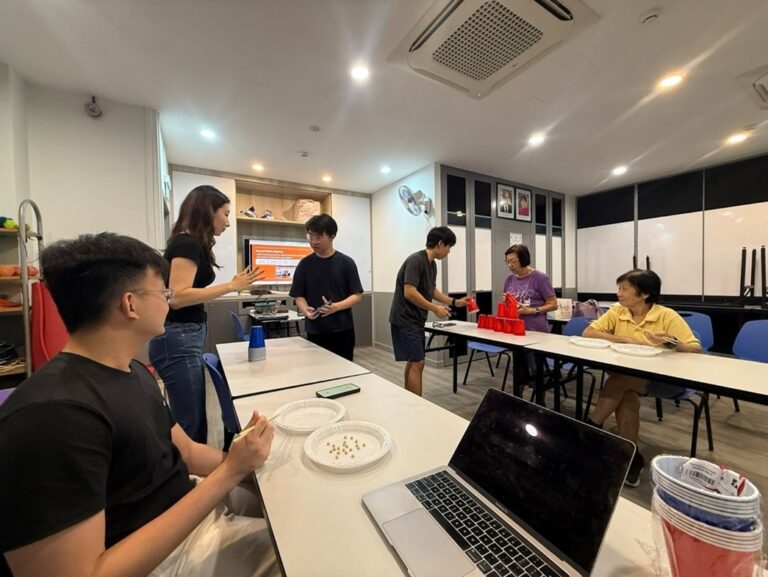
An energetic round of the time-speed relay game, inspired by Korean variety shows, where students and seniors competed using cup stacking, chopstick challenges, and bottle flipping
Another unforgettable highlight was a lively karaoke session where we played “Guess the Song,” blending beloved local tunes with popular Korean hits. This allowed my international groupmates to share their culture while learning about ours through familiar songs. The elderly were introduced to Korean artists and, to our delight, some seniors enthusiastically sang along to “APT” by Rosé and even danced, proving the power of music in bridging generations and cultures.
The cultural exchange was also two-way. Together with the elderly, we introduced the international students among us to local traditions by celebrating Singapore’s National Day and Mid-Autumn Festival. Celebrating these occasions alongside international students reminded me that our culture is not just ours to preserve, but to share. The seniors played a key role in this cultural exchange by recounting their childhood memories – introducing us to old-school games like Zero Point or how they celebrated Mid-Autumn Festival in the past by lighting many candles. These stories not only brought the past to life for the international students but also gave me a richer perspective on Singapore’s history and evolving culture. Through these experiences, I have grown to see Singapore not just as a multicultural society but as a space where connection and compassion can thrive, regardless of age, background, or language. I now carry a deeper appreciation for service work, not as charity, but as mutual learning. It has taught me that ageing does not mean closing doors and leaving experiences behind; it can be about opening new ones and making memories, together.
Prejudice and assumptions about cultural differences often create unnecessary barriers, especially in groups where international participants outnumber local ones. When planning our service work, we had worries that our international groupmates would not be able to fully connect with the elderly, given their cultural differences. However, as our sessions progressed, we realised it would never be possible for one person to fully understand another, even if you were from the same culture. Each person’s lived experiences differ – generational differences, personal experiences, and even upbringing can also create gaps in understanding. Our initial fixation on cultural differences as the key factor to overcome was not only unfair, but also limiting.
What we have come to realise is that our cultural differences were not obstacles, but opportunities, and the warmth and genuine interest from the elderly helped us to understand this. Our international groupmates brought fresh perspectives, questions, and stories that sparked unexpected conversations and mutual discovery both within our group, and with the elderly. These moments of exchange, whether small or profound, created bridges between people who might otherwise have remained strangers. When we move beyond assumptions and open ourselves to truly listening and learning, we build an inclusive space where everyone can contribute meaningfully. Our group was unique in that each of us came from different countries with different mother tongues. Although English was our common language, our varied expressions and cultural perspectives sometimes caused misunderstandings when planning activities. Yet through constant discussion, sharing, and valuing every culture we represented, we turned this diversity into our strength, enriching the sessions we prepared for the seniors, resulting in the group becoming more connected than ever before. Embracing diversity is not about compromising identity, but about enriching our collective experience.
Through this experience, we realised that we often form unintentional stereotypes about people of different ethnicities or ages simply because we lack cultural understanding. While these barriers may seem insurmountable, the elderly showed us that they can be overcome with small gestures of warmth. Reaching out does not require perfect language or confidence – just openness. At the end of the day, we are all human and not that different from each other. When we choose curiosity over hesitation, we make space for unexpected friendships to blossom.
21 Lower Kent Ridge Road
Singapore 119077
+65 6516 6666