
A Course That Took Learning Outside the Classroom
Hello! I am Sophia Chye, an undergraduate from the Faculty of Arts and Social Sciences, majoring in Political Science and pursuing a minor in Community Development & Leadership. I took CLC3308 Being There: Engaging Communities on the Ground in AY2025/2026 Semester 2. The course explores a simple but important question: can our community issues be better understood if we pay closer attention to the perspectives of the people on the ground?
Through this course, students are introduced to the principles, skills, and value of community-based fieldwork. Instead of learning about communities through readings or classroom discussions, we were encouraged to step into everyday social spaces, observe carefully, initiate informal conversations, participate in field trips, and carry out group ethnographic fieldwork. These experiences helped us practise how to notice people, places, routines, relationships, and meanings that may be otherwise be overlooked.
As a Political Science student, I am interested in communities, governance, and public life. I wanted to understand what community engagement looks like beyond policies, institutions, or well-intentioned solutions. Henceforth, CLC3308 appealed to me because it offered a more grounded way of learning – one that required us to slow down, listen, and understand people on their own terms. Over the semester, I came to realise that “being there” was not just about physically entering a community space, but about learning how to observe, listen, and understand people on their own terms.
Learning What It Means to “Be There”
Our visit to National Community Leadership Institute (NACLI) early in the semester helped set the direction for the course. As a training institute for community leaders, NACLI plays a crucial role in equipping grassroots leaders and community practitioners with the skills to engage residents, build trust, and support community life in Singapore. There, I learnt that community engagement is not simply about identifying problems and proposing solutions from the outside. It requires understanding the people, relationships, and everyday realities that already exist within a community. At NACLI’s Our Community Gallery, we also saw how collective action has shaped Singapore’s communities from the early days of nation-building to today, reminding me that community development is built through sustained participation, trust, and shared responsibility. This helped me understand why CLC3308 places such strong emphasis on fieldwork. Before we can speak meaningfully about communities, we must first learn how to enter their spaces respectfully, observe with care, and listen with humility.
This became clearer during my first assignment, where we were asked to conduct observation work at a local public site in Singapore and reflect on the people, physical environment, behaviours, practices, and meanings we encountered. I chose to observe Thaipusam 2026 along the 4-kilometre route from Sri Srinivasa Perumal Temple to Sri Thendayuthapani Temple. Before this, I understood Thaipusam mainly as a major Hindu religious festival in Singapore. But being physically present showed me that it was also a deeply layered social space, shaped by devotion, endurance, family support, volunteer labour, and careful crowd management.
I practised active observation by slowing down and paying attention not only to what was happening, but also to how people moved, interacted, and occupied the space. I observed devotees, family members, volunteers, police officers, photographers, and passers-by along the same route, each experiencing the procession differently. Instead of treating observation as simply watching from the side, I tried to notice the relationships, patterns, and meanings behind what I saw – from the support offered to devotees, to the coordination that kept the procession moving, to the quiet acts of care that held the community together. It was a great experience, and one that I will remember.

Image 1 – A devotee carrying a milk pot appears physically strained while family members/friends supported him, illustrating how individual devotion during Thaipusam is sustained through collective care and shared responsibility.
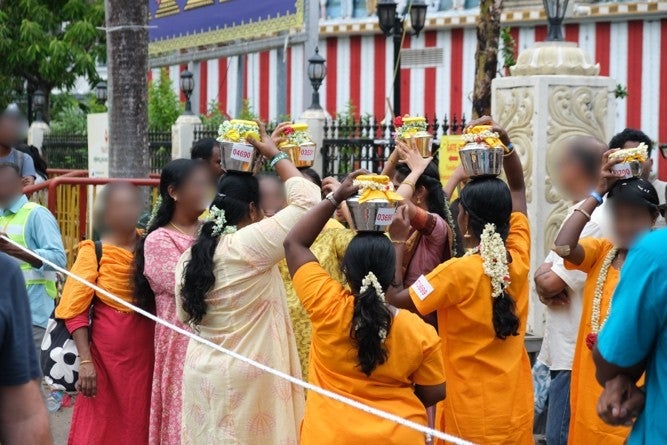
Image 2 – Female devotees at the Sri Srinivasa Perumal Temple before commencing on their 4-kilometre procession route
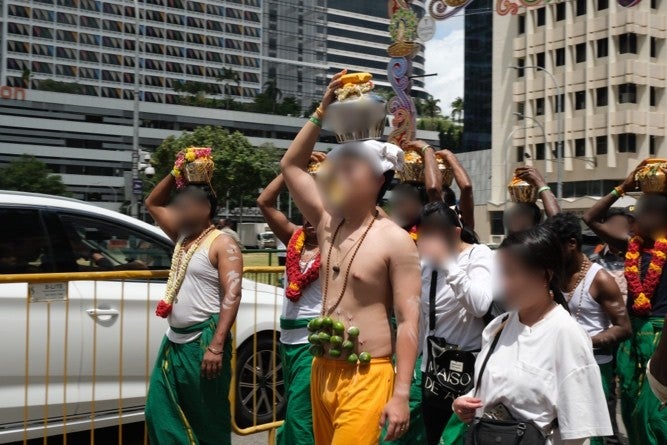
Image 3 – A non-Tamil devotee carrying a milk pot alongside Tamil participants, suggesting that ritual participation may extend beyond ethnic identity.
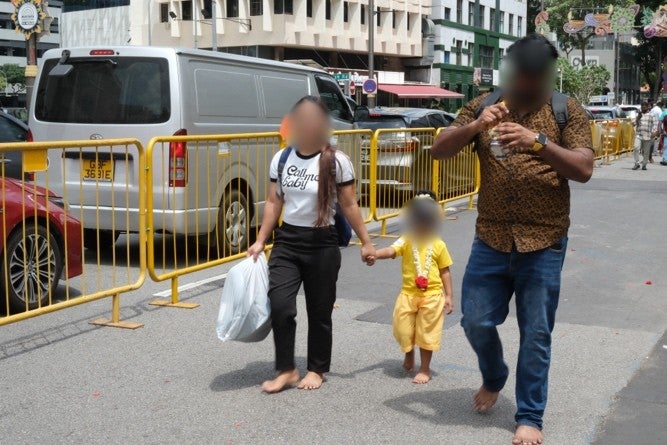
Image 4 – A young child devotee walking barefoot alongside her parents, reflecting how the religious practice of Thaipusam is embedded within family life and intergenerational continuity.
From Observing to Speaking
The course then pushed me beyond observation and into conversation. For Assignment 2, we were asked to visit two different social spaces in Singapore and initiate informal conversations with strangers. The objective was to practise conversational engagement skills, “peel the onion” gradually through small talk, and reflect on what we could learn from people we were meeting for the first time.
I chose two everyday social spaces in Uni: a neighbourhood convenience shop that sold cigarettes, and a nearby Singapore Pools. At the convenience shop, I spoke with customers who were reacting to the recent increase in cigarette prices. What surprised me was that while many complained about the higher prices, they continued buying cigarettes, sometimes by switching to cheaper brands. This challenged my assumption that higher prices would automatically discourage consumption.
At the Singapore Pools outlet, I learnt that lottery-buying was not only about money, but also about routine and hope. One person described buying 4D or TOTO as “一个希望” — a form of hope. I also noticed how people spent time filling in betting slips, queuing, and returning to the same outlet because of convenience, familiarity, or the belief that it was a “lucky” place.
Through these conversations, I realised that ordinary spaces are filled with stories we often overlook. People are not just “customers,” “smokers,” or “punters.” They have routines, worries, habits, humour, and ways of making sense of their choices. The assignment also taught me that listening is not only about asking questions. It requires sensitivity to non-verbal cues, knowing when not to ask something too directly, and recognising that even brief conversations can challenge our assumptions about others.
Our class field trip to Peninsula Plaza further showed me how “being there” can reveal sides of Singapore that many of us may not usually see. We visited Peninsula Plaza on a Sunday, which was especially significant because it is often the only day off for many Myanmar domestic and construction workers – and for some, even a Sunday off may only come once a month. There, we learnt more about their lives and saw how they spent their precious rest day gathering, eating, relaxing, and reconnecting with friends. What struck me most was how warmly we were welcomed. The visit reminded me that places like Peninsula Plaza are more than commercial spaces – they are important social worlds where migrant workers find familiarity, friendship, and a sense of home away from home.
Through these experiences, I realised that ordinary spaces are filled with stories we often overlook. People are not just “customers”, “workers”, or “passers-by”; they have routines, worries, habits, humour, and reasons for being where they are. Listening, I learnt, is not only about asking questions, but also about being patient enough to let people share on their own terms.
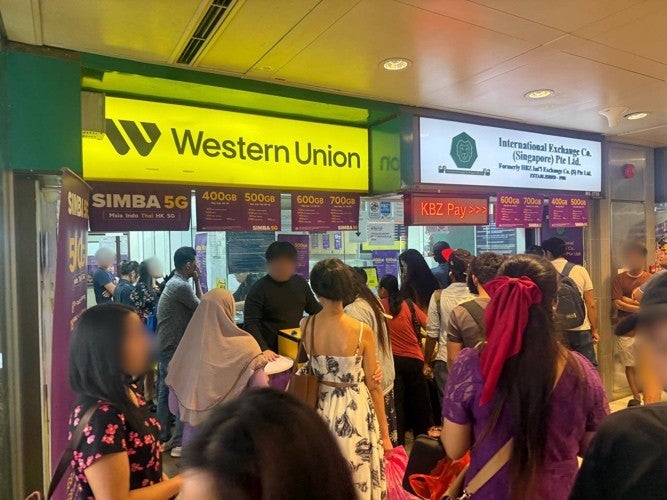
Image 5 – Entrance of Peninsula Plaza. While the storefront may appear to be a remittance company at first glance, it is actually a telco shop where Myanmar workers can purchase or top up their prepaid cards.
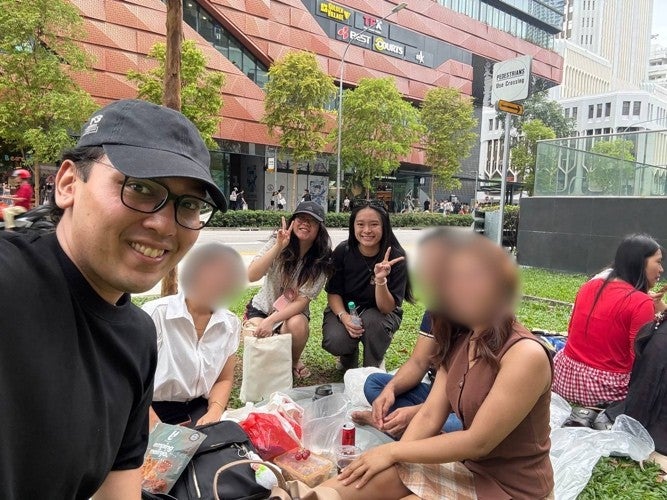
Image 6 – A selfie with Myanmar domestic workers seated on a grass patch opposite Funan Mall. We chatted with them for about 15 minutes, and they warmly offered us food. They shared that their days off are precious, and that they usually spend the day relaxing and catching up with friends in the area.
Seeing the Work Behind Convenience
The course’s emphasis on observation, conversation, and grounded fieldwork was put into practice most fully in our group project, A Working Life. For this project, we had to work as a team to conduct basic ethnographic fieldwork on an occupation or hobby in Singapore. The project required us to observe or participate in the field where safe and appropriate, speak informally with people involved, and present our findings through a 20-minute class presentation and a written report.
My group eventually focused on GrabFood riders because food delivery has become such a familiar part of everyday life in Singapore, yet the people behind this convenience are often only briefly encountered. As customers, we usually encounter food delivery riders only briefly – when food arrives at our doorstep, when we see them waiting outside malls, or when they pass us on the road. Through fieldwork, my group had the chance to slow down and understand their work more closely. We observed them during their waiting periods, followed parts of their delivery routines where possible, and spoke to them at length about what the job was really like.
Through these conversations, we learnt more about the everyday realities behind food delivery work: waiting time, platform incentives, order targets, weather conditions, customer expectations, and the physical demands of moving from place to place. More importantly, we were reminded that riders are not a single, uniform group. Each person had different motivations, constraints, and ways of making sense of the job. This made the project especially meaningful because it challenged the distance between what we assume as customers and what riders actually experience on the ground.
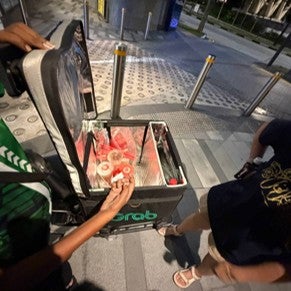
Image 7 – A GrabFood rider showing us a bag of bubble tea collected from LiHO an hour earlier, while he was still waiting for another restaurant pickup. He shared that such delays are common and can affect the total number of orders he completes in a day.
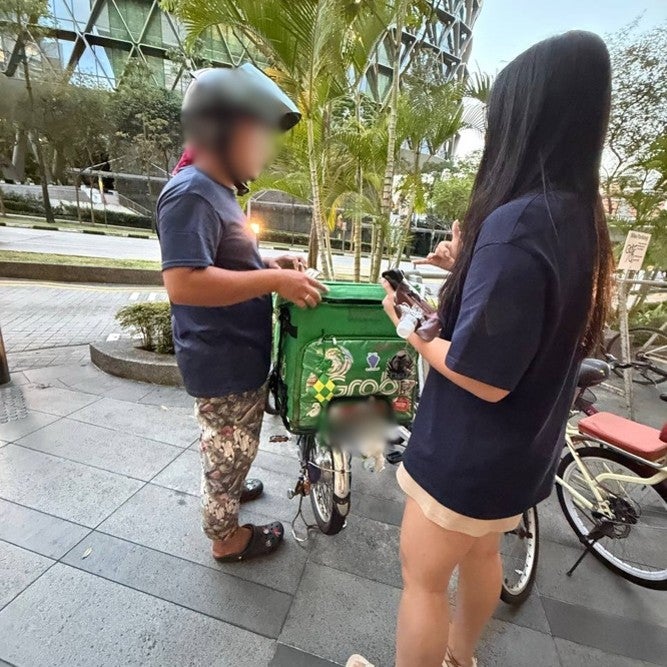
Image 8 – Interview with a rider at Star Vista while he waited to collect an order during peak dinner hours. He shared that delays were common at this time, illustrating how waiting forms a significant part of delivery work.
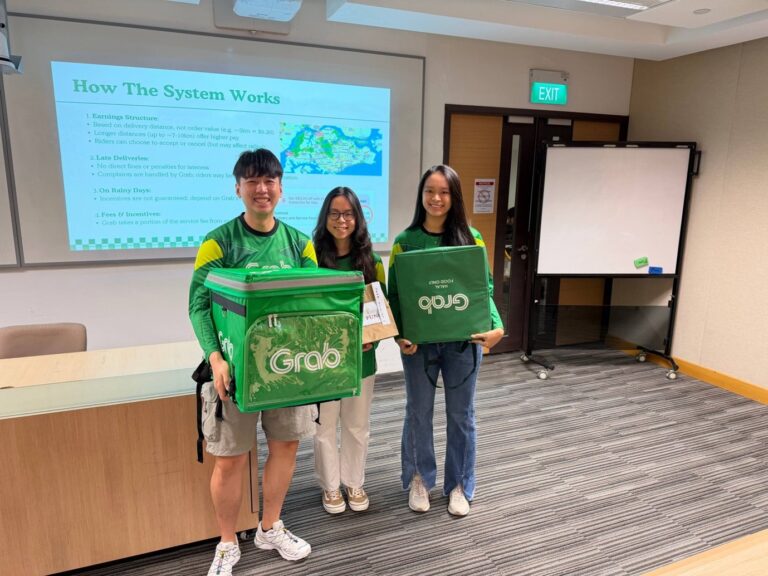
Image 9 – My Group’s Presentation: For our presentation, wearing Grab attire and carrying the thermal bag helped us represent the visible aspects of delivery work. However, it also reminded us that the deeper struggles of the job cannot be fully understood without experiencing the labour itself.
What Stayed With Me
Looking back, CLC3308 was one of the most fulfilling courses I have taken because it made learning feel immediate, grounded, and human. From NACLI, to Thaipusam, to our GrabFood fieldwork, the course kept returning me to one central lesson: communities cannot be fully understood from a distance.
Being there is not just about physically showing up. It is about slowing down, paying attention, listening with humility, and recognising that ordinary lives are never as simple as they first appear. For me, CLC3308 changed the way I see our communities. It taught me that meaningful community engagement does not begin with speaking for others, but with learning how to observe and listen to them first.
To juniors considering this course, I would say that CLC3308 is not just about community work in the conventional sense. It brings together observation, conversation, fieldwork, reflection, and teamwork to help us better understand the people and spaces around us. More importantly, it reminds us that “community” is not something distant or separate from us. It is found in the streets we walk through, the workers we encounter, the festivals we observe, and the everyday spaces we may take for granted. This is our community, and this course taught me to see it with greater care.
21 Lower Kent Ridge Road
Singapore 119077
+65 6516 6666