
Finding the Right Tribe
My name is Jared De Souza, a student from the Department of Architecture at College of Design and Engineering. I joined GEN2000 “Living Culture: Engaging Indian Communities in Singapore” to understand community life beyond drawings and studio work. The course teaches how communities build belonging, support one another, and sustain culture in everyday life. It focuses on empathy, listening, and respectful engagement.
As part of the course, my group worked with the Sikh Welfare Council (SIWEC) on their Active Ageing Programme. This experience moved learning into the real world. It showed me how daily routines, space, and small acts of care shape dignity and connection, especially among seniors. It also reshaped how I see architecture. We do not only design structures. We influence how people meet, feel included, and find purpose.
Learning Through Connection
Our team consisted of Hui Jun, Mahima, Faith, Ahrielle, Sandra, Mithra, and me. We worked with SIWEC to plan an outing for elderly participants at the National Library Board. The aim was to create a meaningful and comfortable experience for them, and it also showed how small design decisions shape human connection. We divided tasks based on strengths. Some handled logistics and wayfinding, others focused on seating, accessibility, and pacing the activities so no one felt rushed or left out. We also thought about how to greet participants, guide movement calmly, and support conversation during breaks. Working together taught me that caring for a community needs coordination, empathy, and shared effort, not only space.
We conducted a recce at the library, mapping accessible routes, resting spots, and activity zones. Each detail, how long to walk, where to pause, where to gather, became a form of care. It showed me how architecture can quietly communicate respect and empathy.
We also joined SIWEC’s “Sunehri Sahelian” (Golden Girls), a group of elder women participants, for an activity before the event in which they design their own banners to support the returning cyclists from SIWEC’s “Ride To Serve” fundraising event (see figure 1). Listening to their stories reminded me that community is built through shared time and presence. Their laughter, strength, and openness made me see the real meaning of ageing with dignity.
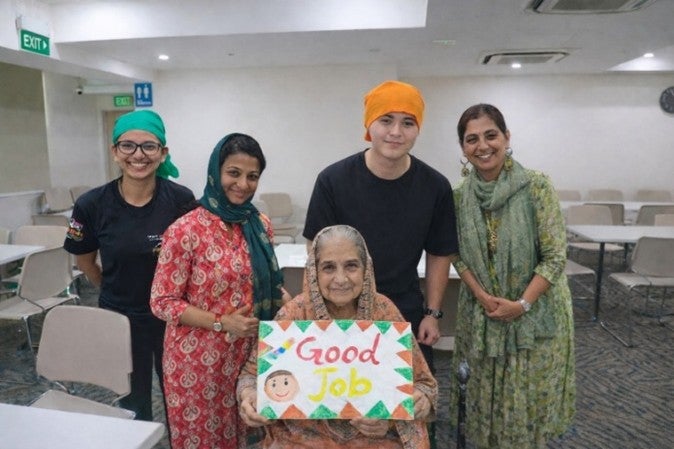
Flash card created for R2S homecoming by our founding member Sarjit Khosa Ji, seated in the middle, From the left is Mithra Naidu (From the NUS Team), Sudipta (Art teacher), Author, and Ms Guchi Kaur (SIWEC) AI generated replication (ChatGPT)
Seeing Design Differently
During the outing, I documented the experience through photos and video. I noticed how connection happens in simple interactions, a helping hand up a step, a shared joke, a pause at a bench. Those moments came from the environment and the care placed into planning movement and rest. It made me more aware that design decisions become social decisions.
SIWEC’s work showed me that community groups form the spine of our society. They create tribes where people share responsibility and feel valued. My goal as a designer is to support these groups while encouraging interaction across different communities. Shared kitchens, courtyards, flexible halls, and everyday circulation spaces can act as commons where tribes meet, learn, and coexist.
This experience led me to reflect on Singapore’s Blue Zone 2.0 vision, which aims to help people live longer, healthier, and more connected lives. I began to focus on one idea, “finding the right tribe.” Through SIWEC’s programme, I saw how friendships and belonging form naturally when people share space and purpose. These bonds cannot be forced, but the right environment allows them to grow. Blue Zones are places where people live well because their environment supports community, routine, and shared purpose. Strong social ties, daily movement, and mutual care are built into everyday life. Singapore’s vision adapts these lessons to strengthen belonging and encourage supportive neighbourhoods. The focus goes beyond health, placing equal weight on connection and meaning, and how space shapes these values.
Designing for Human Bonds
Since this experience, I’ve started exploring how architecture can support such organic connections. How can we design places that spark incidental encounters and help people find their “tribe”?
In my studio work, I’ve been testing ways to layer spaces, creating zones that shift gradually from public to private, open to intimate (see figures 2 to 6). Walkways become places for greeting, gardens become meeting grounds, and shared courtyards invite conversation. The goal is simple: to design spaces that make belonging effortless and purpose possible.
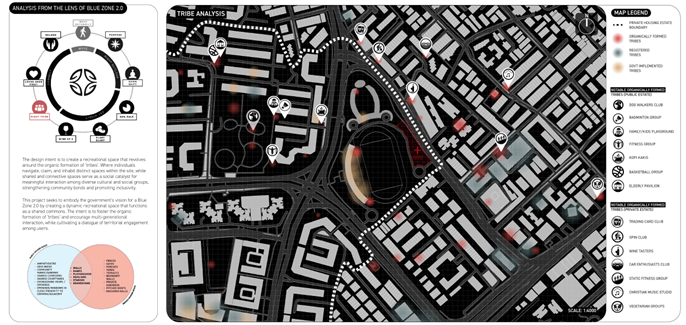
Tribe Mapping Study of my project site
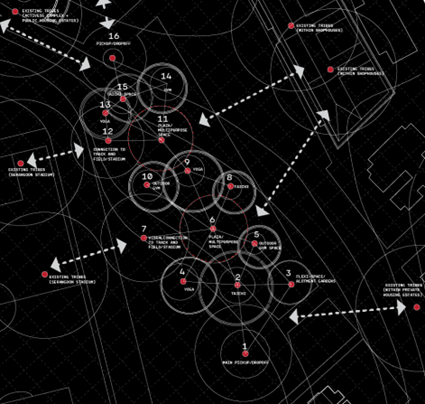
Tribe Proximity Planning of my project site
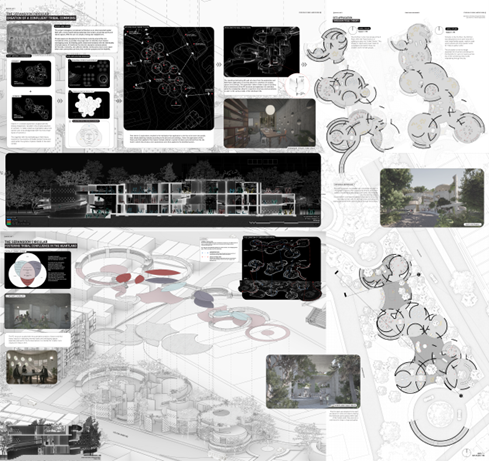
Presentation Board For My Community Hub Project In Serangoon
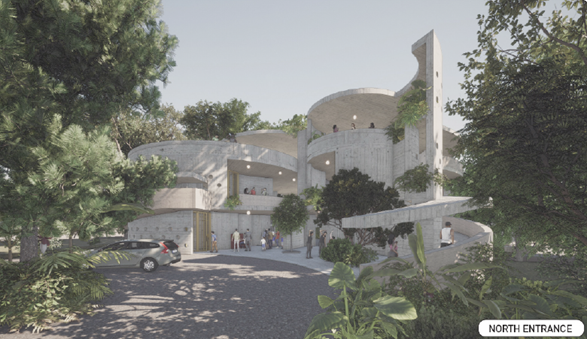
Illustration Render of the Project’s simple and Readable Facades with Jogging Tracks
and Communal Overlaps
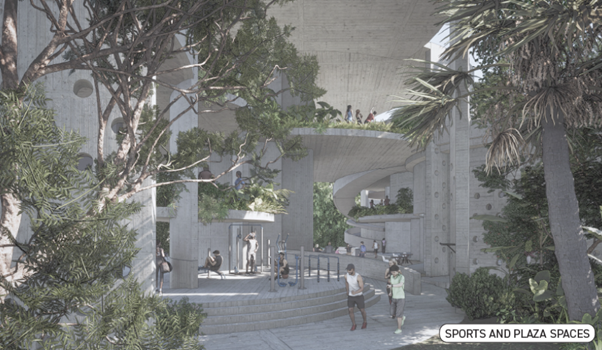
Illustration Render of the Project’s Interior Voids
Beyond the Classroom
Working with SIWEC showed me that empathy is built through collaboration. The project succeeded because of cooperation between SIWEC, the National Library Board, and our student team. Each brought different strengths, but we shared one goal, to create meaningful engagement for the elderly.
This experience taught me that architecture is not only about aesthetics or efficiency. It is about enabling human connection and creating purpose in life. Through design, we can help communities feel rooted, valued, and alive.
Out of all the General Education courses I have taken, this has been the sole one that truly feels educational. It goes beyond theory or grades, it instils values that stay with you. It teaches awareness, humility, and the responsibility to make spaces, and by extension lives, more meaningful. Beyond architecture, it inspires students to be active citizens who find ways to make a difference, whether small or large, within the industries they work/study in.
To my juniors looking to take the GEN2000, join this course with curiosity and respect. You will build a deeper understanding of how different communities hold our society together and support harmony in our country. The topics push you to look beyond surface views and see the value in perspectives outside your own. This course shapes your values through real examples, shared stories, and honest discussion. You will leave with stronger awareness of the people around you and a clearer sense of your role in supporting a more caring and fair society.
21 Lower Kent Ridge Road
Singapore 119077
+65 6516 6666