
My name is Estelle and I am a final year student majoring in Economics. Economics, in essence, delves into how to optimally allocate a society’s scarce resources to maximise welfare. However, considering that Economics is a discipline that is highly theoretical, which often evaluates the implications of a policy on an ex-post facto basis, GEN2061 Support Healthy AgeingSG was a refreshing opportunity to connect with people and witness the real-world impact of policies and initiatives. Above all, it highlighted the importance of having strong social connections and neighbourly support in fostering well-being, especially among the elderly. Previously, my personal experiences and volunteer work have mostly been with young children. This course inspired me to broaden my community engagement beyond familiar demographics. In addition, as I have a close relationship with my grandparents, I wanted to better understand the challenges they faced. Through my experience as a Silver Generation Ambassador (SGA), I realised that while government policies play a crucial role in addressing these challenges, the everyday interactions and relationships within one’s community can be equally, if not more impactful in enabling the elderly to lead a more fulfilling life.
One of the most important lessons I gleaned was the importance of good neighbourliness. In the past, I focused heavily on individual achievement and success, often overlooking the significance of community and neighbourliness. However, through my interactions with the elderly, I began to see how integral these values are to leading a fulfilling life. One particularly impactful encounter was with a 90-year-old woman who lived alone and had no family in Singapore. Despite her solitary circumstances, she spoke warmly of the support she received from her neighbours, who had become an essential part of her daily existence. Her neighbours’ kindness not only extended to assisting her with daily errands, such as helping with groceries, but also an emotional companionship, which helped alleviate the isolation she otherwise would have felt. It became clear to me that, for many elderly individuals, their neighbours are often their primary source of support and connection, especially when family is not nearby. It made me realise that a strong, caring community can contribute substantially to one’s well-being.
I also met several seniors who, despite facing their own personal challenges, remained closely connected to their neighbours, witnessing firsthand the power of community support in helping one overcome hardships and staying positive. One such individual was a resident who, despite long working hours and being separated from his family, who lived in another country, maintained close relationships with his neighbours. Despite being physically distant from his loved ones, he found solace in the relationships he had cultivated locally. His neighbours’ simple gestures, such as checking in on him regularly, encouraged him and reassured him that he was never truly alone in his struggles. Despite his challenges, he remained one of the most cheerful and optimistic individuals I have ever encountered. This interaction revealed the importance of fostering communities built on empathy, where individuals are not left isolated, even in the face of personal adversity. It reinforced my belief that being seen, heard, and cared for by those around us plays a massive role in one’s mental and emotional well-being, especially for those who may not have immediate family support.
As an SGA, one of our key responsibilities in addition to assessing the living and health conditions of the elderly was to educate them about relevant government policies and programmes, for example, the Healthier SG and Advanced Care Planning schemes. However, I noticed that individuals who do not have a good relationship with their neighbours or those living in social isolation were often quick to dismiss these policies and initiatives. This scepticism may stem from a distrust of systems and institutions designed to provide support. It is likely that when individuals lack strong community ties or a sense of belonging, they often feel isolated and disconnected from broader societal structures. This isolation can lead to feelings of alienation and mistrust towards institutions like government agencies. Therefore, without adequate communal support, individuals may perceive these institutions as distant entities that do not understand or cater to their needs. This may be especially so if they have had negative experiences when seeking assistance. Conversely, a cohesive community and supportive neighbours can significantly improve trust in these institutions. When people feel part of a close-knit community where neighbours look out for each other, they are more likely to be more inclined to engage with and benefit from government policies and initiatives. This is because they themselves have experienced the benefits of collective support and cooperation.
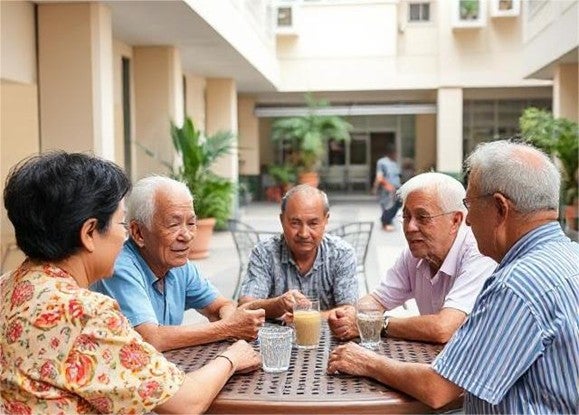
Ennabelle HUANG, Neighbourly gathering. AI generated (DeepAI).
Although I am no longer an SGA, I can confidently say that this experience has been extremely enriching, and I wholeheartedly recommend this course to any student eager to serve the community and contribute meaningfully to the welfare of the elderly population.
Beyond a mere volunteer commitment, it has been a journey of personal growth, reshaping my perspectives and reinforcing core values. Initially, my awareness of societal issues affecting the elderly was superficial, viewing their challenges from a distance. However, through the house visits, I encountered firsthand the unique issues the elderly contend with. Most importantly, this experience underscored the importance of good neighbourliness, where mutual care and compassion can not only alleviate the burdens of the ageing but also improve their quality of life.
21 Lower Kent Ridge Road
Singapore 119077
+65 6516 6666