
I am Germayne, a year 2 Environmental Studies major newly graduated from the Ridge View Residential College (RVRC) Programme. As I was choosing my course for the Communities and Engagement pillar, RVN2001 The Great Extinction: Conservation and Rewilding greatly appealed to me as a self-professed animal lover, and I was keen to take part in a rewilding project.
The semester-long course is offered to RVRC students under the NUS General Education (GE) programme and as the title suggests, it focuses on the current sixth mass extinction, explores the anthropogenic causes for the unprecedented habitat destruction and biodiversity loss, and examines rewilding as a possible conservation strategy. We are introduced to the pressing issues faced by the natural world, such as poaching, habitat loss and global warming, leading to rapid extinctions of animal populations globally. This is done through pre-lecture videos and readings, seminars and peer-teaching activities in the classroom, such as roleplaying as stakeholders and debating the best conservation strategy for wildlife in Singapore.
One of our major tasks was to contribute to citizen science data on the online platform iNaturalist, in which users can publicly record and map their wildlife observations. Through extensive outdoor learning in and out of campus, at sites such as Tampines Eco Green and Sungei Buloh Wetland Reserve, we observed native flora and fauna up close in their natural habitats, honed our wildlife identification skills and learnt about each organism’s unique role in the ecosystem. Through this assignment, I went from having little prior knowledge of native fauna, to being able to identify commonly-sighted wildlife and even distinguish between a Malayan Water Monitor and a Clouded Monitor Lizard! Moreover, I gained an appreciation for less charismatic animals such as predatory snakes which contribute to population control of pest rats, and scavengers like Malayan Water Monitors which help with nutrient cycling, as they feed on carrion.
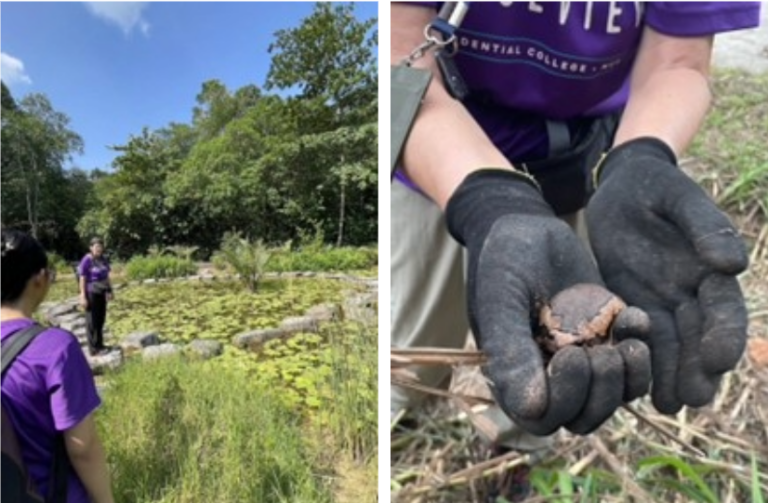
Photos (left to right): RVN2001 Field Trip to Sungei Buloh, course instructor Dr Patricia Lorenz holding a Banded Bullfrog. Photography by Germayne TAN.
For our final mini-rewilding proposal, we worked in multidisciplinary teams to enhance degraded habitats and thus increase biodiversity. Our site of choice was an underutilised garden next to a forest edge, behind NUS’ Central Library. More specifically, we aimed to plant butterfly nectar and host plants to create a butterfly habitat in the garden, and plant native trees to extend the forest edge. My group had the opportunity to pitch our idea to stakeholders from NSS and NUS such as Mr Ang Chee Wee, an Associate Director at University Campus Infrastructure, who oversees the management of facilities and spaces in NUS. The stakeholders provided us with valuable insights and recommendations for our campus rewilding project, such as the land use history and profile of our chosen plot, growth conditions required for specific plants, and a future maintenance plan for the rewilded site. Overall, this experience taught us about the complexities of enhancing an ecosystem; it is not as simple as just planting trees at a site and calling it a day. It requires interdisciplinary knowledge, expertise, and long-term commitment, to have a successful rewilding project.
In conclusion, RVN2001 opened my eyes to the vast native biodiversity in Singapore. It has inculcated in me a deep appreciation of their ability to persist and even thrive in our concrete jungle. It also made me realise how little we Singaporeans know about our own natural heritage, which is such a pity, as our tiny island nation is home to such wonderful flora and fauna. Ever since taking RVN2001, I cannot help but have a heightened awareness of the wildlife in my surroundings, no matter where I go. It has inspired me to go outside and discover what lies out there.
21 Lower Kent Ridge Road
Singapore 119077
+65 6516 6666