

Yong Loo Lin School of Medicine
Undergraduate Education
Degrees Offered
Undergraduate Education: Degrees Offered
The Yong Loo Lin School of Medicine offers two full-time undergraduate programmes, leading to:
- Bachelor of Medicine and Bachelor of Surgery (MBBS)
- Bachelor of Science (Nursing) / Bachelor of Science (Nursing)(Honours)
Overview of Bachelor of Medicine and Bachelor of Surgery (MBBS)
The undergraduate medical programme is a five-year course leading to the degrees of Bachelor of Medicine and Bachelor of Surgery (MBBS). The curriculum is taught over five years, or phases:
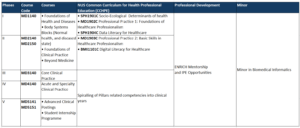
Note: The curriculum outline above is only applicable to students admitted from AY2023/2024 and subsequent academic years, or students graduating in 2028 and onwards. The new enhanced curriculum map is not applicable to students admitted before AY2023/2024 or students who graduated or will graduate in 2027 and earlier.
Students should note that there is a distinction between degree requirements for students who graduated in 2027 and earlier, vis-à-vis degree requirements for students graduating in 2028 and onwards. Where applicable, the distinctions in the requirements are set out in this Bulletin, and students should take note of the requirements that are applicable to them. The Yong Loo Lin School of Medicine will endeavour to give students notice of revisions to any requirements as soon as reasonably practicable, and revised requirements shall apply to students.
Some of the key highlights of the undergraduate medical curriculum are:
- An integrated curriculum where students learn basic sciences holistically with stronger correlations to clinical conditions, and understand healthcare delivery across time, space, discipline and acuity.
- Significant curriculum time for collaborative case-based learning and small group teaching.
- Innovative pedagogy and self-directed learning enabled through extensive use of technology.
- Student Internship Programme to provide students with real-life practical opportunities for clinical care.
- Early meaningful clinical exposure to ready the learners for clinical practice through understanding the Patient’s Journey, the Healthcare Practice, and the Clinical Skills Foundation Programme.
- Strong emphasis on developing caring and ethical medical professionals, who are reflective practitioners grounded in values, resilience, and are effective communicators in a dynamic, inter-professional healthcare setting.
- Integrating healthcare, data science, AI, and information technology, the new Minor in Biomedical Informatics aims to equip students with core skills in data management, large language models, biomedical data analysis, and medical decision support systems, while also developing competencies in evidence-based clinical decision-making, effective communication, strategic leadership, and entrepreneurship.
- The Beyond Medicine programme to lay the foundation for our students to become discerning consumers and meaningful producers of research by equipping them with the necessary skills, knowledge and mindsets.
Overview of Bachelor of Science (Nursing)
The BSc (Nursing) curriculum reflects current healthcare trends and the role of registered nurses in facing the challenges of nursing practice in the 21st century. Students will learn basic skills in a simulated clinical laboratory on campus and be exposed to practice in a range of clinical settings as they progress. The programme is modular in nature and includes the following subjects:
- Nursing Sciences
- Anatomy and Physiology
- Pathophysiology
- Pharmacology
- Immunology
- Microbiology
- Psychology
- Sociology
- Critical Thinking and Analysis
- Healthcare Law and Ethics
- Healthcare Management and Education
- Research and Statistics
- Evidence-based Practice
- Clinical Skills
- Clinical attachments at local hospitals/institutions, etc.
Fourth-year Honours students can choose to pursue research or coursework in community track.
Overview of Bachelor of Science (Nursing Practice)
The part-time Bachelor of Science (Nursing Practice) programme has been introduced to fulfil aspirations of nursing diploma graduates in the workforce who seek career progression and wish to pursue a part-time Nursing degree at NUS. The programme will cover the core competencies required by the Singapore Nursing Board (SNB) as well as offer broad-based courses that will prepare registered nurses (RNs) to be critical thinkers and self-directed reflective practitioners, who can apply theoretical learning at their respective practice areas. The programme is modular in nature:
- NUR2500 Applied Pathophysiology and Clinical Pharmacology
- NUR2501 Clinical Health Assessment and Health Reasoning
- NUR2502 Healthcare Policy
- NUR2503 Global and Community Health
- NUR3500 Practice of Palliative and End-of-Life Care
- NUR3501 Professionalism, Ethics and Law in Healthcare
- NUR3502 Teaching and Learning in Clinical Practice
- NUR3503 Leadership, Innovation and Change in Healthcare
- NUR3504 Chronic Disease Management
- NUR3505 Research Methodology and Statistics
- NUR3506 Translation of Evidence into Practice
- NUR3507 Clinical Practice Development Project
Curriculum structure: https://medicine.nus.edu.sg/nursing/wp-content/uploads/sites/2/2023/12/Bachelor-of-Science-Nursing-Practice-Programme-Structure-2.pdf
Curriculum Structure & Degree Requirements
Admission requirements:
- Guidelines and bonds for medical students: https://medicine.nus.edu.sg/prospective-students/admissions-frequently-asked-questions/
- Health requirements: https://medicine.nus.edu.sg/admissions/health-requirements/
Curriculum Structure & Requirements
Educational Aims
The medical curriculum aims to produce graduates who are competent and compassionate Postgraduate Year 1 students committed to serving the Singaporean community, with the foundation to undergo further training to become excellent clinicians and specialists, clinician-researchers, clinician-scholars, or health administrators.
The curriculum aims to support Singapore’s goal of becoming a regional centre of excellence in healthcare, by meeting the needs of the ageing population, and by fostering translational research as an engine of growth for the economy.
Education Outcomes
Our graduates will:
- be equipped with sound medical knowledge;
- be able to provide quality patient care;
- demonstrate excellent interpersonal and communication skills;
- uphold high standards of professionalism;
- engage in continual practice-based learning & improvement; and
- engage in systems-based practice.
Course of Study
Satisfactory completion of all components of the curriculum is required for graduation. The course of study for students admitted from AY2023/2024 onwards is as follows:
| Phases | Course Codes | Courses | Common Curriculum for Health Professional Education (CCHPE) | Minor |
| Phase I (Year 1) from AY2023/2024 |
MD1140 Foundations of Health and Diseases | Introduction to Human Body | SPH1901C Socio-Ecological Determinants of Health | Minor in Biomedical Informatics
SPH1904C Data Literacy for Healthcare BMI1101C Digital Literacy for Healthcare BMI2207C Intro to Medical Data and Data Processing BMI3102C Value Based Healthcare BMI3201C Clinical Data System Design Testing and Governance |
| Foundations of Human Biology: The cell, tissues, organ and systems, and whole human body (structure and functions) | ||||
| Introduction to Mechanisms of Disease (Pathophysiological Processes) | ||||
| Introduction to Principles of Prevention and Intervention/Reversal of Processes | ||||
| Mechanisms of diseases (Principles of pathophysiology and reversal of these processes) | ||||
| Basics of Clinical Pharmacology and Principles of Treatment | ||||
| Blood and Blood-forming organs system | MD1902C Professional Practice 1: The Foundations of Health Professionalism
SPH1904C Data Literacy for Healthcare |
|||
| Respiratory System | ||||
| Cardiovascular Systems (incl. Lymphatics) | ||||
| Renal, Fluid & Electrolyte Systems | ||||
| Gastrointestinal Systems (with Nutrition & Metabolism, incl. diabetes) | ||||
| Multi-Systems I | ||||
| Phase II (Year 2) from AY2024/2025 |
MD2140 Structure and functions of Systems
Integrated with MD2150 Foundations of Clinical Practice (FCP) |
Endocrine System | MD1903C Professional Practice 2: Basic Skills in Health Professionalism | |
| Reproduction Systems | ||||
| Musculoskeletal System & Neuroscience, with Skin and Connective Tissues | ||||
| Neuroscience / Mental Health with Head & Neck | ||||
| Consolidation and Preparations for Clinical Years | Foundations in Paediatrics and Child’s Health | BMI1101C Digital Literacy for Healthcare | ||
| Foundations in Geriatric Medicine | ||||
| Multi-Systems II | ||||
| Beyond Medicine | ||||
| CSFP Hospital Posting | ||||
| Phase III (Year 3) from AY2023/2024 |
MD3140 Core Clinical Practice | Medicine | ||
| Family Medicine (including Ambulatory Paediatrics) | ||||
| General Surgery | ||||
| Orthopaedic Surgery | ||||
| Electives | ||||
| Phase IV (Year 4) from AY2024/2025 |
MD4140 Acute and Specialty Clinical Practice | Acute Care comprising Anaesthesia and Emergency Medicine | ||
| Psychological Medicine | ||||
| Obstetrics and Gynaecology | ||||
| Paediatrics | ||||
| Ophthalmology | ||||
| Otolaryngology | ||||
| Pathology and Forensic Medicine | ||||
| Communication/Simulation week | ||||
| Electives | ||||
| Phase V (Year 5) from AY2025/2026 |
MD5141 Advanced Clinical Postings | Medicine | ||
| Surgery | ||||
| Clinical Skills and Life Support Training | ||||
| Paediatrics | ||||
| Dermatology | ||||
| Geriatric Medicine | ||||
| Palliative Medicine | ||||
| Orthopaedic Surgery | ||||
| MD5151 Student Internship Program | Medicine Student Internship Programme | |||
| Surgery Student Internship Programme | ||||
| Family Medicine Student Internship Programme | ||||
| Obstetrics and Gynaecology Student Internship Programme | ||||
For more details on the programme, please visit: https://medicine.nus.edu.sg/prospective-students/bachelor-of-medicine-and-bachelor-of-surgery-mbbs/
For details on examinations and the related policies and rules, please visit: https://entrada.nusmedicine.nus.edu.sg/community/facultyassessmentcom [Restricted Access]
For Admission requirements, please visit: https://medicine.nus.edu.sg/nursing/education/bachelor-of-science-nursing-bachelor-of-science-nursing-honours/admission/
For Advanced Placement Units for local diploma holders, please visit: https://medicine.nus.edu.sg/nursing/education-admissions/undergraduate/bachelor-of-science-nursing-bachelor-of-science-nursing-honours/advanced-placement-credits/
Curriculum Structure & Requirements
The BSc (Nursing)(Honours) is a four-year programme with an exit point of BSc (Nursing) after three years and eligibility to register as a nurse with the Singapore Nursing Board (SNB). The nursing curriculum offered by NUS reflects current healthcare trends and the diverse roles of Registered Nurses. Students receive important fundamental knowledge from a range of disciplines in science, social sciences, and nursing. Students who have achieved a minimum Grade Point Average (GPA) of 3.2 at the end of the BSc (Nursing) programme can apply to proceed to the Honours programme, leading to the award of the BSc (Nursing)(Honours) degree.
Curriculum Structure for BSc (Nursing) / BSc (Nursing)(Honours) *
| YEAR | SEMESTER | COURSES |
| 1 | 1 | NUR1113A Healthy Ageing and Well-being ^ ~ |
| NUR1114A Fundamentals of Care | ||
| NUR1123 Anatomy, Physiology and Physical Assessment I | ||
| PL1101E Introduction to Psychology ^ | ||
| SPH1901 Social and Behavioural Determinants of Health | ||
| December Vacation | NUR1107B Clinical Practice: Community Care I | |
| 2 | NUR1113A Healthy Ageing and Well-being ^ ~ | |
| NUR1124 Anatomy, Physiology and Physical Assessment II | ||
| NUR1125 Pathophysiology, Pharmacology and Nursing Practice I | ||
| PL1101E Introduction to Psychology ^ | ||
| MD1902 Professional Practice 1: The Foundations of Health Professionalism | ||
| SPH1904 Data Literacy for Healthcare | ||
| Special Term 1 | NUR1108C Clinical Practice: Medical/Surgical I | |
| 2 | 1 | NUR2113 Mental Health Nursing |
| MD1903 Professional Practice 2: Basic Skills in Health Professionalism | ||
| NUR2204C Women and Children Health | ||
| Dec Vac/ ST 1&2 | NUR2106B Clinical Practice: Medical/Surgical I (year-long) | |
| NUR2107B Clinical Practice: Specialty Care (year-long) | ||
| 2 | MIC2000A Infection and Immunology | |
| BMI1101 Digital Literacy for Healthcare | ||
| NUR2124 Healthy Community Living~ | ||
| NUR2125 Pathophysiology, Pharmacology and Nursing Practice II | ||
| 3 | 1 | NUR3114 Leadership and Management |
| NUR3117A Public and Community Health | ||
| NUR3119 Palliative and End-of-Life Care | ||
| NUR3120 Pathophysiology, Pharmacology and Nursing Practice III | ||
| NUR3202C Research and Evidence-based Healthcare | ||
| Dec Vac/ ST 1&2 | NUR3105C Clinical Practice: Community Care II (year-long) | |
| NUR3106B Clinical Practice: Medical/Surgical III (year-long) | ||
| 2 | NUR3116C Transition to Professional Practice Experience# | |
| Honours | NUR4101C Evidence Implementation in Healthcare (Sem 1) | |
| NUR4102C Consolidated Clinical Practice (Sem 2) | ||
| NUR4103C Applied Research Methods (Sem 1) | ||
| NUR4104C Final Year Project (Research) (year-long)
[Research Track] |
||
| NUR4105 Systematic Review (Sem 1) | ||
| NUR4108 Honours Coursework (year-long)
[Coursework Track] |
||
* Students have to take Unrestricted Elective Courses to make up 120 units and 160 units for the BSc (Nursing) and the BSc (Nursing)(Honours) programme requirements respectively.
^ Half of the cohort reading PL1101E/NUR1113A in Semester 1 and the other half in Semester 2.
~Also offered to non-Nursing students as unrestricted elective course.
# NUR3116C Transition to Professional Practice Experience comprises 10 weeks of clinical posting to meet SNB minimum requirements of clinical placement, including 1 week of simulation on campus.
For more details on the programme, please visit: https://medicine.nus.edu.sg/nursing/education-programmes/undergraduate/bachelor-of-science-nursing-honours/
For Admission requirements, please visit:
Curriculum Structure & Requirements
The CCP-RN (Deg) @ NUS is a 2-year full-time programme designed to meet the Standards of Nursing Education and accreditation requirements of the Singapore Nursing Board (SNB). Upon successful completion of the programme, students are eligible to apply for registration as a Registered Nurse with the SNB.
An intensive programme whereby students will study subjects such as anatomy, physiology, pathophysiology, pharmacology, psychology, mental health, leadership management, ethics and law, and research. Students will spend at least 1280 hours on clinical practicum in community and hospital/healthcare settings during the course of study.
Curriculum Structure for 2-year Bachelor of Science (Nursing)
| Year | Semester | COURSES |
| 1 | 1 | NUR1113A Healthy Ageing and Well-being ^ ~ |
| NUR1114A Fundamentals of Care | ||
| NUR1123 Anatomy, Physiology and Physical Assessment I | ||
| NUR1125 Pathophysiology, Pharmacology and Nursing Practice I | ||
| PL1101E Introduction to Psychology ^ | ||
| SPH1901 Social and Behavioural Determinants of Health | ||
| December Vacation | NUR1202C Clinical Experience I | |
| 2 | NUR1113A Healthy Ageing and Well-being ^ | |
| NUR1124 Anatomy, Physiology and Physical Assessment II | ||
| NUR2124 Healthy Community Living~ | ||
| NUR2125 Pathophysiology, Pharmacology and Nursing Practice II | ||
| PL1101E Introduction to Psychology^ | ||
| MD1902 Professional Practice 1: The foundations of health professionalism | ||
| MIC2000A Infection and Immunology | ||
| Special Term (May/June) | NUR2203C Clinical Experience II | |
| 2 | 1 | NUR2113 Mental Health Nursing |
| NUR2204C Women and Children Health | ||
| NUR3117A Public and Community Health | ||
| NUR3119 Palliative and End-of-Life Care | ||
| NUR3120 Pathophysiology, Pharmacology and Nursing Practice III | ||
| NUR3202C Research and Evidence-based Healthcare | ||
| MD1903 Professional Practice 2: Basic skills in health professionalism | ||
| December Vacation | NUR3204C Clinical Experience III | |
| 2 | NUR3205D Clinical Experience IV | |
| NUR3206C Transition to Practice |
~Also offered to non-Nursing students as unrestricted elective course.
^ Half of the cohort reading PL1101E/NUR1113A in Semester 1 and the other half in Semester 2.
For more details on the programme, please visit:
For Admission requirements, please visit:
Curriculum Structure & Requirements
The BSc (Nursing Practice) programme aims to build on the foundation that the polytechnic nursing graduates have established through their three years of diploma studies.
Table 1: Programme Structure for BSc (Nursing Practice)
| Year of Study | Semester | Courses | Units | Total Units |
| 1 | 1 | NUR2500 Applied Pathophysiology and Clinical Pharmacology | 6 | 12 |
| NUR2501 Clinical Health Assessment and Reasoning | 6 | |||
| 2 | NUR2502 Healthcare Policy | 6 | 14 | |
| NUR2503 Global and Community Health | 8 | |||
| 2 | 1 | NUR3500 Practice of Palliative and End-of-Life Care | 6 | 14 |
| NUR3501 Professionalism, Ethics and Law in Healthcare | 8 | |||
| 2 | NUR3502 Teaching and Learning in Clinical Practice | 6 | 12 | |
| NUR3503 Leadership, Innovation and Change in Healthcare | 6 | |||
| 3 | 1 | NUR3504 Chronic Disease Management | 6 | 14 |
| NUR3505 Research Methodology and Statistics | 8 | |||
| 2 | NUR3506 Translation of Evidence into Practice | 6 | 14 | |
| NUR3507 Clinical Practice Development Project | 8 | |||
| Total | 80 |
For more details on the programme, please visit: https://medicine.nus.edu.sg/nursing/education-programmes/undergraduate/bachelor-of-science-nursing-practice-part-time/
Financial Assistance and Scholarships
Financial Assistance
The School has several bursaries available to full-time undergraduate MBBS students who require financial assistance to help them through their course of study. For more information regarding financial assistance and the application procedure, please visit: https://medicine.nus.edu.sg/prospective-students/tuition-fees/
There are several bursaries available to full-time undergraduate BSc (Nursing) students who require financial assistance to help them through their course of study. For more information regarding these bursaries, the conditions of the award and the application, please visit: https://medicine.nus.edu.sg/nursing/education-admissions/undergraduate/bachelor-of-science-nursing-bachelor-of-science-nursing-honours/scholarships-bursaries-financial-aids/
There are several bursaries available to part-time undergraduate BSc (Nursing Practice) students who require financial assistance to help them through their course of study. For more information regarding these bursaries, the conditions of the award and the application, please visit: https://nus.edu.sg/oam/financial-aid/overview-eligibility/part-time-undergraduates
For university-wide financial assistance, please visit http://www.nus.edu.sg/oam/financial-aid
Awards
For university-level awards, please visit: https://www.nus.edu.sg/registrar/academic-information-policies/education-at-nus/medals-and-prizes-(university-level)