

School of Design and Environment
The College of Design and Engineering (CDE) came into existence on 1 January 2022 from the merger of the Faculty of Engineering (FoE) and the School of Design and Environment (SDE). Do check cde.nus.edu.sg for the latest on CDE’s programmes.
Undergraduate Education
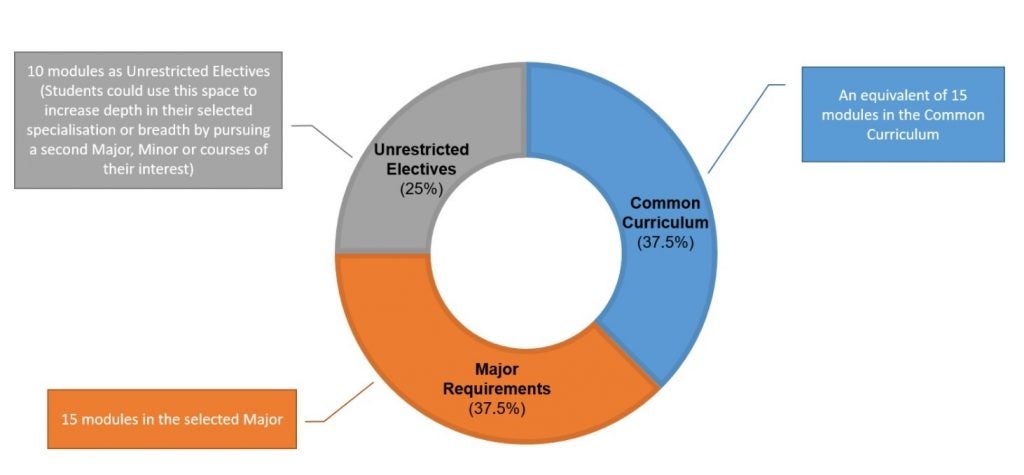
SDE, together with the Faculty of Engineering (FoE), will adopt a new undergraduate curriculum structure for students enrolled in the new academic year starting in August 2021. Students will read a total of 160 modular credits (or the equivalent of 40 modules), as shown in the following schema:
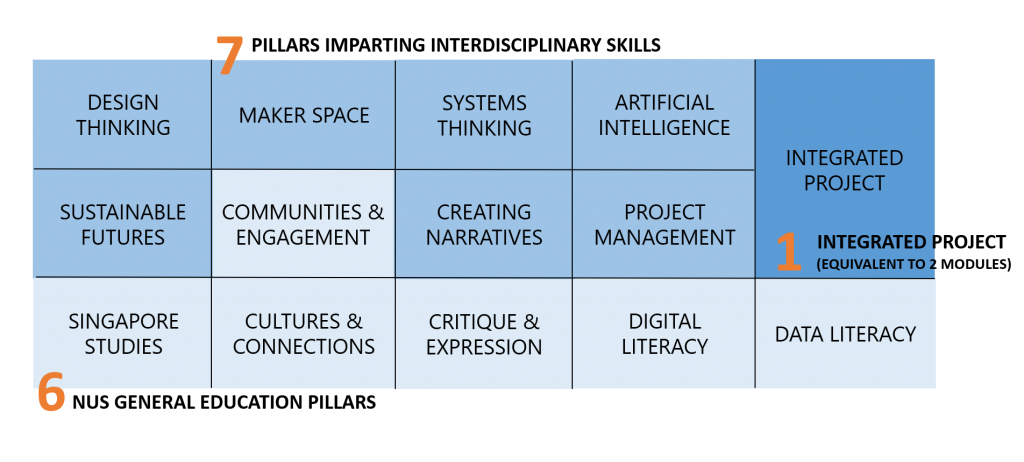
The Common Curriculum is jointly developed by SDE, FoE and 6 industry partners who sit on the task force. It seeks to integrates knowledge and skillsets relevant to the professional training offered by both schools and to equip students with essential 21st century competencies. The following pillars make up the Common Curriculum, comprising 60 MCs (or the equivalent of 15 modules):
For more information, please refer to https://www.sde.nus.edu.sg/news/new-common-curriculum-offers-more-breadth-flexibility-and-choices-to-school-of-design-environment-and-engineering-students/.
*Please check back for further updates for Cohort AY2021/2022.*
The BA (Arch) is a four-year honours degree programme that comprises a general programme and three other design-focused tracks – 1) Design, 2) Landscape Architecture (LA) and 3) Urban Planning (UP). The curriculum content for the first three years is common to the general as well as the design-focused tracks.
The general programme terminates at the BA (Arch) degree whereas the design-focused tracks are concurrent with the Master of Architecture (M (Arch)) or Master of Urban Planning (MUP) degree programmes. Only students who have achieved creditable grades in design, i.e. at least a B or B- in design at the third year (depending on the track of study) will be permitted to opt for a design focused tracks.
Students who are not eligible for the design focused tracks will continue in the general programme in their fourth year of study, leading to BA (Arch). Under this programme, students will no longer be required to take the design modules at fourth year. In its place, students will take elective modules with options to focus on Design Computing, Architectural & Urban Heritage or Urban Studies. Students who graduate with a high CAP in the general programme would continue to have the opportunity to pursue other graduate programmes.
Career Opportunities and Professional Registration
Graduates with a BA (Arch) degree who have completed Advanced Architectural Studies on Design Computing, Architectural & Urban Heritage or Urban Studies could work within these areas in architectural practices, government agencies or in research.
Graduates would also have opportunities to work in related fields including and not limited to interior design, industrial design, industrialised building systems, graphic design, commercial art and architectural journalism. Graduates who complete the Landscape Architecture (LA) or Urban Planning (UP) specialisation may also work in fields related to their specialisation.
The BA (Arch) degree does not in itself qualify graduates for registration with the Board of Architects. In order to eventually register as an architect with the Board of Architects, Singapore, BA (Arch) graduates must complete the M (Arch) degree and serve a minimum of two years of practical experience in an architectural practice to be eligible for the Professional Practice Examination conducted by the Board of Architects, Singapore. Those who pass the examination are then eligible to apply for registration as architects in Singapore.
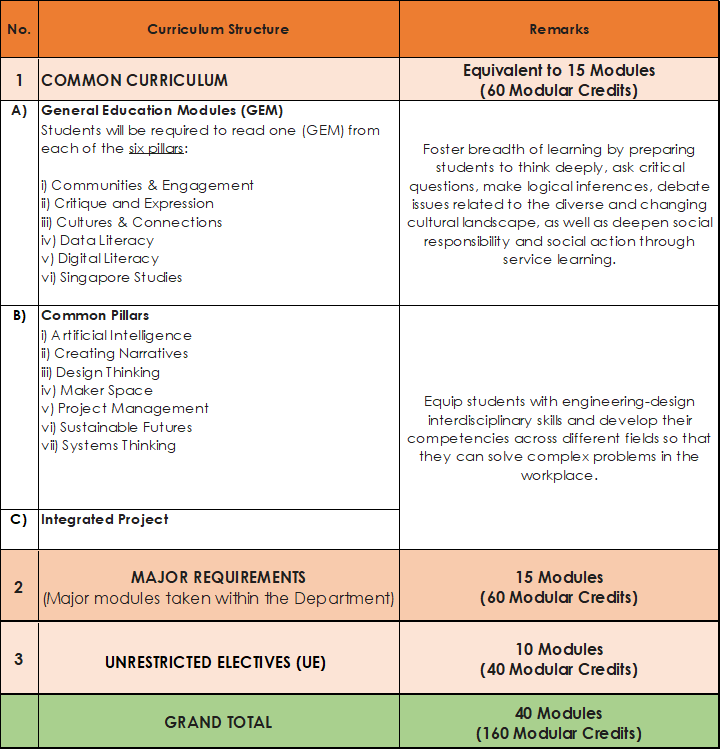
Table 1: Curriculum Structure of the Four-year BA (Arch) Programme
For more information, please refer to: https://www.sde.nus.edu.sg/arch/programmes/bachelor-of-arts-in-architecture.
*Please check back for further updates for Cohort AY2021/2022.*
The Bachelor of Arts (Industrial Design) (BA(ID)) programme at NUS was first offered in 1999 with support from the Faculty of Engineering and School of Business.
The BA (ID) programme is a four-year undergraduate honours programme, consisting of courses crafted with our synergistic three-pronged approach:
- Design Thinking: Out-of-box innovation strategies and investigative methods to discover new ideas and unmet needs.
- Multi-Disciplinary Aptitudes: Behavioral sciences, social economics, business strategy, engineering and technology knowledgedevelop entrepreneurial strategic thinking and holistic problem-solving.
- Artistic Sensibility: Training of imagination, taste, and craft-like ability to give pleasing and appropriate aesthetics and emotion to ideas, through traditional and 2D/3D digital means, so that solutions are both functional and desirable.
The combined approaches equip our graduates with high-level strategic thinking, and enable them to translate problems and ideas to tangible, desirable solutions, i.e. meaningful products, environments and experiences that people love to have, love to use – and those which have a big impact on lives.
As part of our strategy to be thought leaders in industry, a major component of the course is a series of industry-sponsored ‘vertical studio platforms’. These are project teams comprising a mix of year 2 to year 4 students, encouraging cross-pollination of thoughts, skills and learning.
In these platforms, students tackle both conceptual and real-life projects led by our industry collaborators, e.g. Asus, Dell, L’Oreal, Estee Lauder, BMW Group DesignworksUSA, Tupperware, Toshiba, Osim, ICI, Swarovski, HansGrohe, Risis and Nakamichi.
Students may customize their individual course during the 4 years by selecting from amongst these different industry platforms – Each student will get the opportunity to be involved in 6-7 of these projects.
The programme has been proven to be effective in grooming students for the design and related industries. Apart from the success in local and international competitions and awards, recent graduates have achieved recognition in gaining scholarships for further studies as well as being placed in well-known design practices and reputable companies.
Students can also opt to do a second major in Management (Technology), offered by School of Business, in four years.
International Exposure
To broaden our students’ exposure to global challenges, two-thirds of each cohort are involved in one-semester overseas exchange programme during their 3rd year. Students typically go to distinguished design schools in Switzerland, France, Japan, Netherlands, Finland, USA, Germany, Italy and China.
Career Opportunities
Students are educated to become expert innovators and master problem-solvers. These attributes make them highly valuable in any industry.
Graduates pursue careers as industrial designers, interaction designers, brand and packaging designers, design managers, product managers and innovation consultants. It is also possible for industrial designers to rise to corporate leadership levels in the areas of creative innovation or design. These are highly-coveted positions, such as Chief Designer, Chief Innovation Officer (CIO), etc.
Armed with design, business and technological knowledge, graduates will be well-positioned to serve in R&D companies, technology start-ups, design consultancies, service industries, marketing sectors and government agencies as well as in design education.
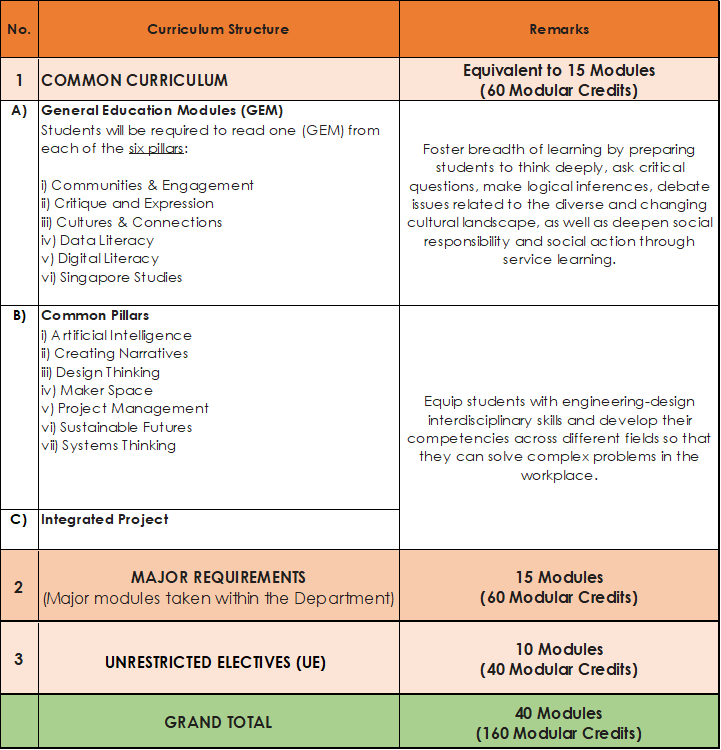
Table 1: Curriculum Structure of the BA (Industrial Design) Programme
For more info, please visit:
https://www.sde.nus.edu.sg/did/programme/undergraduate/.
*Please check back for further updates for Cohort AY2021/2022.*
The Bachelor of Landscape Architecture (BLA) is a four-year Honours degree programme that prepares students to respond to multifaceted socio-ecological issues in Asia through critical thinking, analytical inquiry, and creative expression. BLA provides core foundation training in skills and knowledge that equips our graduates for professional practice or entry into advanced Master degree programmes. Relevant topics, including tropicality, site specificity, boundaries and scales, densification, multifunctionality, and placemaking are played out in the programme through integrated learning platforms in design studios and lectures. BLA is taught in unique education settings that concurrently promotes speculation in design and at the same time being produces grounded and action-oriented design outcomes relevant to real life issues.
Table 1: Curriculum Structure
For more information, please refer to:
https://www.sde.nus.edu.sg/arch/programmes/bachelor-of-landscape-architecture/
*Please check back for further updates for Cohort AY2021/2022.*
The four-year direct honours Bachelor of Science (Project & Facilities Management) (BSc (PFM)) programme combines management and technologically oriented subjects in a holistic and integrated manner. It is designed to develop leaders for the built environment sector.
Core areas of study
- Project Management
- Contract Management / Quantity Surveying
- Facilities Management
- Event Management
Eligible BSc (PFM) undergraduates may opt for a second major in Management (offered by NUS Business School) or in Management (Technology) (jointly offered by NUS Business School and Faculty of Engineering). Students may also opt for a Double Degree Programme.
Polytechnic diploma holders who are granted Advanced Placement Credits (APCs) may complete the programme in 3.5 years.
Table 1: Curriculum Structure of the BSc (Project and Facilities Management) (Hons) Programme for students admitted from AY2021/2022 onwards
For more information, please refer to: https://www.sde.nus.edu.sg/bdg/undergraduate/bsc-project-facilities-management/introduction/.
The credit-bearing internship programmes offered by the Departments within SDE are listed below.
For updated information, please visit https://www.sde.nus.edu.sg/education/special-programmes/internship-programmes/. For a list of other internship opportunities, please visit Centre for Future-ready Graduates (CFG)’s internship page.
Architecture Internship Programme – Department of Architecture
The internship programme aims to provide opportunities for third year undergraduates to work in architectural or allied firms or organisations with design centric focus to gain the exposure and experience and apply the knowledge learnt in school in the professional setting.
Students are required to perform a structured and supervised internship in a company/organization for 24 weeks during the regular Semester. Weekly logbook as well as internship reports will be used a part of the evaluation of their internship experience.
Practical Training Scheme – Department of the Built Environment
BSc (Project and Facilities Management) students may undertake a twelve-week-long Practical Training Scheme which is normally held at the end of the second semester in the Third Level. The aim of this scheme is to give students essential real-life work exposure in Singapore or abroad. The Department finds suitable placements with an organisation in the construction or real estate industry for students, and their work is supervised by a staff member of the Department, and a senior person within the organisation to which they are attached.
The module will contribute 4 MCs and a CS/CU grade is awarded.
Work Experience Internship – All Departments
Undergraduate students may undertake an approved internship of at least 10 weeks in duration during the vacation period. This module is opened to full-time undergraduate students who have completed at least 60 MCs.* The module recognises that work experiences in fields that may or may not be directly related to the student’s major can lead to viable career pathways.
The module will contribute 4 MCs and a CS/CU grade is awarded.
*Departments may impose additional requirements or pre-requisites.
The School of Design and Environment’s donated scholarships and bursaries are designed to offer generous financial support to our undergraduates. To be considered for the School-Level financial assistance/scholarships and selected NUS-level donated scholarships, please apply through the Office of Financial Aid (OFA) at the Undergraduate Financial Aid portal from February to April every academic year.
School-Level and Department-Level Financial Assistance/Scholarships
Please visit https://www.sde.nus.edu.sg/education/admission-information/scholarships-and-bursaries/
More university-wide Scholarships and Financial Aid, visit the following links:
- Scholarships: http://www.nus.edu.sg/oam/scholarships
- Financial aid: http://www.nus.edu.sg/oam/financial-aid
Medals and book prizes are awarded only once in the academic year, after the Semester 2 Examination. In all instances, a prize-winner must be of sufficient merit. He/She must have passed all modules attempted and must be a good overall student. No award will be made unless there is a candidate of sufficient merit.
In general, to be eligible for consideration for an Academic Year Award, a student must have completed a minimum workload of 40 MCs, 80 MCs and 120 MCs for the Year 1, Year 2 and Year 3 awards respectively. In addition, students must have completed at least 36 MCs of graded modules within the academic year of the award.
The exception to this ruling would be students who are involved in internships, accelerated programmes or double degree programmes. For these students, they need to have a minimum of 24 MCs graded modules. In addition, students must have also completed a minimum of 16 MCs in the subject within the academic year.
For a full list of the medals and prizes for SDE undergraduates, please visit https://www.sde.nus.edu.sg/education/admission-information/awards-and-prizes/